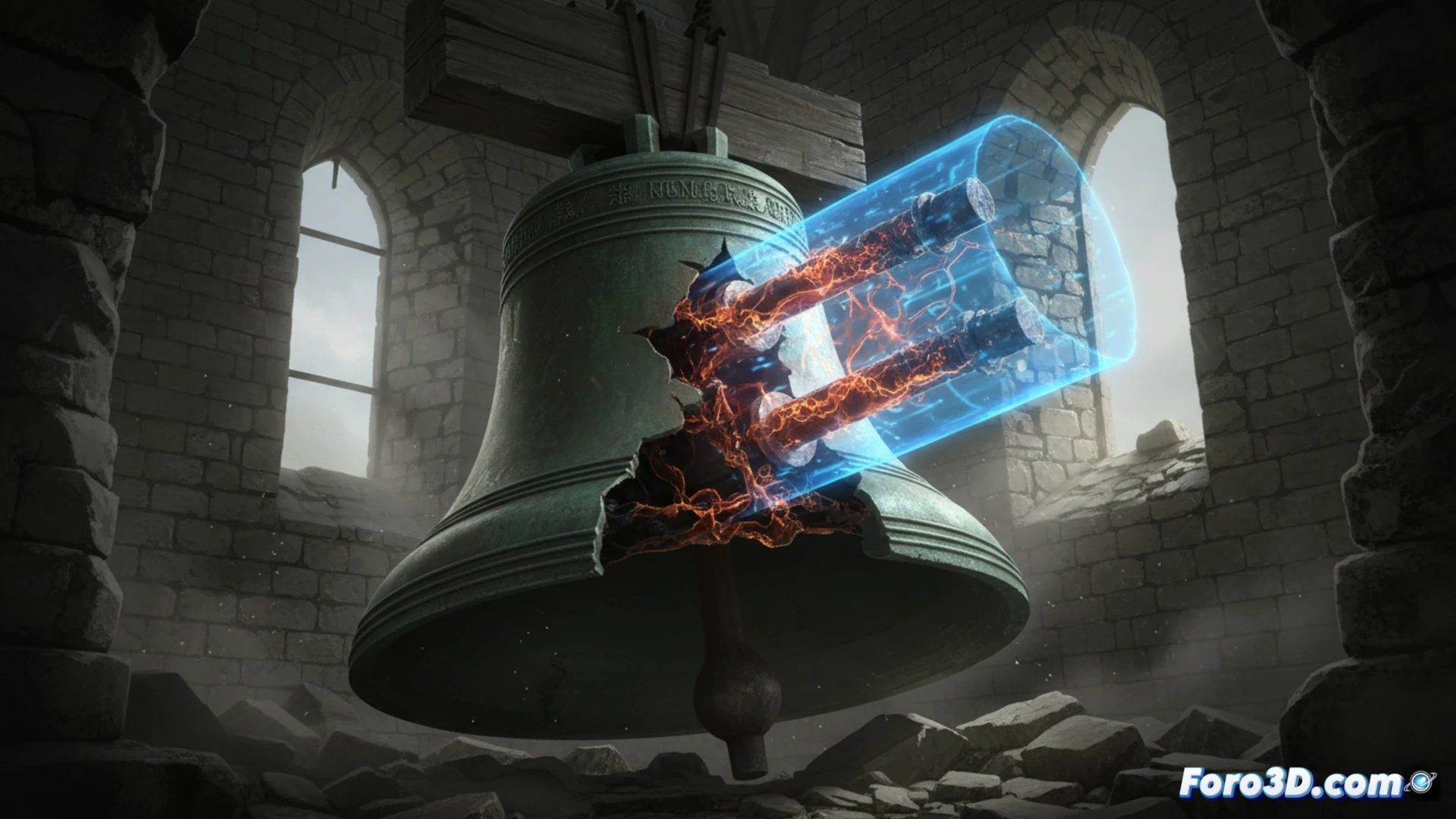
The collapse of a historic 5-ton bell during its restoration was not a random accident. The forensic team, armed with 3D scanning, discovered the real cause: anaerobic corrosion that devoured the interior of the steel bolts from the inside out. This case demonstrates how digital technology can reveal structural failures invisible to the human eye, especially in historical heritage where material integrity is hidden under layers of patina and wood.
Forensic workflow: From photogrammetry to fracture simulation 🔍
The process began with digitizing the collapsed structure using RealityCapture. Both the wooden beam and the metal fittings were photographed from multiple angles to generate a high-resolution point cloud. The 3D model was imported into Autodesk Fusion 360, where the components were separated: the wood (apparently healthy) and the bolts. By digitally sectioning the fittings in the software, the internal damage was visualized: an irregular cavity resulting from metallic woodworm. Subsequently, in SketchUp, the original geometry of the bell was recreated and the fracture point was simulated, confirming that the central bolt had lost 70% of its cross-section without showing external signs of fatigue.
Digital twins: The new prevention layer for heritage 🛡️
This incident underscores a key lesson for architects and restorers: visual inspection is not sufficient in historic structures. Creating a digital twin, fed by periodic scans, would allow monitoring the evolution of corrosion without physically intervening in the material. If this bell had had an updated 3D model, engineers would have detected the anomaly in bolt density years before the collapse. Technology not only reconstructs the past but anticipates failure before it occurs.
What forensic analysis techniques allow differentiating between natural structural fatigue and a failure induced by metallic woodworm in large-tonnage historic pieces.
(PS: Simulating a collapse is easy. The hard part is not crashing the program.)