The recovery of indented writing, those embossed marks left by the pressure of a pen on upper sheets, is a classic challenge in criminal investigation. Traditionally, oblique lighting and revealing powders were used, but these techniques can damage evidence or miss subtle details. High-resolution 3D scanning offers a non-invasive alternative that captures the microscopic topography of the paper, allowing experts to visualize and measure these marks with millimeter precision without physical contact. 🔍
Capture and Topographic Processing Protocol ⚙️
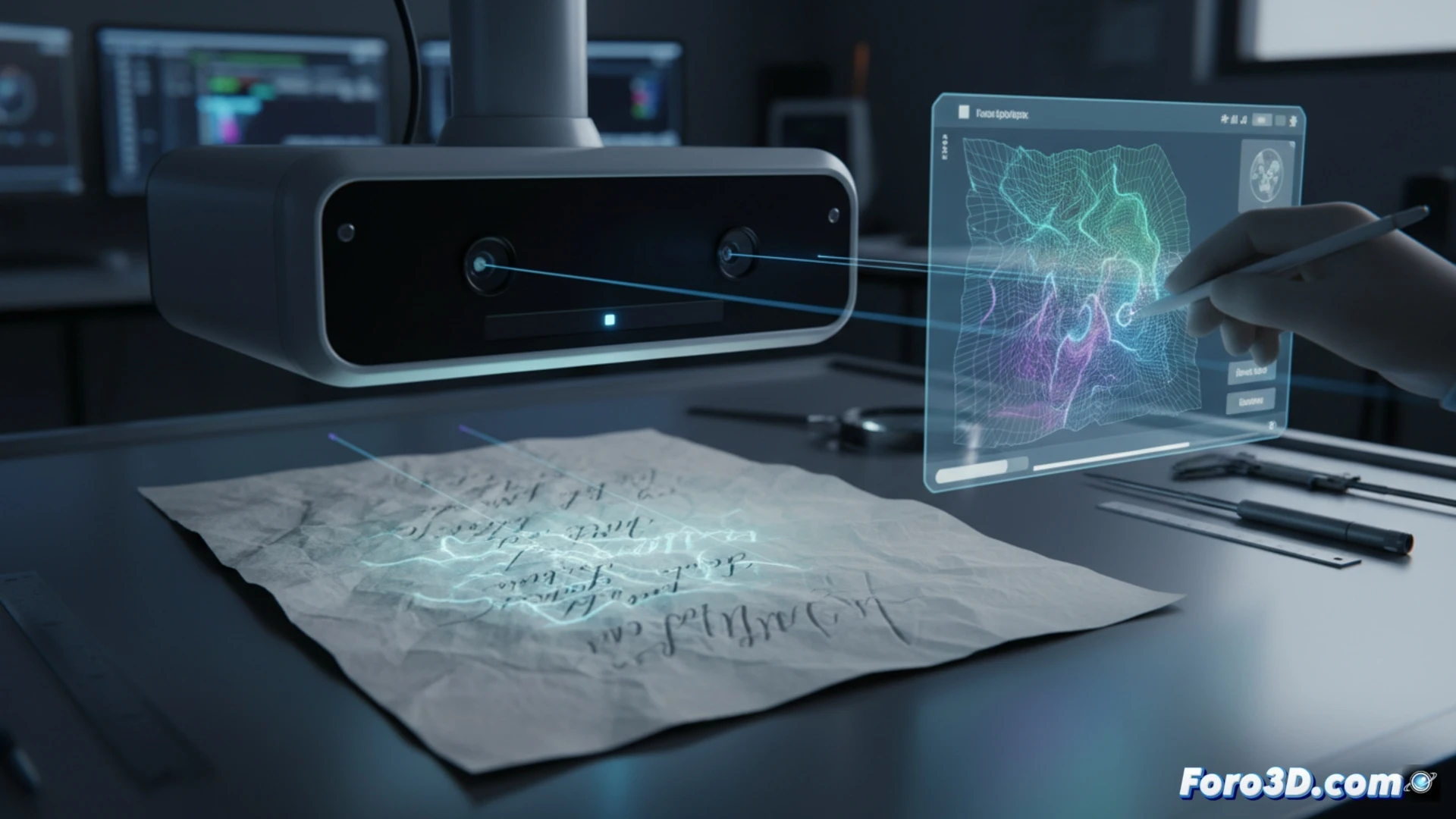
The workflow begins with stabilizing the document on a flat, non-reflective surface. A blue structured light scanner or an optical profilometer with a Z resolution of less than 10 microns is used. Lighting is critical: diffuse light is discarded, and an adjustable LED oblique light source is used at an angle of 15 to 30 degrees relative to the paper plane. This creates projected shadows that accentuate the depressions. Multiple passes are made by rotating the light source to capture all directions of the strokes. The processing software merges these point clouds into a polygonal mesh or a depth map (height map). Subsequently, a high-pass filter is applied to remove the natural waviness of the paper and isolate only the indented marks, generating a 3D model that can be inspected from any angle or even animated to simulate dynamic lighting.
The Depth of Invisible Analysis 📐
Beyond simple visualization, the 3D model allows for quantitative forensic measurements. Experts can calculate the exact depth of each groove, differentiate between overlapping strokes by their pressure profile, and, in some cases, infer the temporal sequence of writing. This digitization turns fragile evidence into an immutable file that can be shared between laboratories without risk of degradation. The technology does not replace the expert's eye, but rather provides them with a tool to see what flat light always hid.
What is the recommended protocol for calibrating a structured light 3D scanner when capturing indented strokes on glossy paper without generating artifacts from surface glare?
(PS: don't forget to calibrate the laser scanner before documenting the scene... or you might be modeling a ghost)