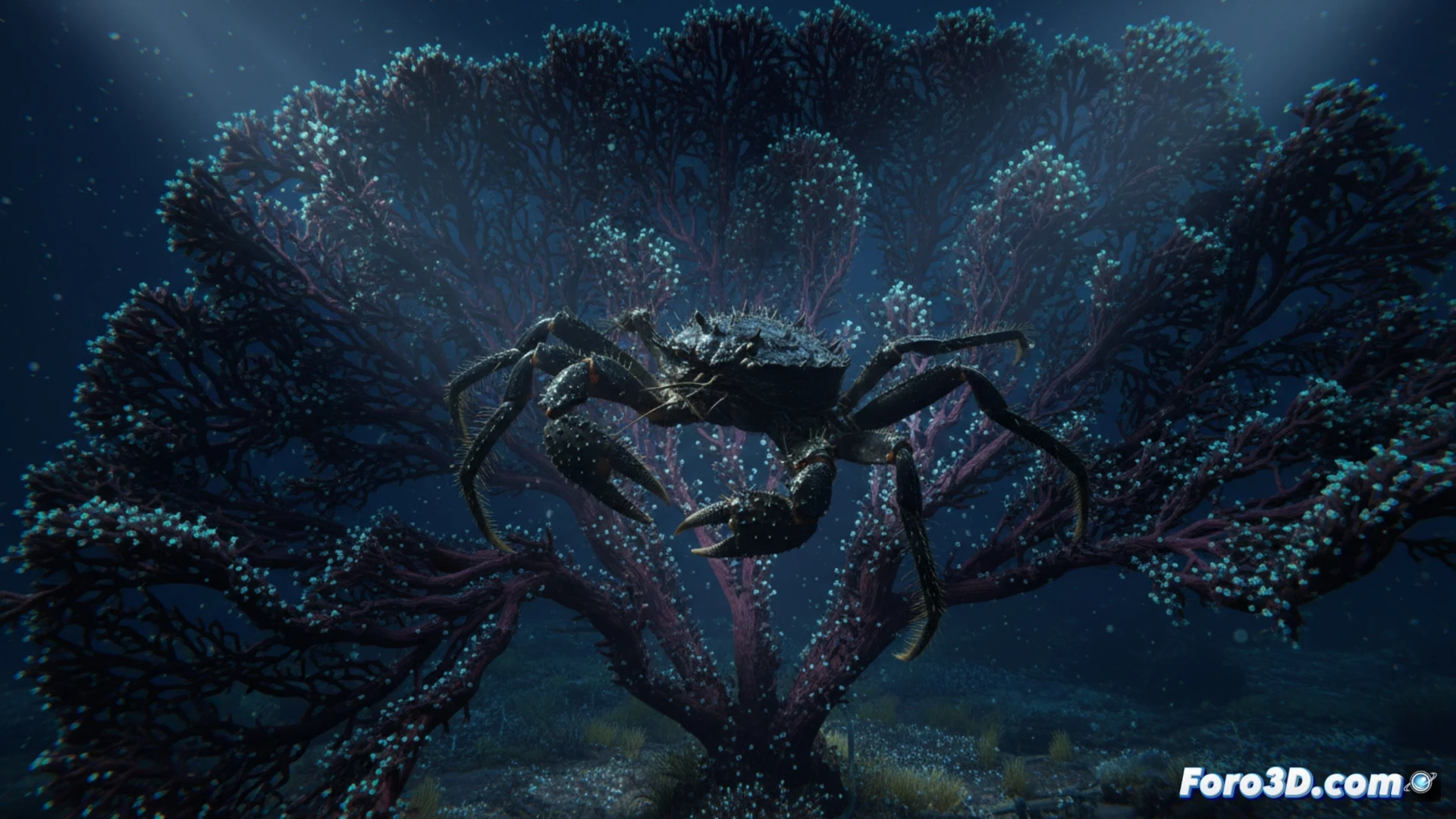
The Black Coral Crab (Chirostylidae sp.) represents a fascinating challenge for scientific 3D visualization. This crustacean, characterized by its thin, elongated claws, lives in symbiosis with black corals that can be over 2,000 years old. Its unique morphology and ecological relationship offer an ideal case study for the digital recreation of deep-sea ecosystems, combining anatomical precision with real habitat data.
Anatomical modeling and commensalism dynamics 🦀
For a rigorous 3D model, priority must be given to the geometry of the locomotive appendages and the chelae (claws), which have an unusually high length-to-width ratio. Texturing requires a scattering map that reflects the cryptic coloration of the carapace, adapted to the dim light of the mesophotic zone. The animation must capture the filtering behavior: the crab positions itself on the branches of the black coral (Antipatharia) to capture suspended particles without harming the host. Recreating the habitat requires a particle system to simulate marine snow and volumetric lighting to emulate light absorption at depths of 300 to 1,000 meters.
The paradox of time in scientific animation ⏳
Visually representing a relationship where a short-lived crustacean (2-5 years) coexists with a coral that has witnessed human empires is a narrative challenge. The animation must suggest this timescale, perhaps through a time-lapse of the coral's growth while the crab moves at real speed. This contrast not only educates about commensalism but also invites the viewer to reflect on the fragility of an ecosystem where each interaction is an instant in the life of an immortal being.
How can the 3D modeling of a Chirostylidae sp. be optimized to accurately reflect its ancient symbiosis with black coral and its biomechanical adaptations, without losing detail in scientific visualization?
(PS: fluid physics for simulating the ocean is like the sea: unpredictable and you always run out of RAM)