San Francisco Bay, a vital maritime corridor, has become a deadly trap for gray whales during their migration. Now, an AI-powered monitoring system promises to change this reality. The technology, developed over 15 years, combines high-precision thermal cameras with deep learning algorithms to detect whales up to seven kilometers away, generating real-time alerts for ships. This breakthrough represents a milestone in scientific visualization applied to conservation. 🐋
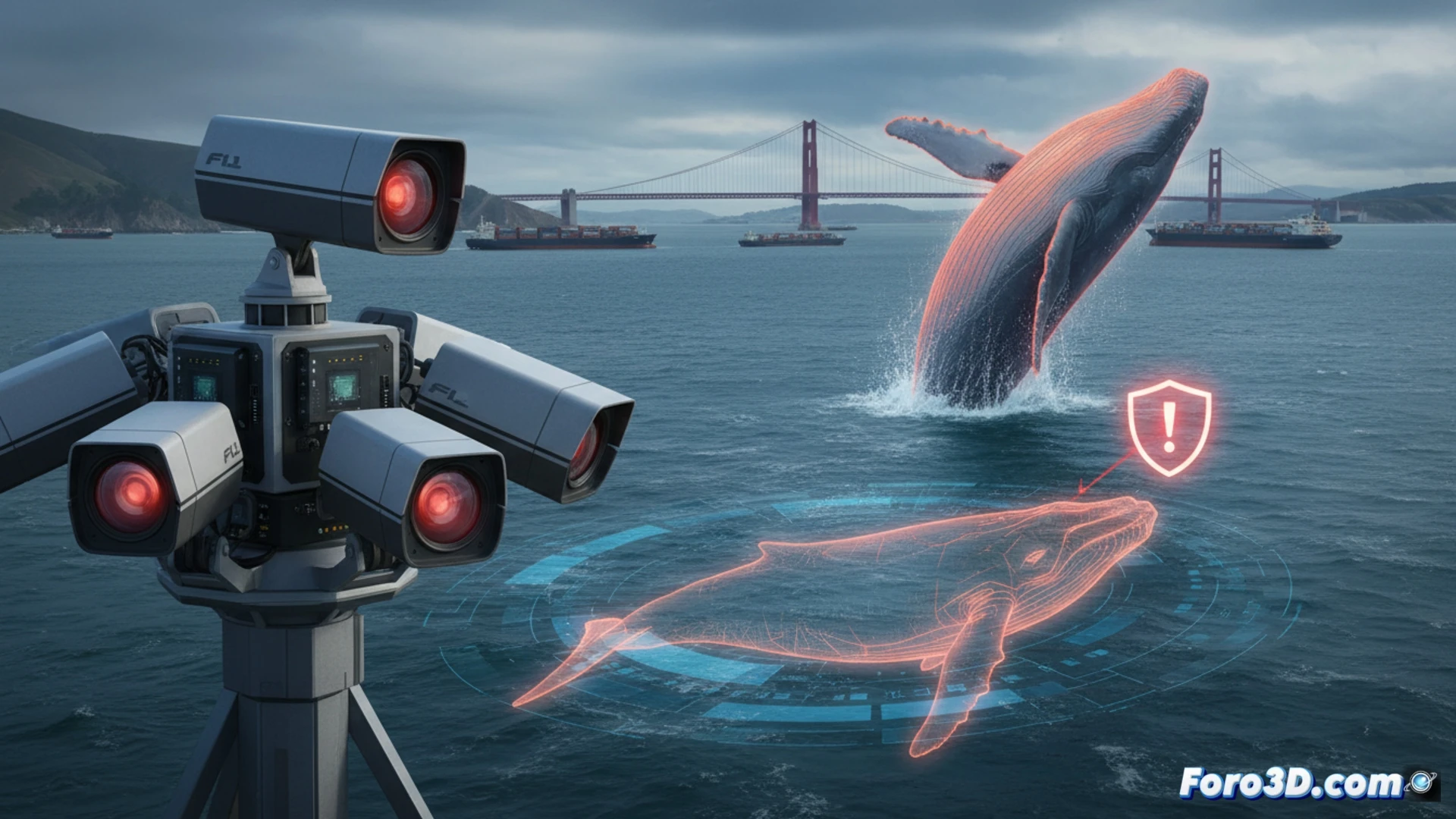
System architecture: 3D thermography and predictive models 🌊
The core of the system lies in creating digital twins of the marine ecosystem. Thermal cameras, installed on Angel Island and soon on ferries, the Golden Gate Bridge, and Alcatraz, capture thermal differences of just two degrees Celsius between the water and the whale's body. This data stream feeds an AI trained on hundreds of thousands of images, capable of modeling the cetacean's thermal silhouette in 3D and predicting its trajectory. Maritime route maps are overlaid onto these thermal diagrams, allowing for simulation of potential collisions and optimization of ship routes in real time. The visualization not only shows where the whale is, but also where it is heading, thanks to movement algorithms that integrate current and traffic data.
Beyond detection: a simulated ecosystem for conservation 🧬
The most innovative aspect is not just detection, but the ability to simulate scenarios. Oceanographers and the Coast Guard use these 3D models to train the AI with virtual risk situations, improving its accuracy before implementing real course changes. This scientific visualization approach turns abstract data into concrete operational decisions. By integrating thermography, artificial intelligence, and digital twins, the system not only prevents collisions but also generates a visual record of migratory behavior, opening new avenues for research and dissemination of marine life in urban environments.
How can the integration of artificial intelligence algorithms with thermal camera data improve the accuracy of gray whale detection to generate real-time digital twins in San Francisco Bay
(PS: modeling manta rays is easy; the hard part is making them not look like floating plastic bags)