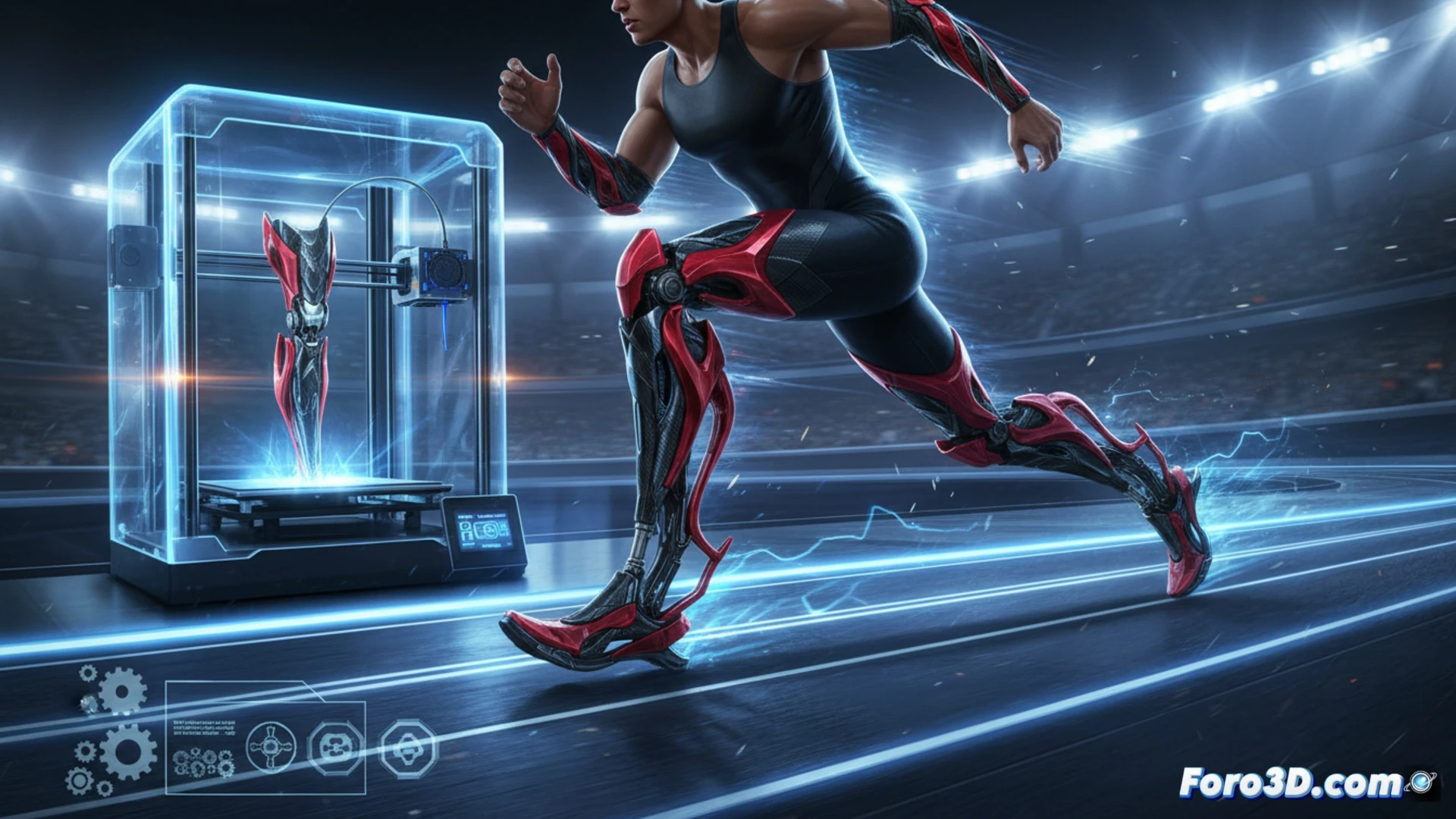
The Marvel universe introduces us to Calamity, an athlete who, after losing his legs in an accident, turns to advanced prosthetics not only to regain his mobility but to achieve superhuman speed. This character, created by Matt Fraction and Barry Kitson, mirrors a very real technological revolution: additive manufacturing of medical devices. At Foro3D.com, we analyze how 3D printing of customized prosthetics is bridging the gap between science fiction and elite sports biomechanics. 🦾
Additive biomechanics: from 3D scanning to carbon fiber 🏃
To replicate Calamity's abilities, the process would begin with a high-precision 3D scan of the athlete's stump, capturing every anatomical detail for a perfect fit. 3D printing allows for designing prosthetics with organic geometries impossible to manufacture using traditional methods, optimizing energy transfer with each stride. Composite materials like carbon fiber, combined with honeycomb structures printed in titanium, offer an ideal strength-to-weight ratio. However, Calamity's fiction clashes with reality: current prosthetics do not actively store or release kinetic energy; they merely return a percentage of impact energy, far from Marvel's super speed.
Real athletes, technological limits, and the future of sports 🏅
Athletes like Paralympic sprinter Oscar Pistorius demonstrated the potential of carbon fiber prosthetics but also highlighted their limitations compared to biological legs. Today, 3D printing allows for customizing each piece for specific sports, from sprinting to long jump. Although we cannot print a super-speed motor, technology is advancing toward smart damping systems and integrated sensors. Calamity reminds us that the real leap is not in fiction, but in 3D printing's ability to restore mobility and performance to those who need it most.
How the hypothetical properties of Calamity's super-speed prosthetics can be translated into real design and material parameters for 3D printing high-performance sports orthoses and prosthetics
(PS: 3D prosthetics are so customized they even have a fingerprint.)