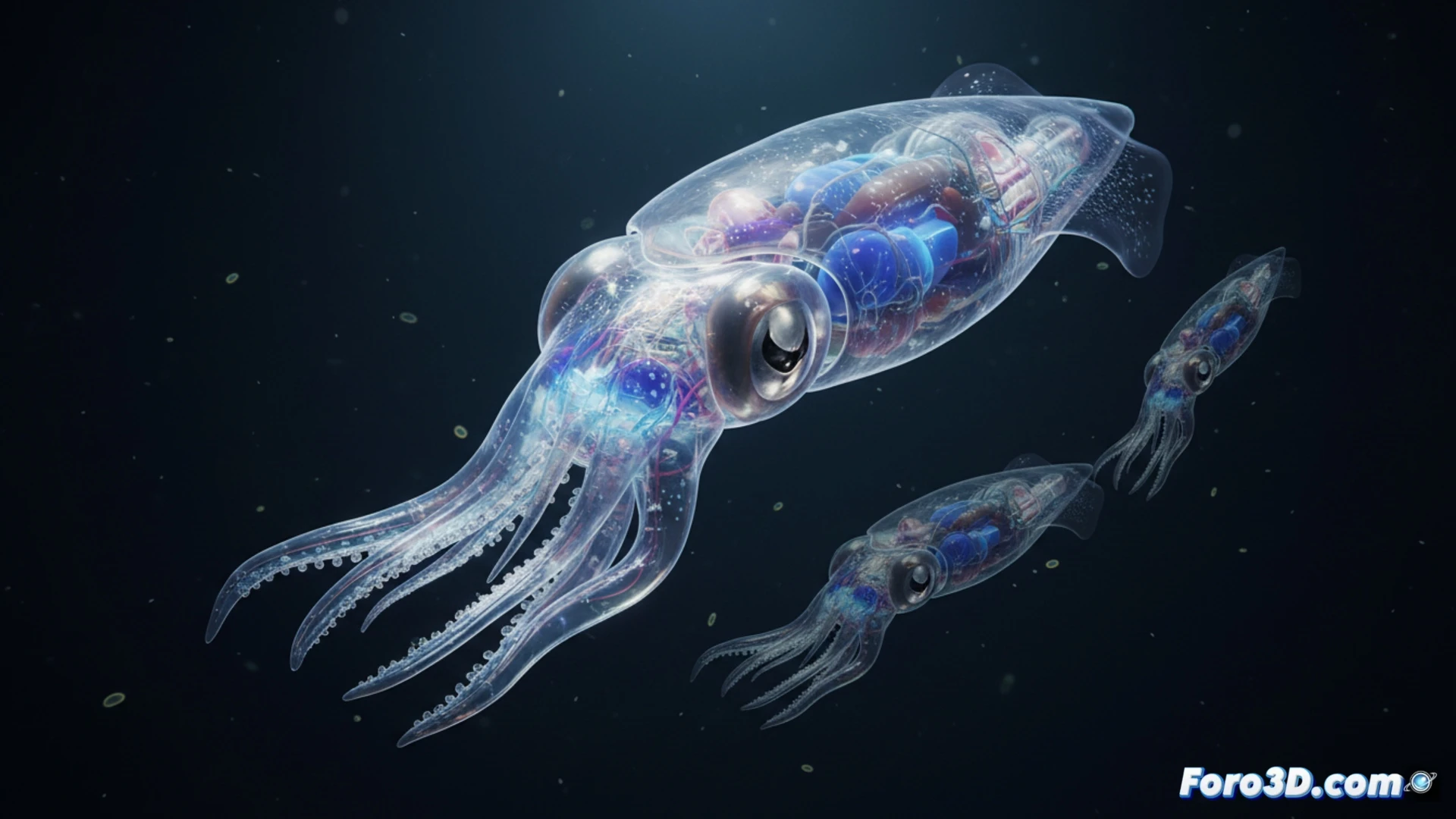
The observation in 2024 of the Glass Squid with Big Eyes (Teuthowenia sp.) has reignited interest in these abyssal creatures. Its translucent body, enormous eyes, and unique ability to retract its tentacles into the mantle represent a fascinating technical challenge for scientific visualization. This article details the process of creating an anatomically accurate 3D model, designed for research and outreach in simulated ocean environments. 🦑
Digital Anatomy and Tentacular Retraction Mechanics 🔬
The modeling focused on three fundamental axes: transparency, ocular proportion, and mantle kinematics. For transparency, subsurface scattering (SSS) shaders were used to simulate the gelatinous tissue, revealing the digestive gland and internal photophores. The eyes, with a body-to-size ratio of 1:3, required spherical lenses with a high refractive index. The animation of the retraction mechanism involved rigging with soft influence control bones, allowing the tentacles to fold and disappear into the mantle cavity in a 2-second cycle. A comparative table of mantle volumes between Teuthowenia and the common squid (Loligo vulgaris) was included to highlight the hydrodynamic adaptation.
Evolutionary Context in the Mesopelagic Zone 🌊
Beyond geometry, the model's value lies in its ability to illustrate an extreme evolutionary adaptation. Transparency is camouflage against bioluminescent predators at 2000 meters depth, while hypertrophied eyes maximize photon capture in darkness. Tentacular retraction, before being a defense, is a stealth strategy: by hiding the arms, the squid reduces its silhouette and avoids reflecting light. The 3D model includes a habitat scene with light pressure gradients, allowing visualization of how the creature blends into the ocean floor in real time.
How can the extreme transparency and internal structures of the glass squid be translated into a 3D model that is scientifically accurate without relying on opaque textures that obscure its anatomical complexity.
(PS: at Foro3D we know that even manta rays have better social bonds than our polygons)