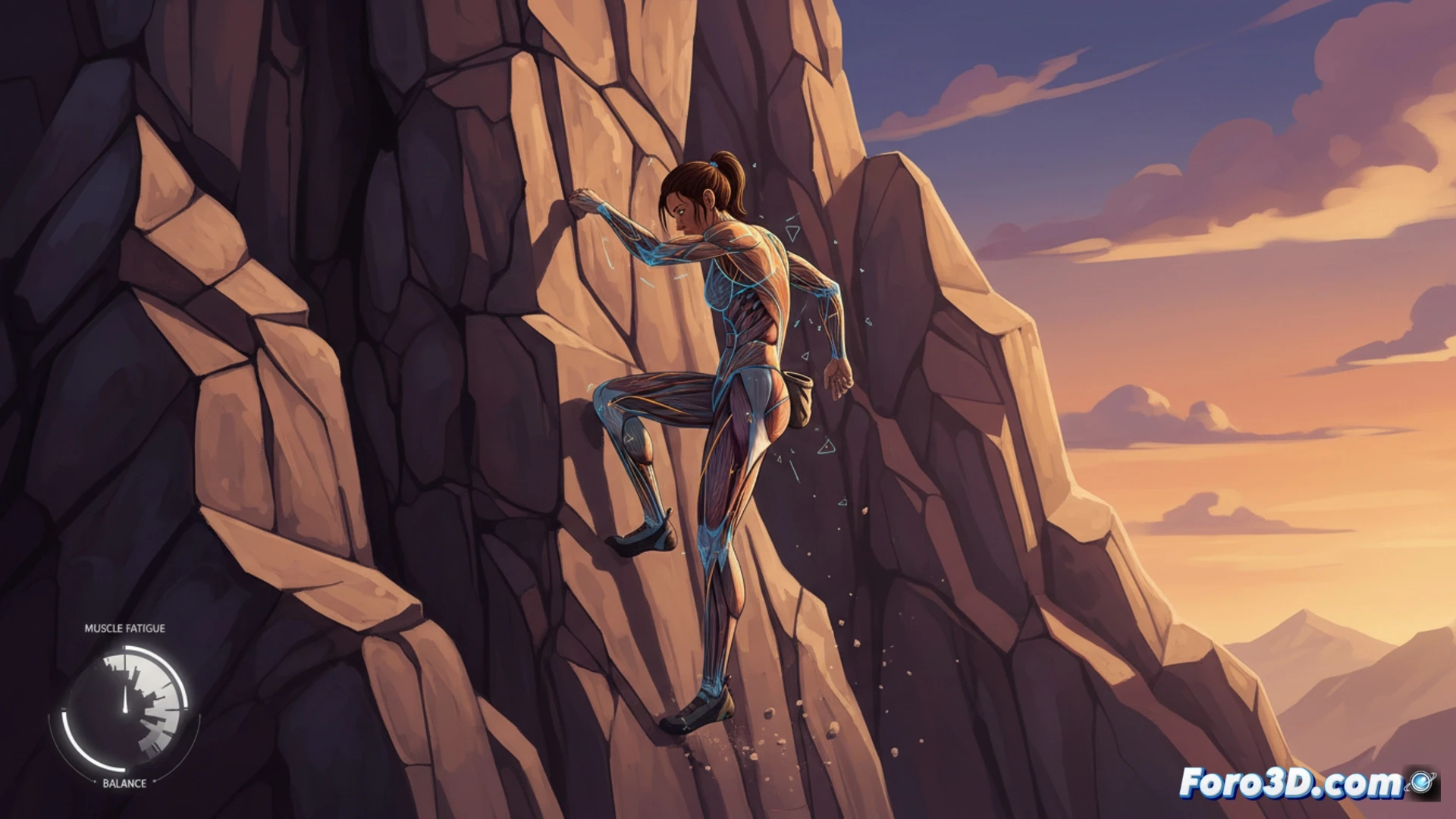
The Game Bakers studio, known for Furi and Haven, returns with Cairn, an indie title that promises to revolutionize climbing simulation. Developed in Unity, the game bets on a movement system based on custom biomechanics tools. This technical approach seeks to capture the climber's muscle fatigue and balance, offering a gameplay experience that prioritizes physical realism over arcade style, a considerable technical challenge for the graphics engine.
Artistic pipeline: From Blender to animated illustration 🎨
The visual aspect of Cairn moves away from photorealism to embrace a style that emulates hand-drawn illustration. The vibrant color palette is combined with soft cel-shaded shadows, achieving an aesthetic reminiscent of a moving painting. To achieve this finish, the production pipeline relies on Blender for modeling and sculpting the rocky environments, while Photoshop is used for texture creation and defining color palettes. This combination of tools allows for detailed artistic control, optimizing performance in Unity by reducing the complexity of traditional shaders.
Biomechanics as the game engine ⛰️
The main technical innovation of Cairn lies in its custom biomechanics systems. These are not simple pre-rendered animations, but rather calculate in real-time the weight distribution and force applied to each hold. The challenge for The Game Bakers has been integrating this complex physics system within Unity, making the character react organically to fatigue. The result is gameplay where every move counts, raising the technical bar for adventure simulators.
As a developer, what specific biomechanical challenges did you face when implementing realistic climbing in Cairn, and how did you make the system feel natural without sacrificing gameplay within a cel-shaded visual style?
(PS: a game developer is someone who spends 1000 hours making a game that people complete in 2)