The promise of autonomous robotics in high-altitude maintenance vanished in seconds when a window-cleaning robot plummeted from the 50th floor of a skyscraper. The impact on the public thoroughfare, fortunately without fatalities, triggered a 3D forensic investigation to clarify the causes. The initial hypothesis pointed to a mechanical failure, but the detailed scan revealed a more subtle and dangerous truth: chemical contamination of the facade.
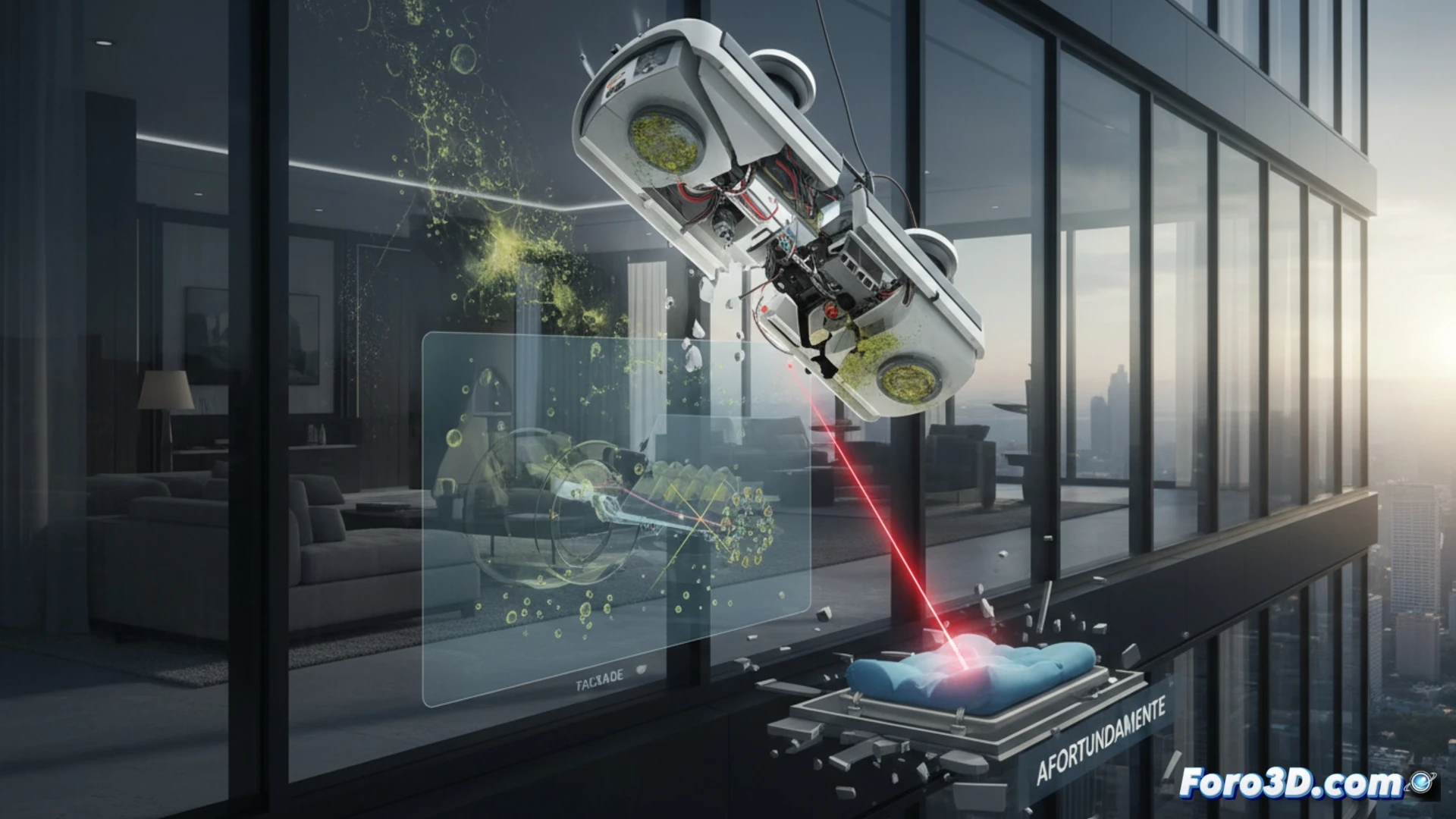
Virtual reconstruction and analysis of the suction failure 🛠️
The forensic team used a FARO Zone 3D scanner to document the impact scene and the robot's trajectory. Simultaneously, samples were taken from the suction cups and the glass surface in the work area. Using a Keyence VHX digital microscope, a 3D surface analysis of the suction cups was performed, revealing a homogeneous chemical contamination film. This layer, composed of sealant residues and industrial oils, had drastically reduced the coefficient of friction. With this data, the facade and robot geometry were imported into SimScale. Computational fluid dynamics (CFD) simulations demonstrated that the nominal suction of the cups was insufficient to maintain grip on the contaminated surface, causing a progressive loss of vacuum until complete detachment.
3D lessons for disaster prevention in high-altitude robotics ⚠️
This case demonstrates that the reliability of autonomous robots depends not only on their hardware but also on the operating environment. 3D modeling, from scene scanning to failure simulation, allows identifying risk factors invisible to the naked eye, such as chemical contamination. For the industry, the solution is not just to improve the suction cups but to implement prior surface inspection protocols using integrated sensors. The virtual reconstruction of this catastrophe serves as a warning and a guide for designing more robust safety systems in high-altitude maintenance.
What finite element simulation parameters should be prioritized in the design of a window-cleaning robot's magnetic anchoring systems to ensure its stability against wind gusts at height?
(PS: Simulating catastrophes is fun until the computer crashes and you are the catastrophe.)