A study published in Science Advances advances the early stages of horse domestication, confirming that humans were already riding and trading these animals around 6,000 years ago. From digital archaeology, this finding opens the door to virtual reconstructions of the Eurasian steppe landscapes, where three ancient populations between western Siberia and central Europe independently began the process around 3500-3000 BC.
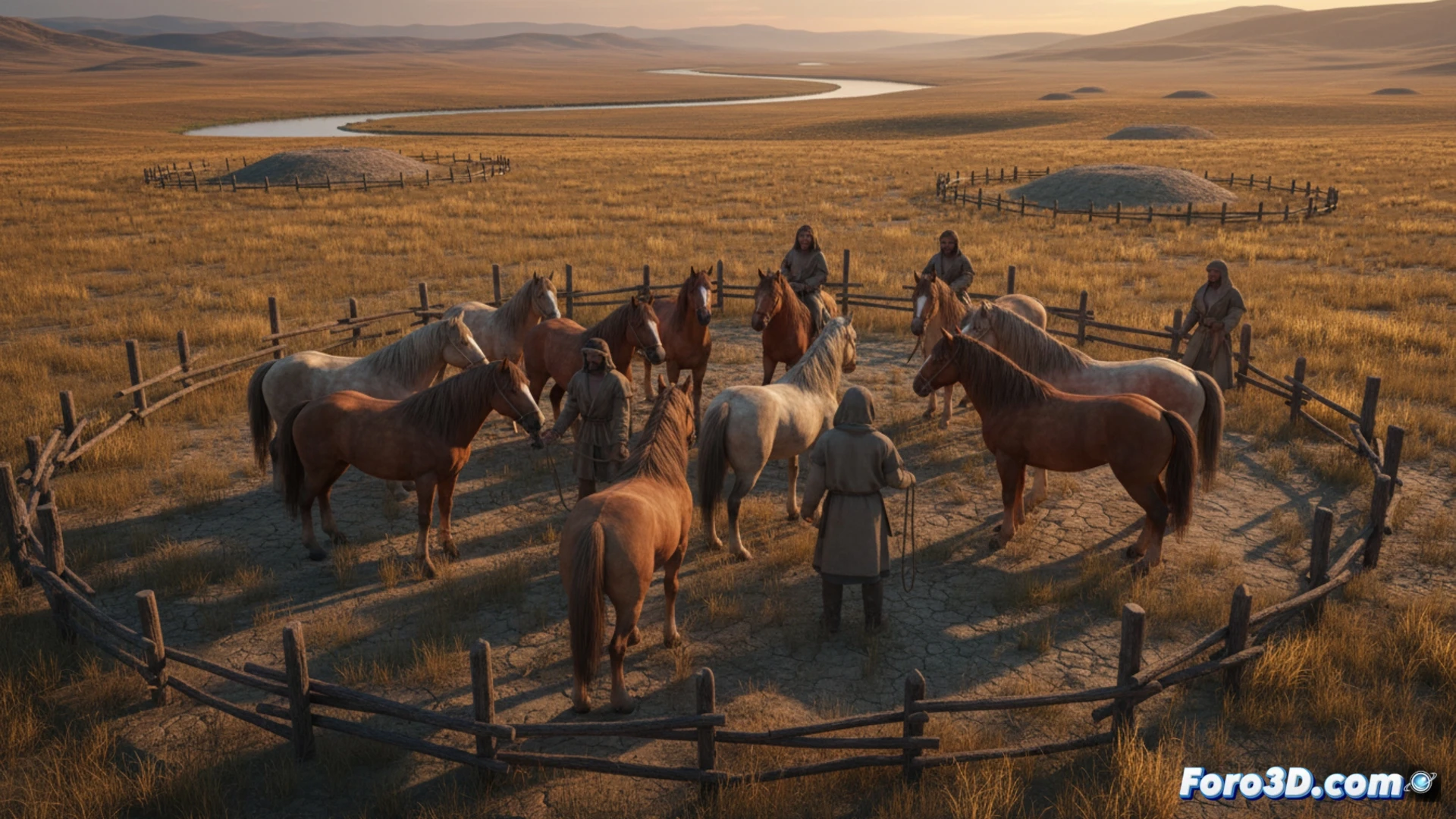
Photogrammetry and simulation of the Yamna culture 🐎
The research identifies the DOM2 population, located north of the Black and Caspian Seas, as the origin of modern domestic horses. For a technical writer at Foro3D, this data is key: we can model in 3D the ox-drawn carts that Yamna nomads used to migrate east and west, facilitating the spread of Proto-Indo-European languages. Using photogrammetry techniques on bone remains and artifacts, it is possible to recreate ancient equine morphology and simulate migration routes, offering an immersive visualization of how these animals transformed human mobility.
The myth of the Przewalski's horse in the digital age 🦄
The study also contradicts the idea that the Przewalski's horse is a relic of the first wild horses. From digital archaeology, this allows us to update virtual reconstructions of prehistoric fauna, discarding erroneous models and generating more accurate representations based on genetic data. Science communication benefits from these 3D models, which bring the public closer to the complex domestication processes that shaped human history.
How 3D modeling of equine remains from the Yamna culture influenced the confirmation of riding techniques used 6,000 years ago
(PS: and remember: if you can't find a bone, you can always model it yourself)