Blue Protocol is not just an MMORPG; it is a technical manifesto on how to bring the aesthetic of traditional Japanese animation into an interactive 3D environment. Bandai Namco Online has achieved this milestone using Unreal Engine 4 as a foundation, but the secret lies not in the base engine, but in a layer of custom shaders that mimic the diffuse lighting and carbon-like outlines typical of anime. In this article, we break down the graphical pipeline that allows every frame to look like a frame from a Studio Ghibli film, but rendered in real-time. 🎨
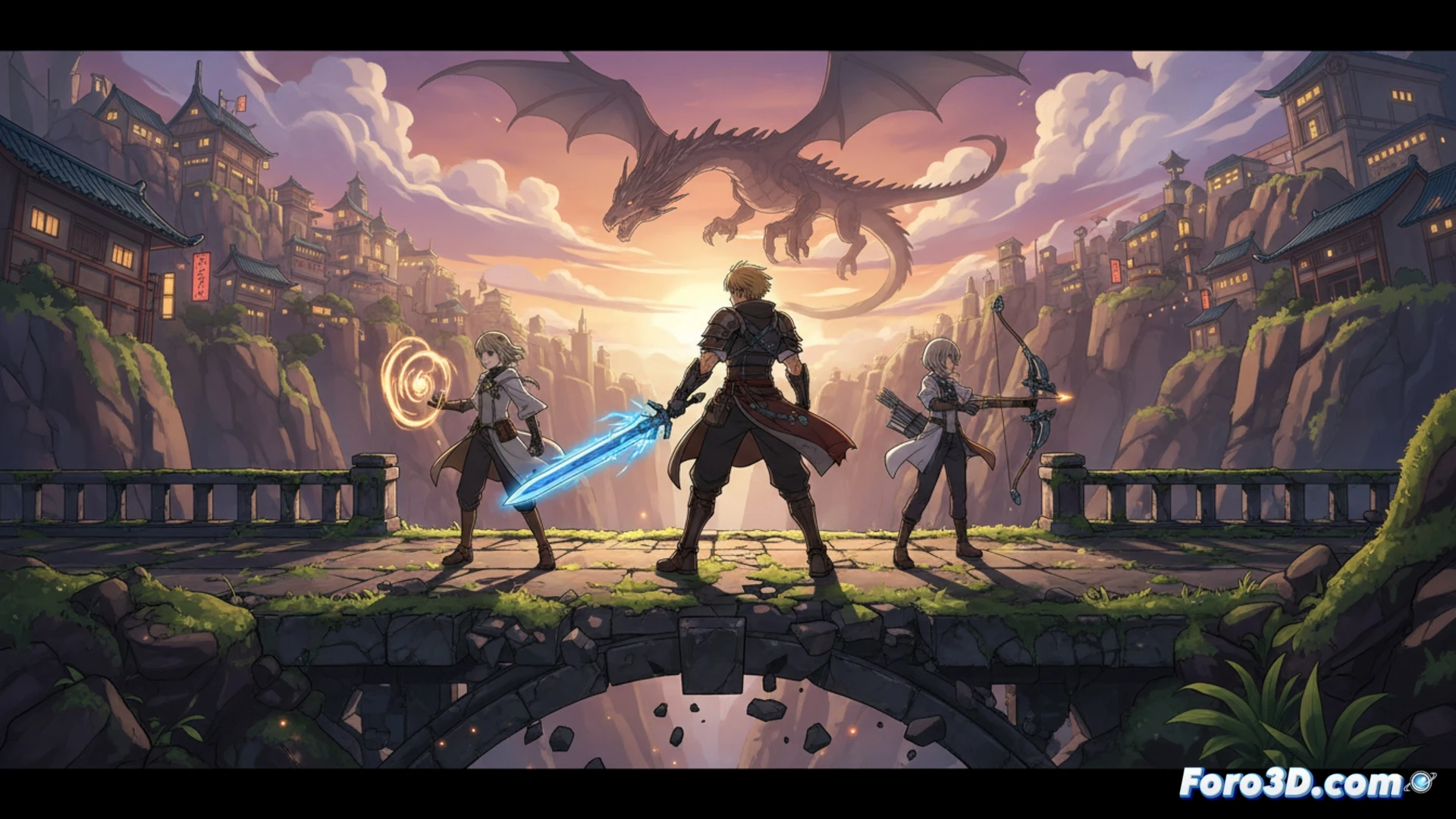
Technical Pipeline: Rigging in Maya and Modeling in Blender 🛠️
Blue Protocol's workflow divides responsibilities between two titans of 3D modeling. Autodesk Maya handles character rigging and animation, leveraging its skeletal deformation system and native integration with Unreal Engine 4 to transfer bone and weight data seamlessly. On the other hand, Blender takes on the modeling of props and environments. The reason is strategic: Blender offers a faster iteration cycle for static assets, and its material node system allows previewing toon shaders before exporting them. The key optimization here is that prop models are built with low polygon density, but with UV maps specifically designed to receive the ink outline shaders generated via a post-process effect in the engine.
The Illusion of Animated Depth of Field 🌸
The greatest technical challenge in Blue Protocol is simulating the depth of field (DoF) of a 2D animation camera. Instead of a generic Gaussian blur, the developers implemented a shader that desaturates the color and applies a line shift to out-of-focus objects, mimicking the blurred paint effect of a cel. Combined with a diffuse lighting system that eliminates hard shadows, the result is a world that breathes like a cartoon. The visual comparison is clear: while other games use post-process filters that break coherence, Blue Protocol integrates these rules directly into the material of each mesh, making even water reflections look like digital watercolors.
As a video game developer, what are the key techniques in Unreal Engine 4 that Blue Protocol implements to achieve the 2D Japanese animation aesthetic in a 3D world without resorting to traditional cel-shading?
(PS: optimizing for mobile is like trying to fit an elephant into a Mini Cooper)