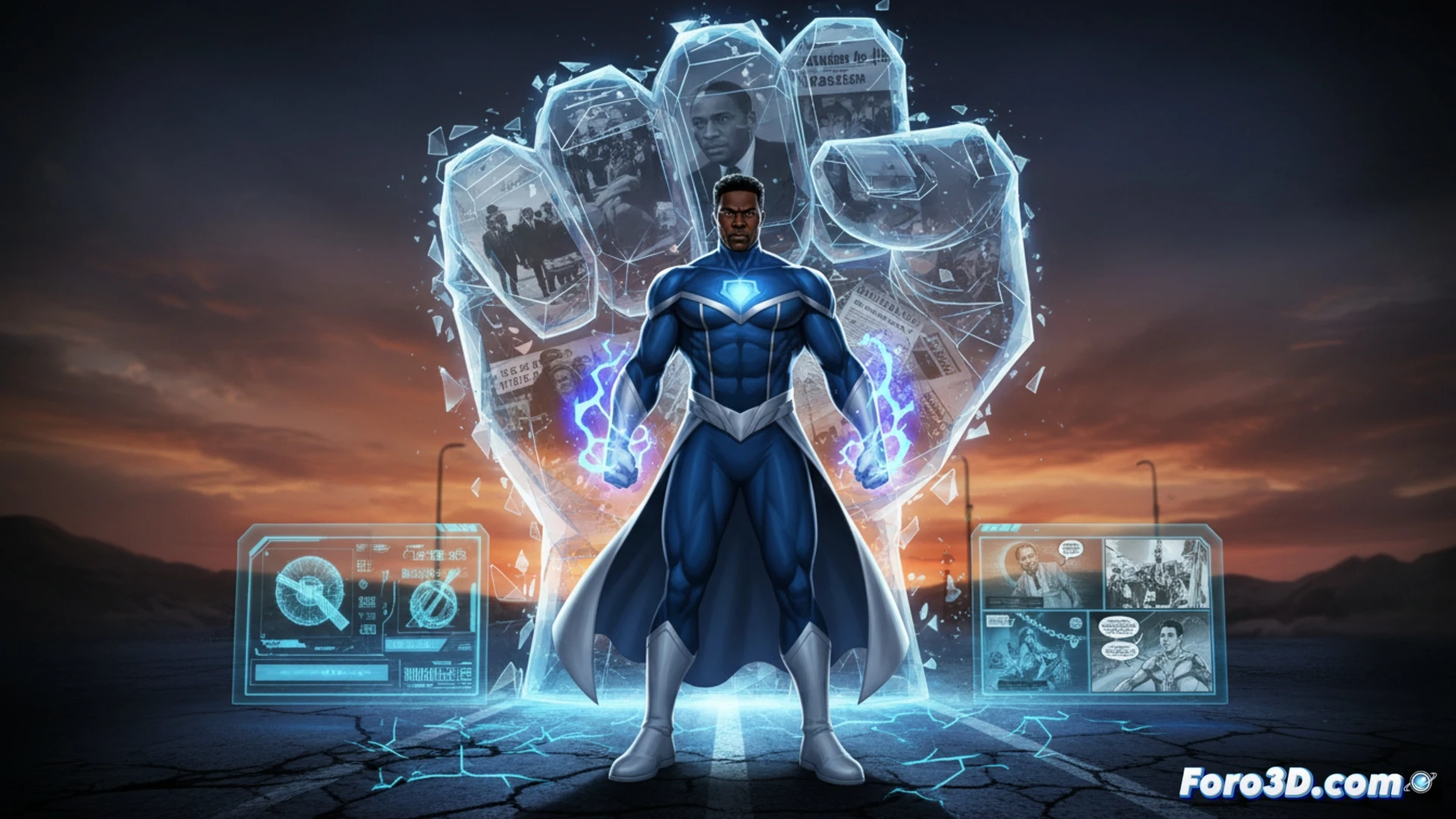
Adam Brashear, alias Blue Marvel, is an African American scientific genius with anti-matter powers. Created by Kevin Grevioux and Mat Broome, this Marvel character operated in secret during the 1960s, forced into retirement by the institutional racism of the era. His story is not just a superhero tale, but a scathing critique of systemic racism. In the niche of art and digital activism, Blue Marvel represents a perfect case of how comics can convey a social message, and how 3D technologies can amplify that historical denunciation.
3D Modeling and Period Environments to Narrate Racism 🎨
The digital recreation of Blue Marvel requires 3D modeling that captures both the aesthetic of the 1960s and the power of his anti-matter energy. Period environments, such as government laboratories or segregated streets, can be built with historical precision in software like Blender or Maya. 3D animation allows showing the contrast between the grandeur of his powers and the social oppression he suffers, generating an immersive experience. Virtual reality projects like The Silent History or fan arts of characters like Storm or Black Panther have already demonstrated that 3D modeling can be a tool for racial denunciation, by placing the viewer within historical contexts of discrimination.
The Comic as a Platform for Social Change in the Digital Age 🚀
Blue Marvel is not just a character, but a symbol of resistance. His story shows that sequential art can be a vehicle for activism, especially when combined with digital tools. Creating 3D sculptures, photorealistic renders, or animated short films about his origin allows new audiences to connect with the fight against institutional racism. In a world where digital art is accessible, every 3D model of Adam Brashear is an act of historical memory and an invitation to reflect on how technology can serve social justice.
Considering that Blue Marvel was born in the civil rights era but was retired by the US government to avoid racial tensions, how could 3D modeling of his figure and the creation of interactive digital environments serve as a tool to educate and make visible the history of systemic racism in science fiction?
(PS: at Foro3D we believe all art is political, especially when the computer freezes)