The work of Yasuhiro Nightow, creator of Trigun, offers us in Blood Blockade Battlefront a perfect visual laboratory for developers. Hellsalem's Lot, the New York transformed by a dimensional fog, is a setting where visual density and controlled chaos are the norm. This article analyzes how to translate its cluttered aesthetic into engines like Unity or Unreal Engine, optimizing assets for urban environments teeming with creatures and power effects that demand solid real-time performance.
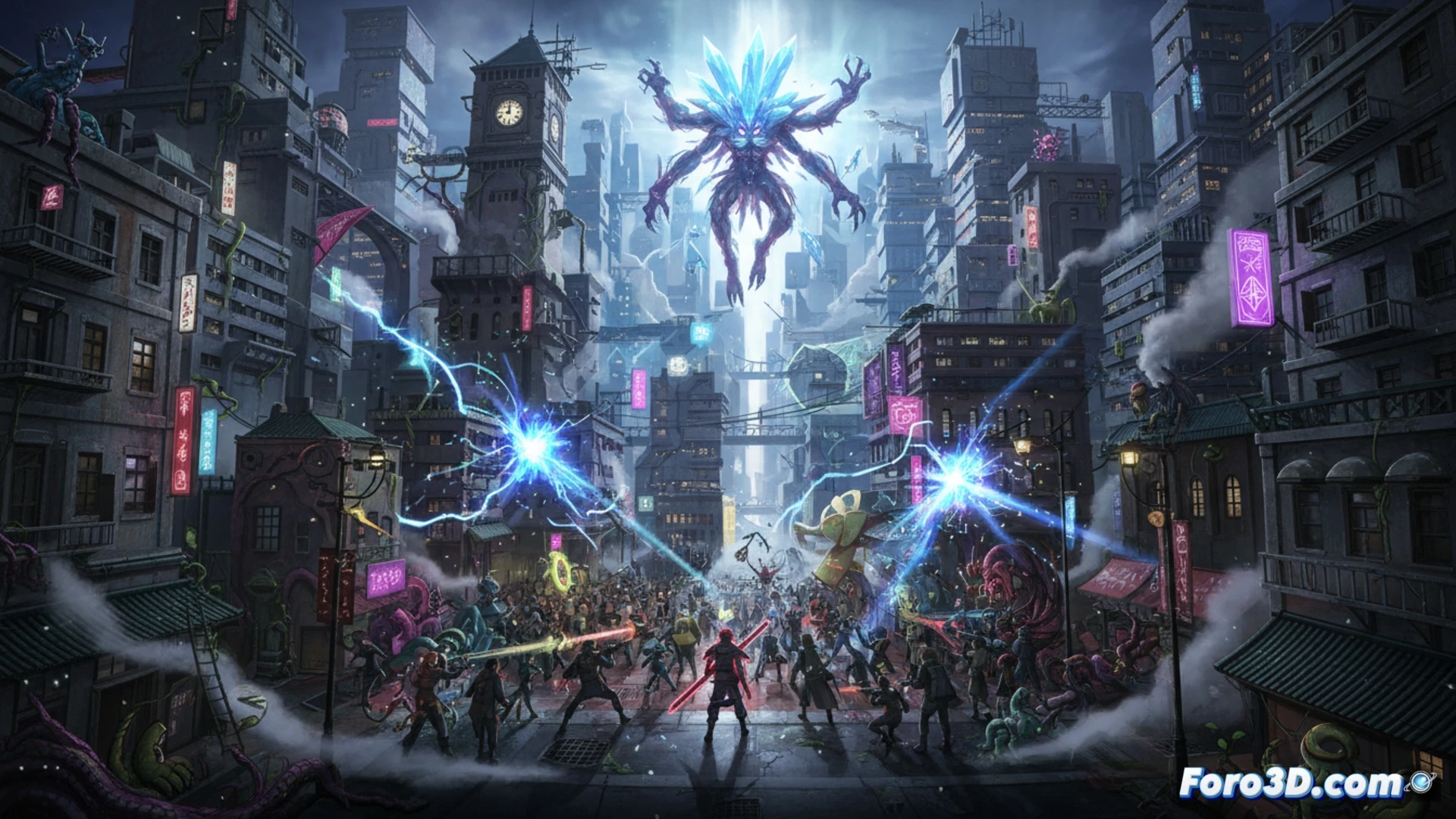
Monstrous silhouettes and dense environments: Asset and level techniques 🏙️
Character design in Kekkai Sensen is based on extremely recognizable silhouettes, from Leonardo's red coat to the organic forms of monsters. For a video game, this is crucial: an enemy must be instantly readable even in the whirlwind of battle. In asset creation, we can use post-processing shaders to emulate the neon lighting and hard shadows of the series, while for levels, the key lies in depth of field and layering (signs, pipes, background creatures) without saturating the draw buffer. A modular building system with atlas textures allows recreating that density without sacrificing frames.
Power effects and controlled chaos in real time ⚡
Nightow's action is pure kinetic energy. To replicate the clans' powers in a game engine, we must prioritize particle effects with short durations and vibrant colors. In Unreal Engine, Niagara systems can emulate the bloodlines and characteristic white light flashes, while in Unity, using VFX Graph with noise textures allows simulating the city's supernatural fog. The essential thing is that each visual effect has a gameplay purpose: indicating attack range, telegraphing danger, or marking safe zones, transforming visual chaos into an interactive design tool.
How to balance player visibility with the density of supernatural elements in a chaotic urban setting like Blood Blockade Battlefront without compromising performance in Unreal Engine
(PS: shaders are like mayonnaise: if they break, you start all over again)