The explosion of an electric water heater devastated the partitions of a home, leaving the metal tank deformed like a light bulb. The incident, classified as a BLEVE (Boiling Liquid Expanding Vapor Explosion), underwent a 3D forensic analysis to determine the exact cause. An Artec Leo scanner was used to capture the geometry of the collapsed tank, revealing anomalous volumetric expansion pointing to a catastrophic failure of the pressure relief system.
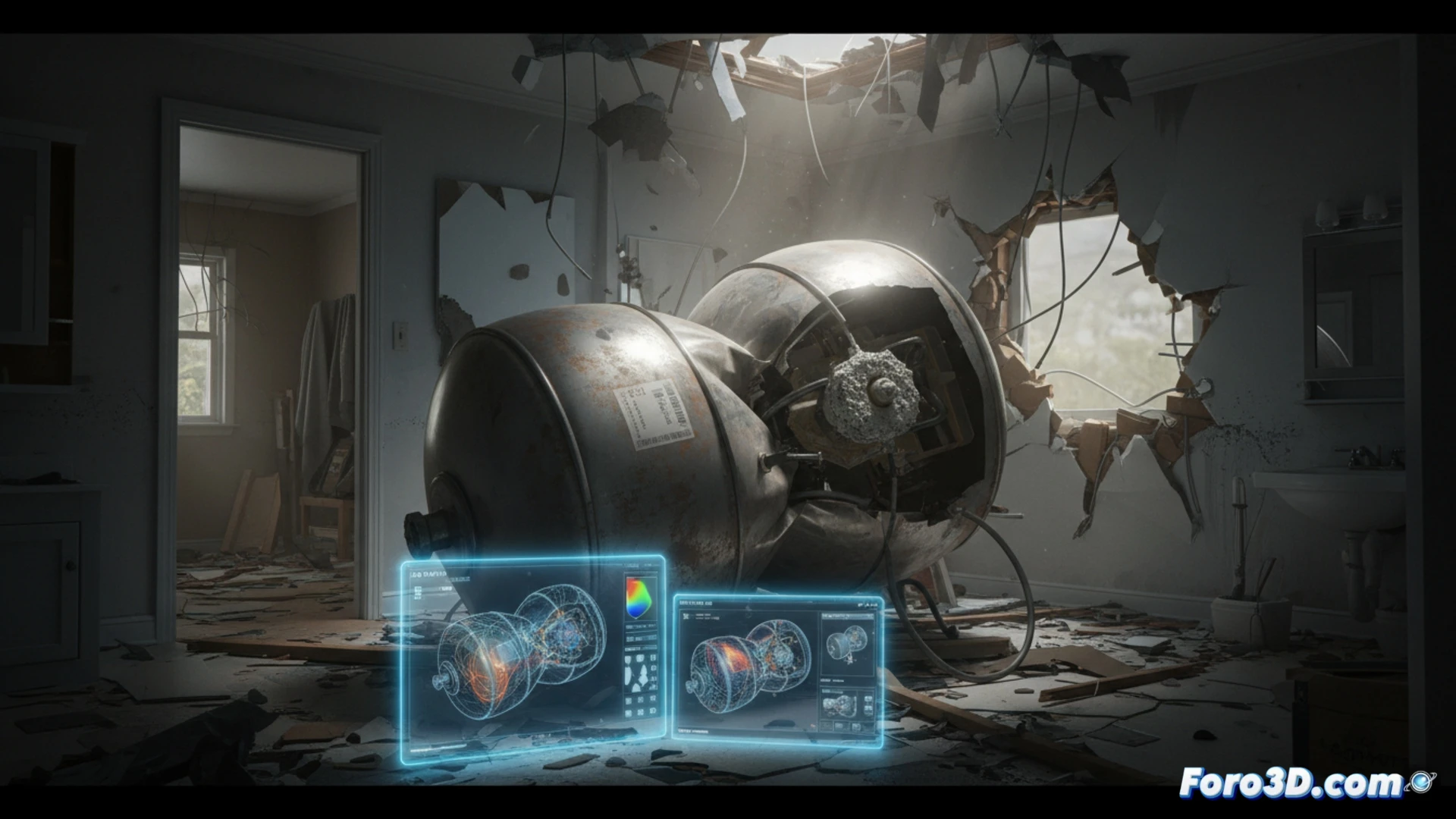
Forensic Workflow: Scanning, Simulation, and Modeling 🔍
The process began with volumetric scanning of the deformed tank using an Artec Leo, generating a high-resolution polygonal mesh that captured every bulge and crack. This mesh was imported into Fusion 360 to reconstruct the original CAD model and calculate the plastic deformation suffered. Thickness and curvature data were entered into LS-DYNA to simulate internal pressure expansion. The simulation correlated the actual deformation with a burst pressure of 12 bar, well above the design pressure of 8 bar. The analysis concluded that the safety valve was completely blocked by a layer of calcareous sediment, rendering it inoperative. Visual comparisons between the original CAD model and the post-explosion scan show a 40% volume increase, typical of a BLEVE without relief. Pressure-time graphs generated in LS-DYNA indicate an instantaneous peak followed by a shock wave that justifies the destruction of the partitions.
Technical Lessons for Disaster Prevention ⚠️
This case demonstrates that limescale buildup is not just an efficiency issue, but a trigger for catastrophes. The lack of maintenance on the safety valve turns a common household appliance into a time bomb. The combination of forensic 3D scanning and finite element simulation offers a robust methodology for understanding these failures and redesigning more reliable protection systems, especially in areas with hard water where limescale blockage is endemic.
In a forensic scan of a water heater exploded by a domestic BLEVE, what metal deformation patterns allow distinguishing a pure pressure wave from secondary fragment impact?
(PS: Simulating catastrophes is fun until the computer crashes and you are the catastrophe.)