The local production of mRNA vaccines faces extreme logistical challenges, especially in regions without pharmaceutical infrastructure. BioNTech has responded with the BioNTainer, a modular laboratory encapsulated in a standard shipping container. For industrial visualization specialists, this system represents a fascinating challenge: modeling in 3D the flow of materials, robotic automation, and the cold chain within a hyper-compact space.
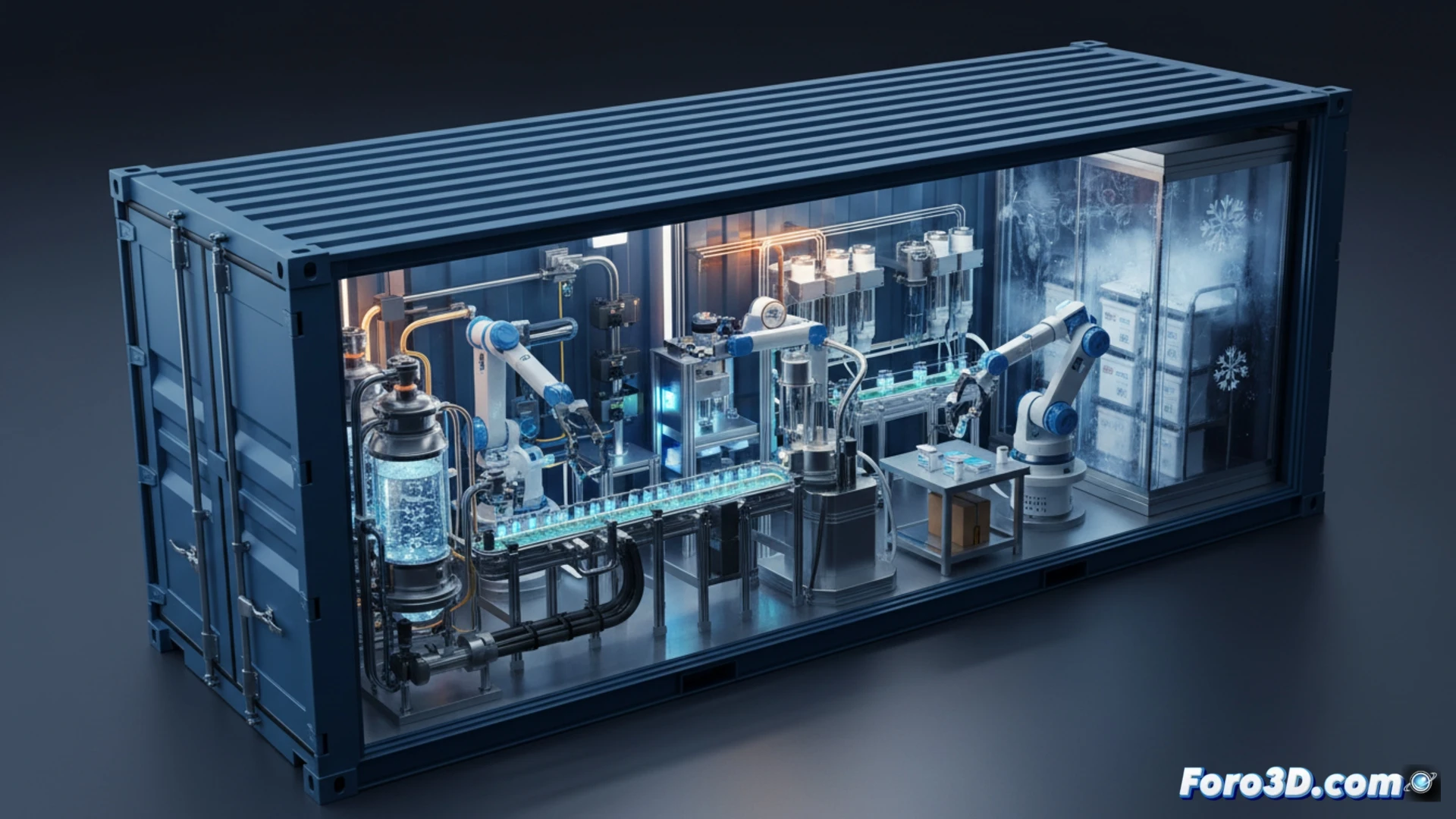
Modeling the internal layout and automation flow 🏭
When developing a digital twin of the BioNTainer, the first step is to recreate the interior layout of the 12-meter container. The production modules, single-use bioreactors, and purification systems must be organized following strict GMP standards. 3D simulation allows visualizing the flow of vials, the movement of robotic arms, and the synchronization of mRNA synthesis stages. Tools like Siemens Tecnomatix or FlexSim help optimize cycle time, detecting bottlenecks in material transfer between adjacent modules. This modeling is critical to validate that a single unit can produce up to 10 million doses per year without cross-contamination errors.
Tactical deployment and distribution logistics 🚚
The true innovation of the BioNTainer is not just its manufacturing capacity, but its portability. In 3D simulation, the impact of transport by truck or ship to hard-to-reach areas, such as African regions or remote islands, can be assessed. Visualizing unloading, anchoring, and connection to unstable electrical grids allows anticipating failures. By integrating GIS data with the 3D model, engineers can plan vaccine distribution routes from the container's exit to the vaccination point, closing the logistical cycle from start to finish.
How can the distribution and assembly logistics of the BioNTainer modules be optimized to ensure that the 3D simulation accurately reflects installation times in regions with limited infrastructure?
(PS: at Foro3D we optimize routes like we optimize polygons: until the computer says stop)