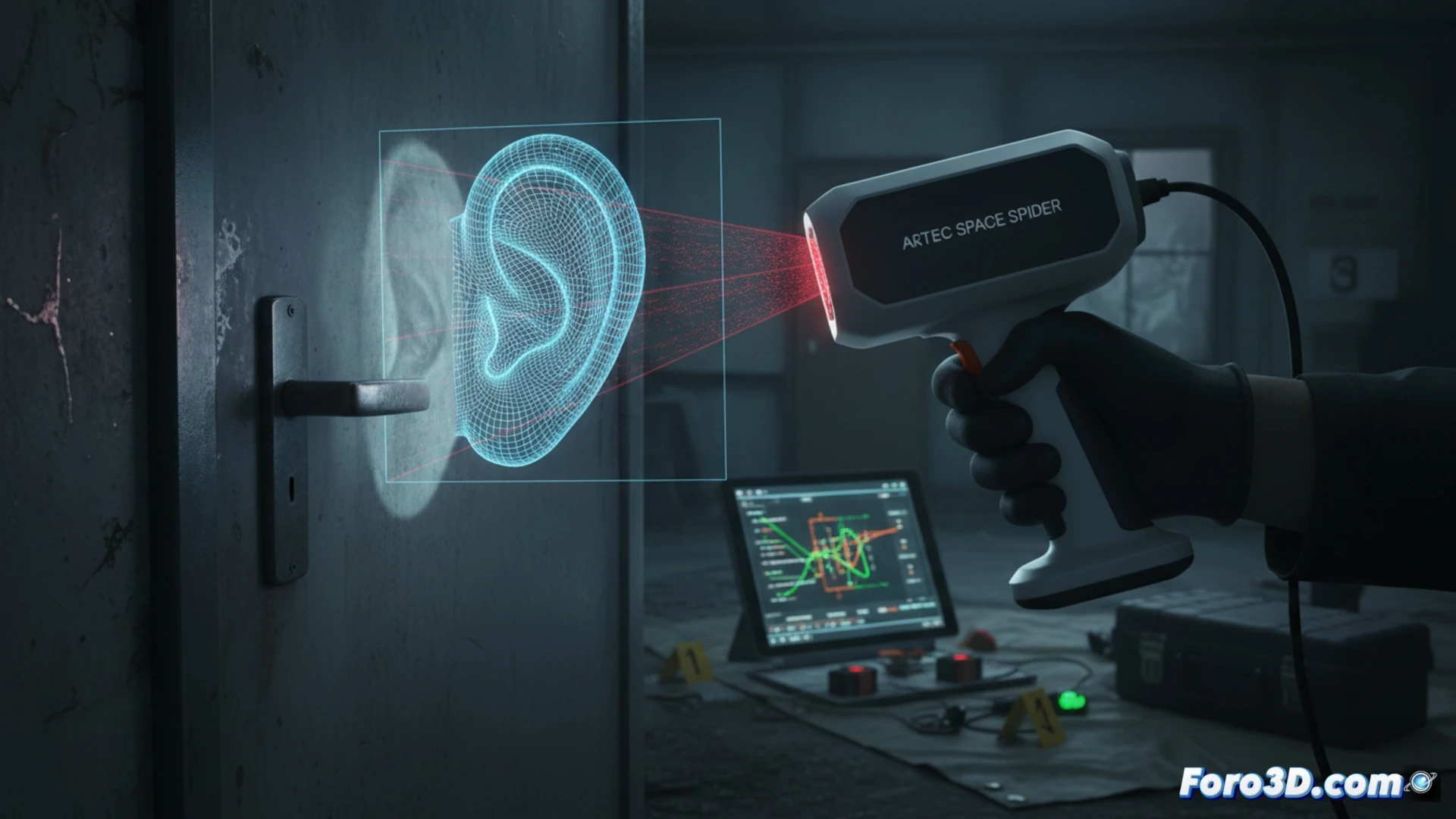
The human ear, with its complex topography of folds and cavities, becomes a unique forensic signature when a thief presses it against a door to listen. This article details a cutting-edge forensic pipeline that uses the Artec Space Spider scanner to capture the microscopic relief of the pressure mark, transforming an almost invisible trace into solid expert evidence through algorithmic comparison of the helix and antihelix.
Capture and Morphological Analysis Pipeline 🔍
The process begins with capturing the door's surface using the Artec Space Spider's blue structured light, achieving a resolution of 0.1 mm. The resulting point cloud is processed in GOM Inspect to isolate the ear's topographic deformation, generating a height map that reveals the microgeometry of the helix and antihelix. This model is compared with suspect scans using PolyWorks for a surface deviation analysis, calculating the root mean square (RMS) distance between the surfaces. The match threshold is set at a tolerance of 0.05 mm to ensure unequivocal identification, supported by the low probability of false positives in otometric biometrics.
Legal Validity and Future of Expert Evidence ⚖️
The robustness of this pipeline lies in its ability to document evidence non-invasively and reproducibly, meeting Daubert standards for the admissibility of scientific evidence. The height map generated in Adobe Photoshop serves as visual material for the expert, facilitating the explanation of the match pattern to the jury. Integrating otometric biometrics into forensic protocols not only increases the clearance rate in burglaries but also sets a precedent for using the ear as a geometric fingerprint in modern criminalistics.
What is the main technical challenge when capturing a high-fidelity 3D scan of the ear at a crime scene, considering factors such as lighting, movement of the corpse, or the presence of biological fluids?
(PS: don't forget to calibrate the laser scanner before documenting the scene... or you might be modeling a ghost)