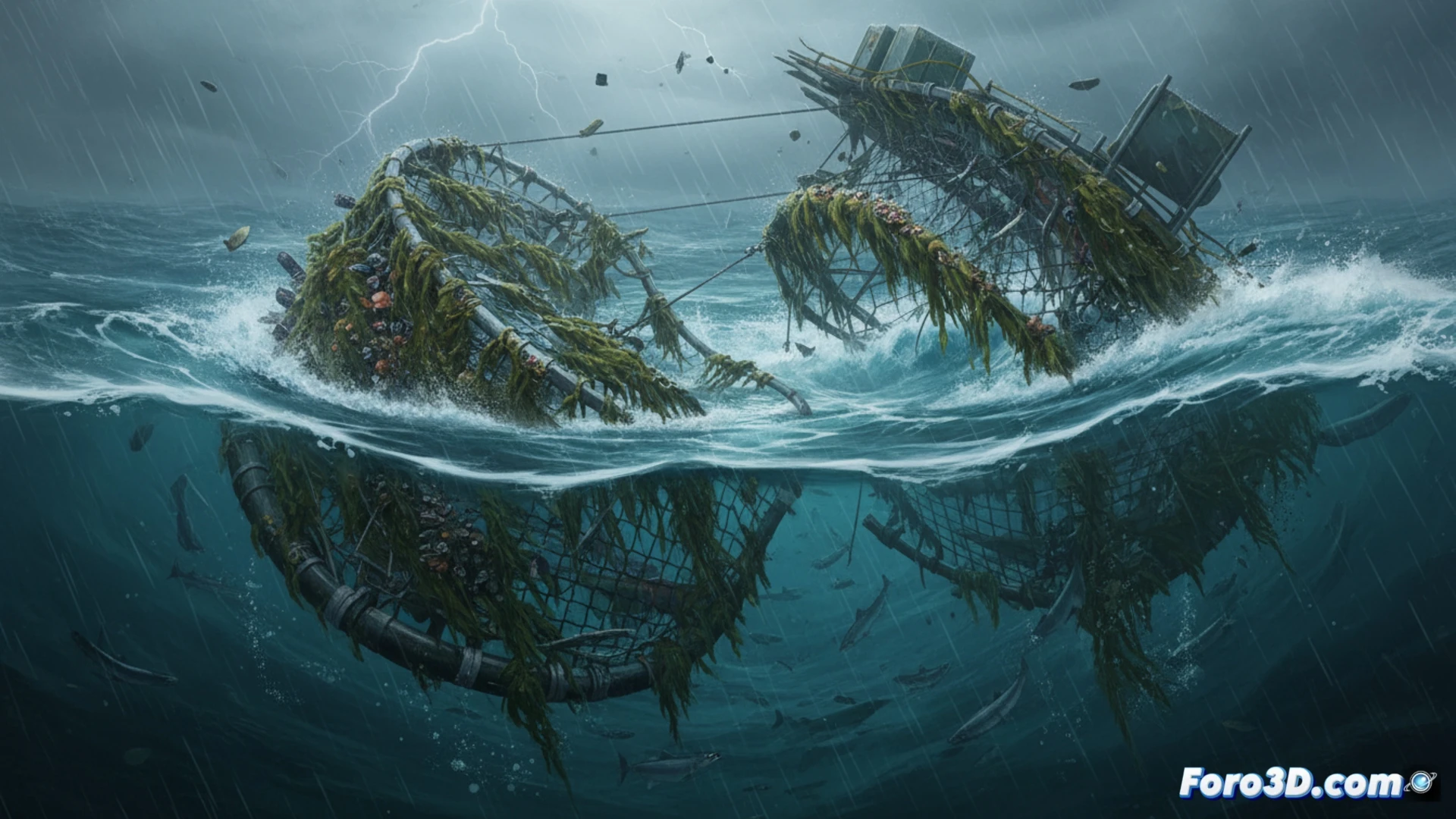
A state-of-the-art salmon farming cage sank during a storm in the North Atlantic. The forensic investigation, based on a 3D reconstruction of the accident, identified excessive biofouling as the critical factor that triggered the structural failure. Algae and mollusks attached to the nets multiplied the drag coefficient and submerged weight, exceeding the buoyancy capacity of the rings and causing the infrastructure to collapse.
Forensic reconstruction with OrcaFlex, Rhino 3D, and RealityCapture 🛠️
The engineering team used RealityCapture to generate an accurate photogrammetric model of the collapsed cage from images captured by an ROV. This model was imported into Rhino 3D to clean the geometry and recreate the net with its estimated fouling load. Subsequently, the model was introduced into OrcaFlex, a non-linear marine dynamics software. The simulations showed that the layer of fouling organisms, which added an extra 40% weight and doubled the hydrodynamic resistance, raised the stresses on the buoyancy rings far above the design limits during the extreme storm waves.
Lessons for the offshore industry: The digital twin as a lifeline 🌊
This case reveals the need to integrate biofouling monitoring into predictive maintenance protocols. Creating a digital twin, updated in real-time with data from stress sensors and biological growth, would have allowed the risk of collapse to be anticipated. For the offshore aquaculture industry, the lesson is clear: underestimating the live load of fouling is as dangerous as ignoring a storm. Numerical simulation with tools like OrcaFlex is no longer a luxury, but a requirement for structural safety.
Could biofouling on the net of an offshore aquaculture cage increase structural stress enough to cause its collapse during a high-energy storm?
(PS: Simulating catastrophes is fun until the computer crashes and you are the catastrophe.)