A fleet of autonomous marine drones, designed for microplastic cleanup, has suffered a critical failure in its filtration systems. 3D analysis of the graphene micro-sieves revealed that a specific species of phytoplankton adheres to the mesh, generating a biofouling that the self-cleaning system cannot process. This finding, documented using scientific visualization tools, opens the door to a redesign based on three-dimensional data. 🛸
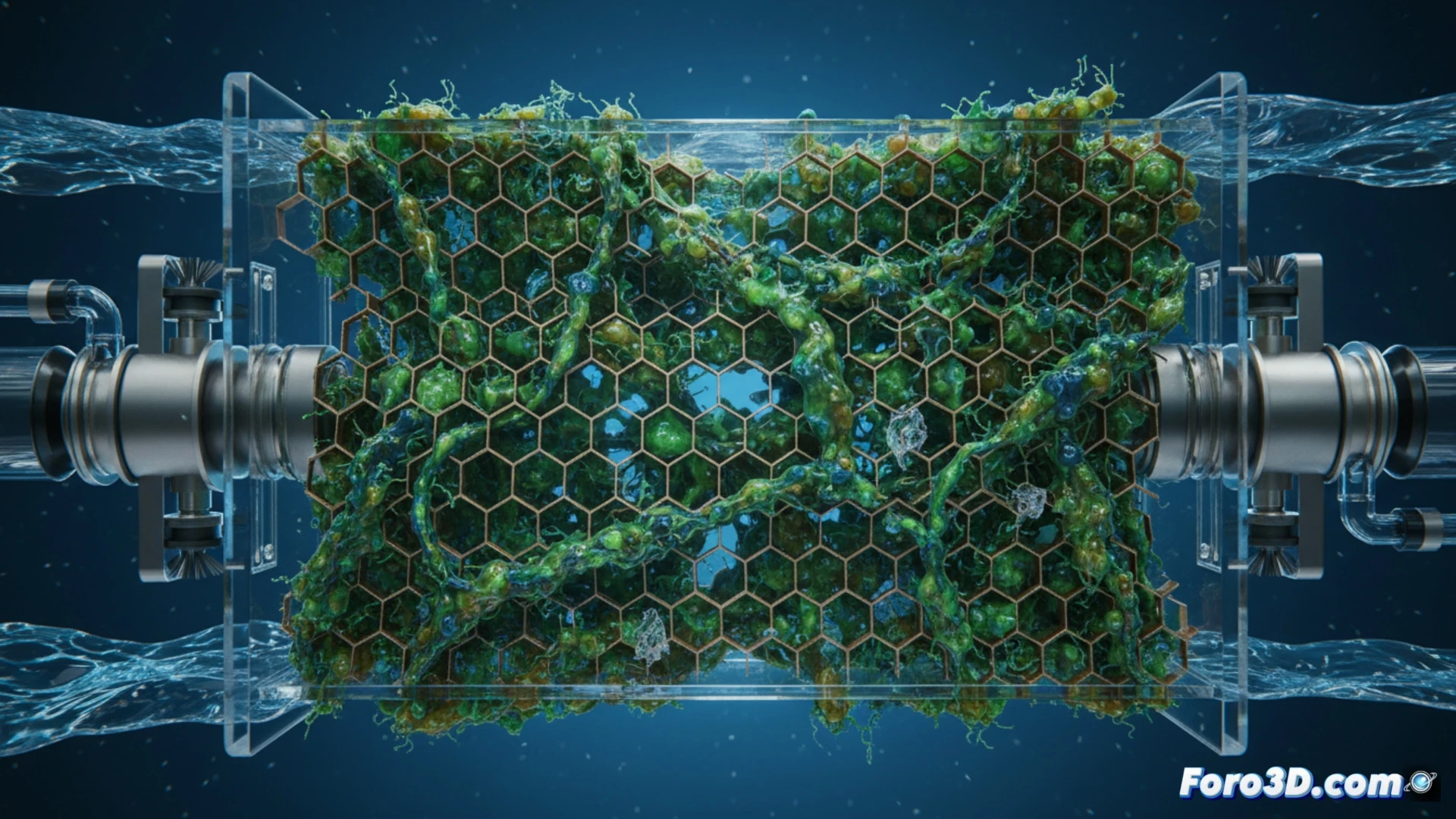
Micrometric reconstruction and CFD simulation of the adhesion mechanism 🔬
The first step in understanding the failure was capturing the sieve morphology using a Keyence VK Analyzer 3D microscope. This equipment allowed for the generation of high-resolution point clouds of the graphene fibers, revealing organic micro-deposits impossible to see with conventional optics. Subsequently, RealityCapture was used to reconstruct the exact geometry of the clogged filter from multiple shots. With this clean 3D mesh, simulations were run in Ansys Fluent to model water flow and shear stress. The results showed that phytoplankton colonies generate low-velocity and recirculation zones, creating a microhabitat that protects cells from hydrodynamic drag, explaining why the water jet cleaning system proved ineffective.
Towards an anti-fouling design guided by 3D data 🧠
The combination of 3D microscopy, photogrammetry, and computational fluid dynamics not only diagnosed the problem but also offers a path to a solution. By knowing the exact geometry of the obstruction and the flow conditions that favor it, engineers can redesign the surface texture of the graphene sieve or modify the frequency of the self-cleaning system. This case demonstrates that scientific visualization is the key tool for translating a biological phenomenon at the micrometric scale into a viable engineering solution for marine robotics.
How can the colonization dynamics of phytoplankton on drone filters be modeled in 3D to predict critical clogging points and optimize the design of the self-cleaning system?
(PS: if your manta ray animation doesn't excite, you can always add documentary music from channel 2)