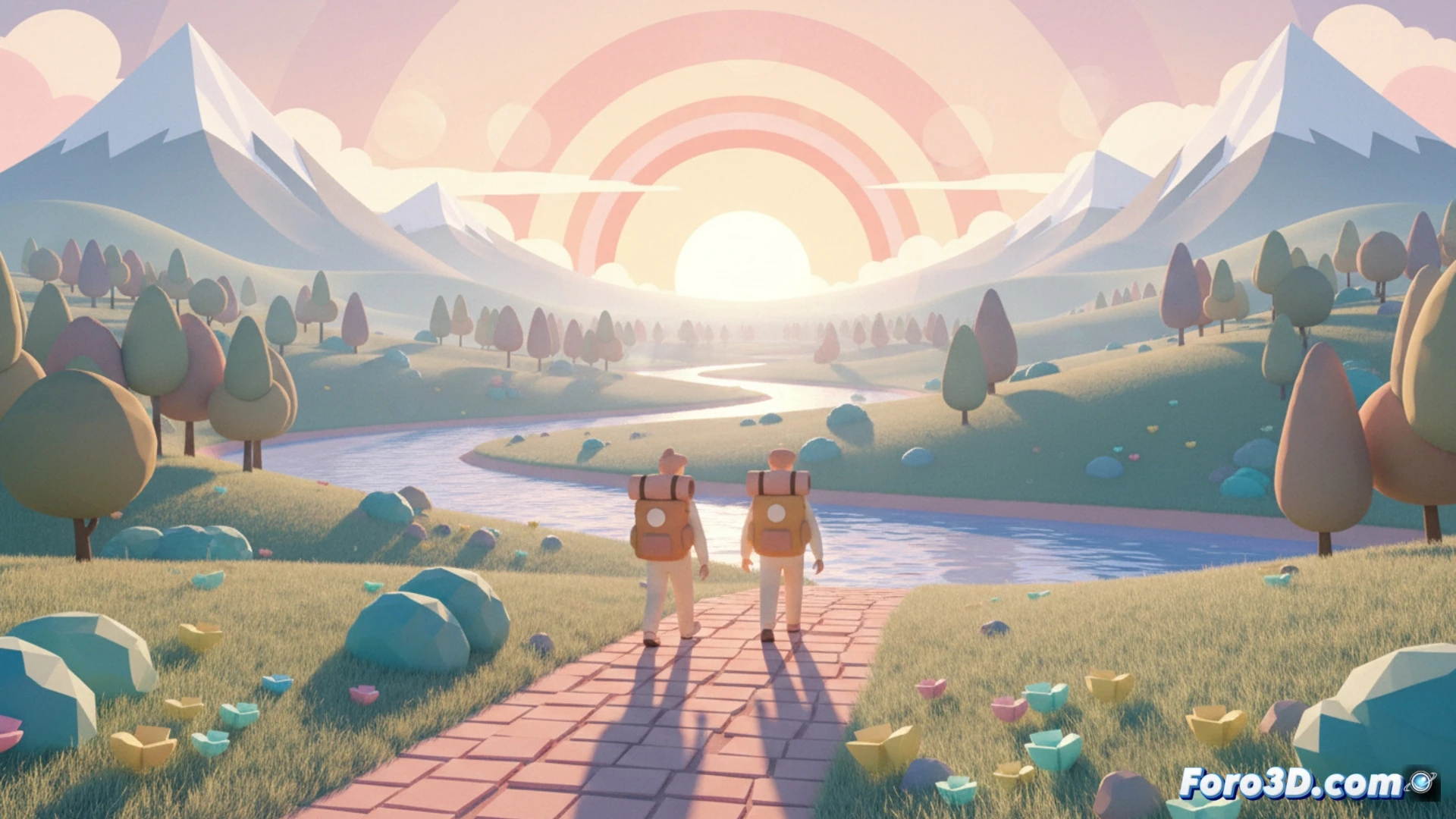
The team at House House, creators of the phenomenon Untitled Goose Game, returns with Big Walk, a cooperative title that bets on a stylized and simplified 3D style. Developed in Unity, the game prioritizes visual legibility and vast natural landscapes through a clean art direction and pastel colors. This article analyzes the optimization techniques and production pipeline that make achieving this aesthetic in real-time possible.
Production Pipeline: Unity, Blender, and Photoshop 🛠️
To achieve such a polished look, the pipeline relies on three key tools. In Blender, models are built with low-poly geometry and primitive shapes, avoiding superfluous details that compromise visual clarity. From there, assets are exported to Unity, where the baked global illumination system (lightmaps) eliminates the need for costly dynamic shadows, preserving the characteristic flat color. Photoshop is used to create noise-free albedo textures, with palettes limited to pastel tones and smooth transitions. This workflow reduces draw calls and allows open landscapes to function without sacrificing performance on modest hardware.
Lessons for Indie Developers 💡
Big Walk demonstrates that technical limitation is not an obstacle, but a creative opportunity. By prioritizing legibility over realism, the studio ensures the player instantly interprets distances and environmental elements. For any indie developer, the lesson is clear: coherent art and early optimization in Unity, combined with efficient modeling in Blender, can produce visually striking worlds without the need for AAA engines. The key lies in color discipline and geometric simplification.
How does Big Walk maintain visual legibility in a pastel environment without sacrificing the clarity of interactive elements for player cooperation?
(PS: 90% of development time is polishing, the other 90% is fixing bugs)