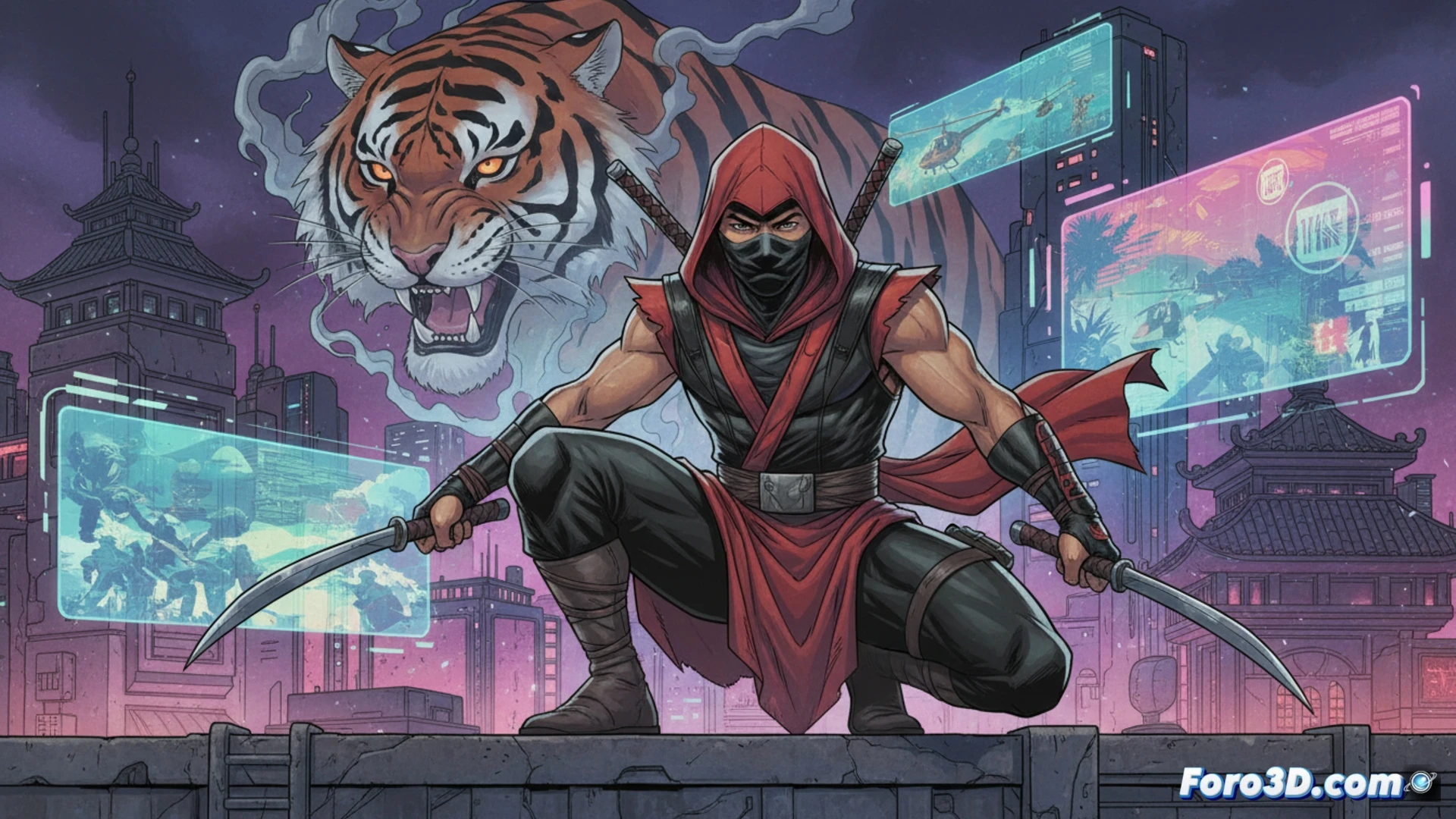
The character Bengal, alter ego of Duc No Tranh, created by Fabian Nicieza and Ron Lim for Marvel, is not a simple fictional ninja. His background as a victim of the Vietnam War makes him a narrative vehicle to explore pain, loss, and the search for justice outside official channels. Through his traditional weapons and stealth, Bengal represents a cultural resistance that transcends mere entertainment.
3D Modeling and Visual Narrative of War Trauma 🎨
From a technical perspective, Bengal's design offers a fascinating challenge for 3D modeling. His attire, which blends elements of traditional Vietnamese clothing with a modern tactical harness, requires careful study of proportions and textures to convey his duality: the ancestral warrior and the tormented soldier. Digital sculpting tools allow recreating the folds of his clothes and the shine of his bladed weapons, while ambient lighting can accentuate the shadows on his face, reflecting his internal trauma. This process seeks not only realism but the transmission of a contained emotion, key to the visual activism implicit in his story.
Stealth as a Metaphor for Historical Memory 🕵️
Bengal does not seek revenge, but justice. His stealth is not cowardice, but a survival strategy that evokes the struggle of those displaced by war. By reinterpreting this character in digital environments, such as animations or video games, the artist can emphasize how trauma is internalized and becomes a driving force. Digital activism here lies in giving voice to a hero who does not forget his roots, using technology to remind the world that the scars of Vietnam remain open in popular culture.
How would you translate this work into a virtual reality environment?