The medieval survival genre has found in Unreal Engine 5 a perfect ally to elevate realism. Bellwright is a clear example of how Lumen technology for dynamic lighting and the interactive foliage system transform a forest into another character in the game. We analyze the technical decisions and workflow behind this promising title. 🎮
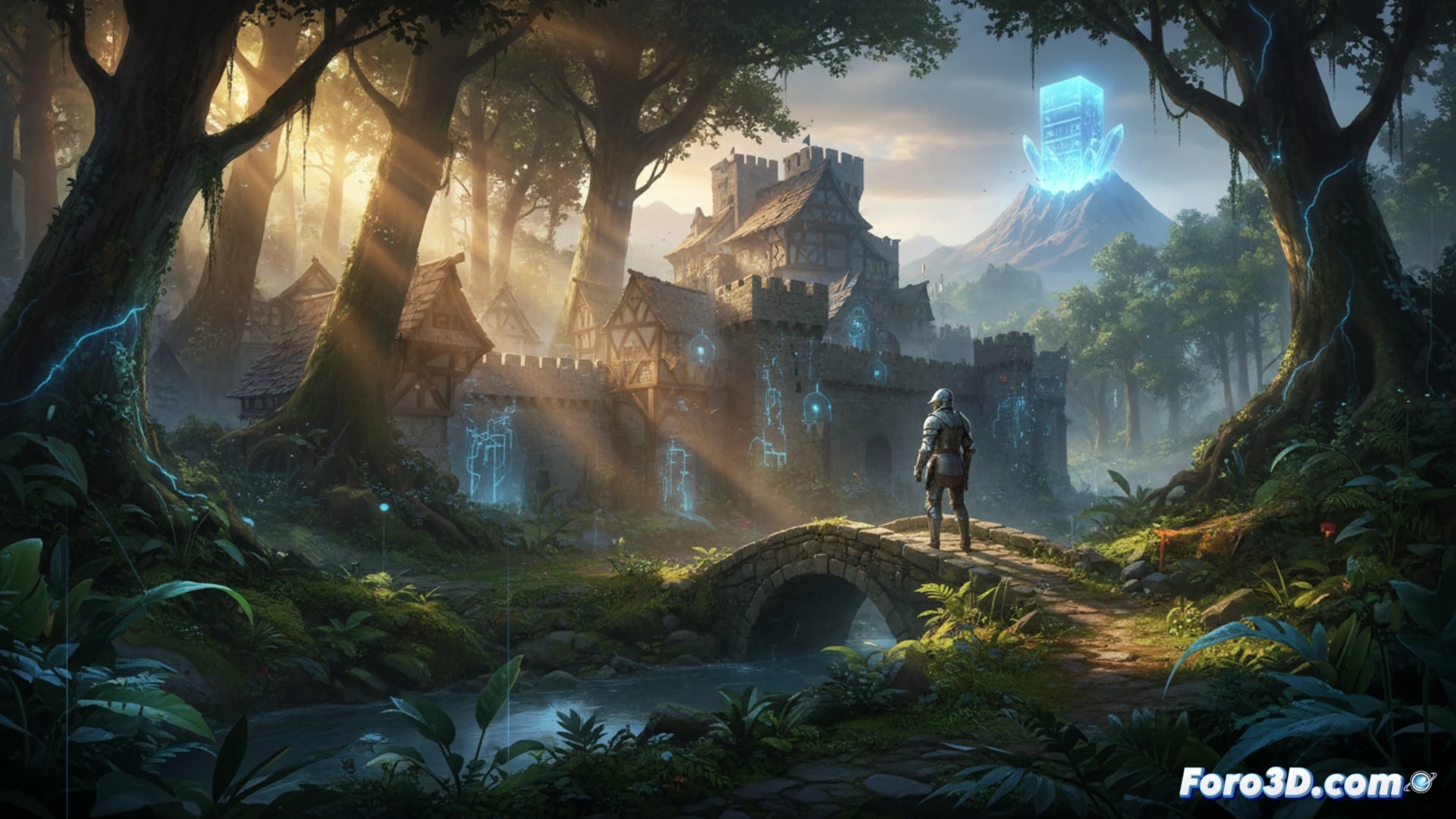
Workflow: From ZBrush to UE5 with Substance 3D 🔧
Asset creation in Bellwright follows a classic pipeline but optimized for UE5's high fidelity. Organic models, such as armor and tools, are initially sculpted in ZBrush, where high-frequency details are captured. Subsequently, they are retopologized to ensure optimal real-time performance. Texturing is done in Substance 3D Painter, leveraging its smart materials to simulate wear, rust, and aged wood. The final step is integration into Unreal Engine 5, where Lumen and Nanite systems are applied. Nanite allows importing high-density models without worrying about polygon count, while Lumen calculates global illumination in real-time, making canopy shadows react to the day-night cycle without the need for pre-baking.
Foliage as an engine of immersion and performance 🌿
One of the biggest challenges in Bellwright is managing the dynamic foliage that defines its forests. The team has used UE5's Procedural Foliage system to populate the map, but with a key trick: leaf geometry has been simplified using texture atlases and opacity masks. To avoid rendering overload, aggressive LODs and occlusion culling are employed, always prioritizing player visibility. The result is an environment that feels alive, where every bush and tree responds to the wind without sacrificing the fluidity necessary for an open-world game.
How does Bellwright optimize the performance of real-time modular building systems without sacrificing the visual fidelity offered by Unreal Engine 5?
(PS: 90% of development time is polishing, the other 90% is fixing bugs)