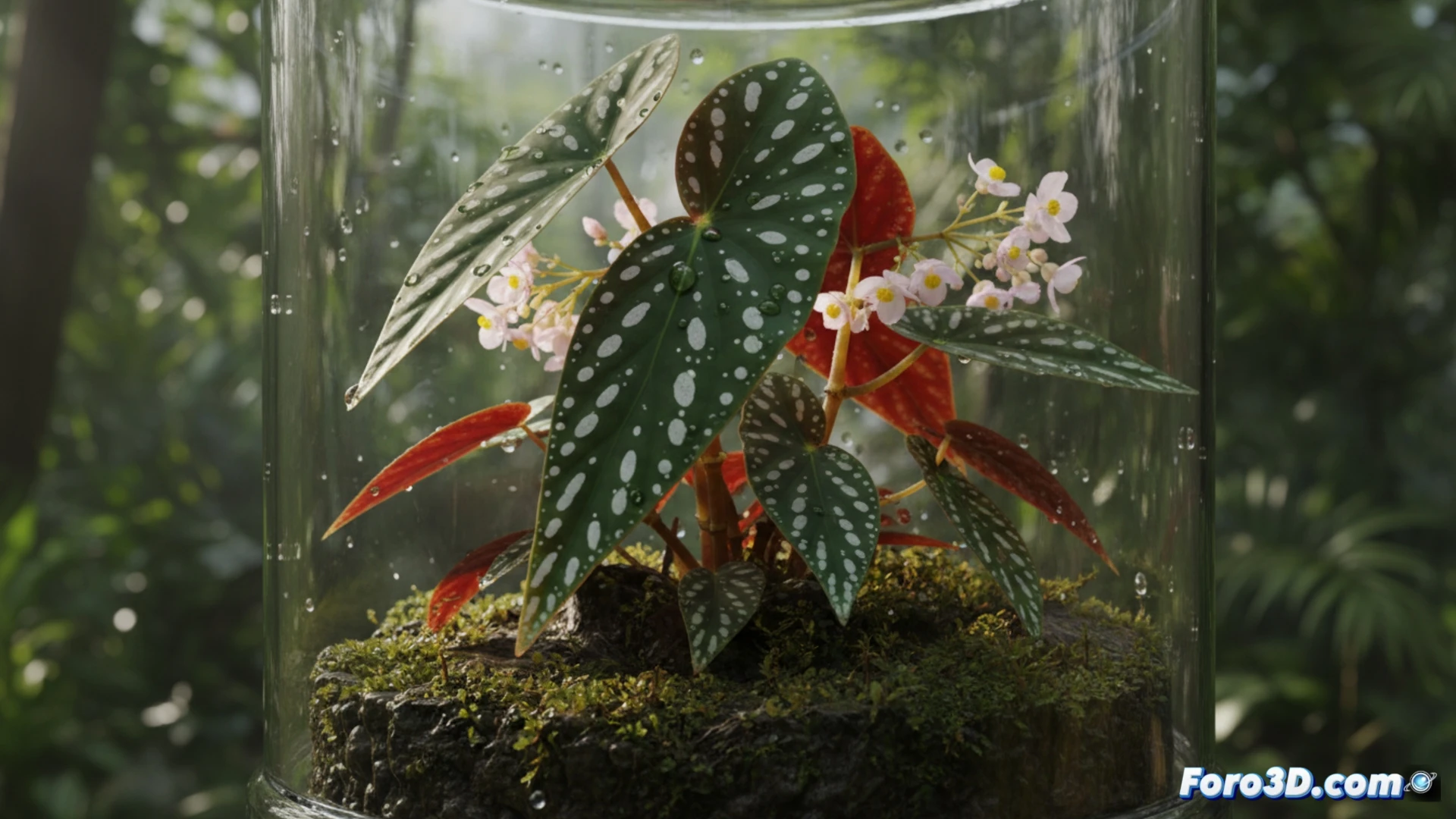
The Begonia albopunctata, discovered in Vietnam in 2023, features dark green foliage speckled with white spots arranged in an almost perfectly symmetrical pattern. This characteristic gives it an artificial appearance, as if hand-painted, making it a fascinating subject for scientific visualization. Its rarity and unique morphology demand a digital representation approach that captures both its beauty and taxonomic value.
Model construction and lighting parameters 🌿
For photorealistic modeling, it is recommended to start with a high-resolution photogrammetric scan of a preserved specimen, followed by reconstruction of the leaf geometry in software such as Blender or ZBrush. The texture should prioritize the contrast between the deep green of the leaf blade and the pure white of the spots, using displacement maps to simulate the slight velvety texture of the surface. Lighting should be soft and diffuse, with a single directional spotlight at a 45-degree angle to avoid specular reflections that hide the spots. A 360-degree orbital animation, with progressive zoom to 200% on the upper leaves, will allow the viewer to appreciate the bilateral symmetry of the pattern. A data overlay should be included with the discovery date (2023), collection coordinates in the Annamite region, and a graphic scale in millimeters.
The value of rarity in the digital age 🔬
The Begonia albopunctata is not only a botanical discovery but also a reminder that nature can imitate art. Its 3D representation allows virtual museums and educational apps to offer an immersive experience that a physical herbarium could never provide: the ability to rotate the leaf, illuminate it from within, and study the distribution of its spots without damaging the specimen. This model thus becomes a digital conservation tool, preserving the image of a plant that, due to its rarity, could be threatened in its natural habitat.
How can 3D modeling of Begonia albopunctata capture the natural variability in the arrangement of its white spots so that botanical outreach is scientifically accurate and visually appealing?
(PS: fluid physics for simulating the ocean is like the sea: unpredictable and you always run out of RAM)