When Frank Miller and David Mazzucchelli redefined the Dark Knight's origin in 1987, they didn't just reinvent a character; they established a visual style manual based on economy of resources. With a sober palette and drawing that prioritizes atmosphere over detail, Batman: Year One demonstrates that the strength of an image lies not in the complexity of the model, but in the power of its lighting and composition. For a 3D previsualization artist, this work is a masterclass in building tension and oppression with minimal elements.
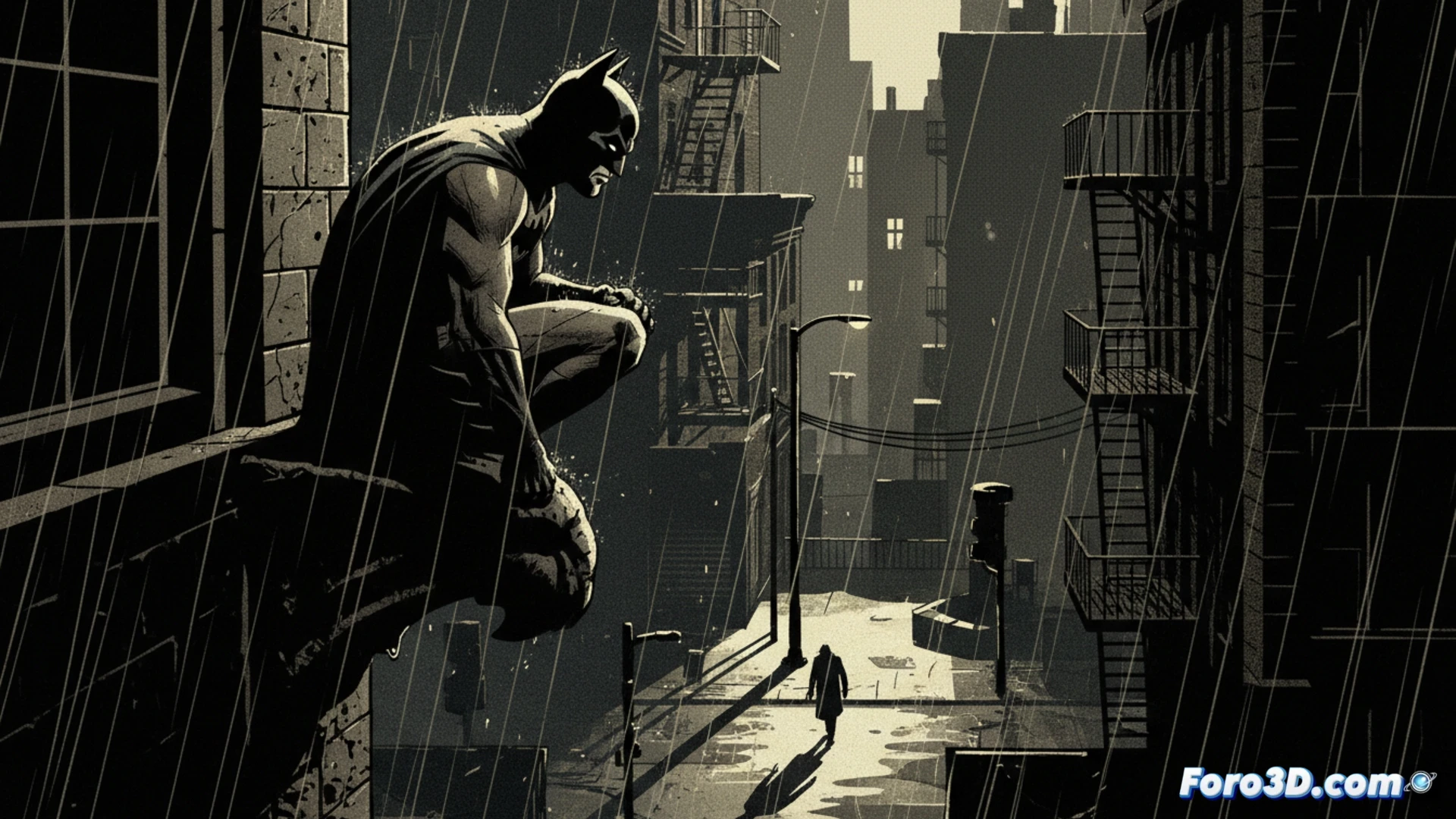
Blockout Noir: High Contrast Lighting in Unreal Engine 🦇
The aesthetic of Year One is based on extreme chiaroscuro. Mazzucchelli's panels use silhouettes against backgrounds of rain and hard shadows to conceal the protagonist, generating mystery. In Unreal Engine, we can replicate this using a main directional light with very low intensity (around 0.5) and a cool color temperature (6500K), combined with a warm fill point light (3000K) to simulate streetlamps. The trick lies in post-processing: raising contrast to maximum and reducing gamma to minimum, eliminating midtones. This forces the eye to read shapes as solid blocks, exactly like in the comic. The rain, implemented as a simple particle system without specular reflections, adds the layer of grime and hopelessness that defines Gotham.
The Narrative of the Panel and the Virtual Camera 🎥
Miller structures his pages like storyboards. High-angle shots from skyscraper heights and low-angle shots from the wet asphalt are no coincidence; they are a camera guide to create oppression. When translating this into a 3D previsualization, we must think in terms of panels. A sequence shot is less effective than a direct cut between a close-up of Gordon and a wide shot of Batman's silhouette. The key is to use the camera like a pencil: position it at awkward angles, right at ground level, so the viewer feels the weight of the city. Instead of seeking photographic realism, seek the emotional realism of the printed page.
How can you apply the use of extreme shadows and chiaroscuro from Batman Year One to build narrative tension in your 3D previsualizations without the need for dialogue?
(PS: Previs in film is like the storyboard, but with more possibilities for the director to change their mind.)