In the world of nutrition, few appliances generate as much debate as high-power blenders. Brands like Vitamix or Blendtec claim that their blades break down cell walls to release hidden vitamins, an idea that sounds revolutionary. However, from a biochemical perspective, this claim is misleading. The reality is that any sufficiently powerful blender crushes the fruit, but the true effect is not releasing nutrients, but rather destroying the insoluble fiber that regulates sugar absorption.
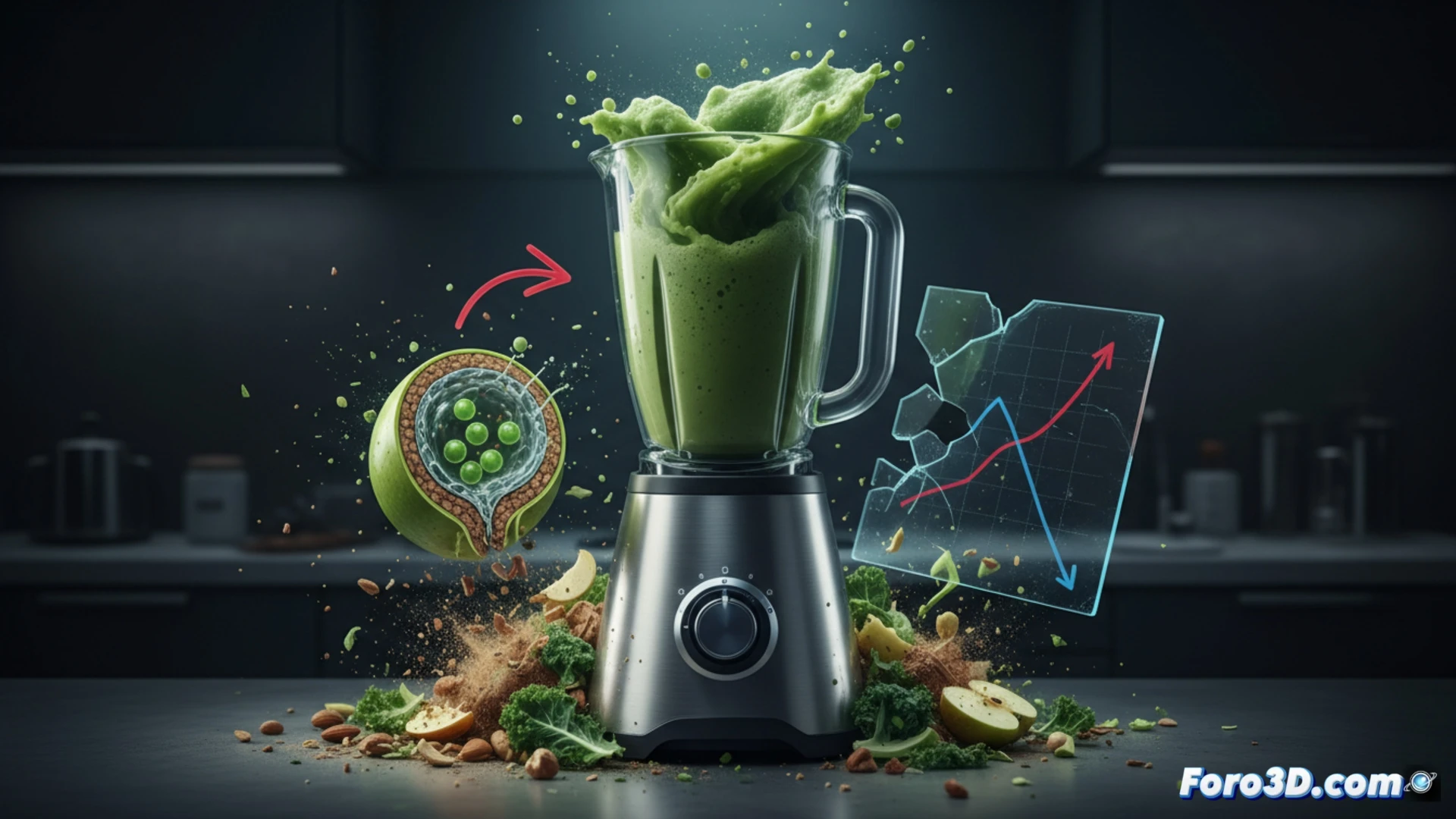
The hidden mechanism: fiber and glycemic response 🍎
When we model the process in 3D, we see the key difference. In a whole fruit, cell walls act as physical barriers that slow down digestion. When chewing, we partially break these walls, but the fiber remains intact in its three-dimensional structure. In a conventional blender, the blades cut the fiber into smaller fragments, but do not disintegrate it completely. In contrast, in a high-power blender, the blades spin at extreme speeds (over 30,000 RPM), generating shear forces that literally pulverize soluble and insoluble fiber. The result is a homogeneous drink where natural sugars are free and accessible, eliminating the slow-release effect provided by intact fiber. This causes a glycemic spike similar to that of industrial juice, not that of a piece of fruit.
Visualizing the impact on metabolic health 🥤
For an educational 3D infographic, I recommend modeling three scenarios: a whole apple with its cell walls represented as compact spheres surrounded by intertwined fibers; a conventional blender where those spheres appear partially broken; and a high-power blender where the spheres and fibers are reduced to a cloud of sugar particles and fine pulp. The animated graphic should show how free glucose passes directly into the bloodstream, raising insulin. The final visual advice: if you seek the full benefits of fruit, including the fiber that regulates sugar, consume it whole or in large chunks. If you use a blender, do so with leafy green vegetables and add seeds to compensate for the lost fiber.
Is it possible that a high-power blender, such as a Vitamix, by breaking down the cell walls of fruits and vegetables, releases more nutrients that the body can actually absorb, or is this a benefit exaggerated by marketing without solid scientific backing in the context of 3D food education?
(PS: modeling an apple in 3D is easy; the hard part is making it not look like a sphere with red texture)