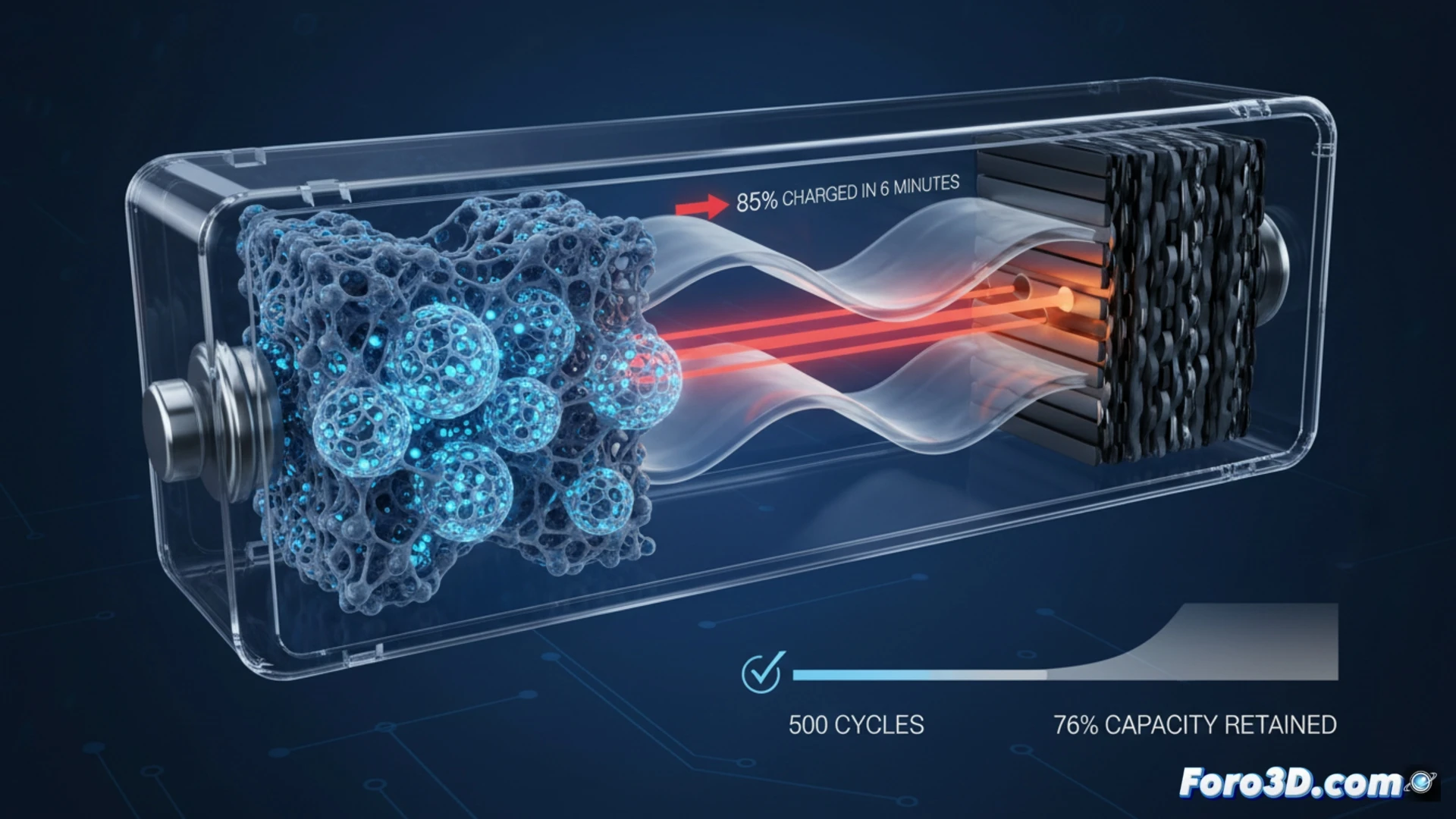
A new lithium-ion battery with a silicon anode promises to change the game for electric vehicles. It reaches 85% charge in just six minutes and retains 76% capacity after 500 cycles. The secret lies in the silicon anode, which stores more ions than traditional graphite, though with one problem: it swells like a balloon.
The trick of carbon nanoparticles against swelling 🧠
Silicon has a theoretical capacity ten times greater than graphite, but when absorbing lithium ions, it expands up to 300%, fracturing the anode. Researchers solved the problem by encapsulating silicon nanoparticles in a carbon layer. This flexible structure prevents the material from breaking during charging and discharging, maintaining the electrode's integrity. The result is a battery that not only charges quickly but also does not lose performance with repeated use.
Silicon is no longer the drama queen of batteries 😅
Finally, silicon has stopped throwing tantrums. Before, every time you tried to put ions into it, it swelled up like a hippo in a small bathtub and broke everything. Now, with its carbon jacket, it behaves like a gentleman: charges in a flash and doesn't complain even after 500 cycles. Electric cars could charge faster than your patience in a traffic jam.