The celestial mechanics we learned in school is a useful but inaccurate simplification. Planets do not orbit the center of the Sun, but rather an invisible point called the barycenter, which represents the center of mass of the entire system. Although the Sun concentrates 99.86% of the total mass, the gravitational influence of Jupiter, which holds 70% of the remaining planetary mass, shifts this point enough to make the orbital dance much more complex than we imagine.
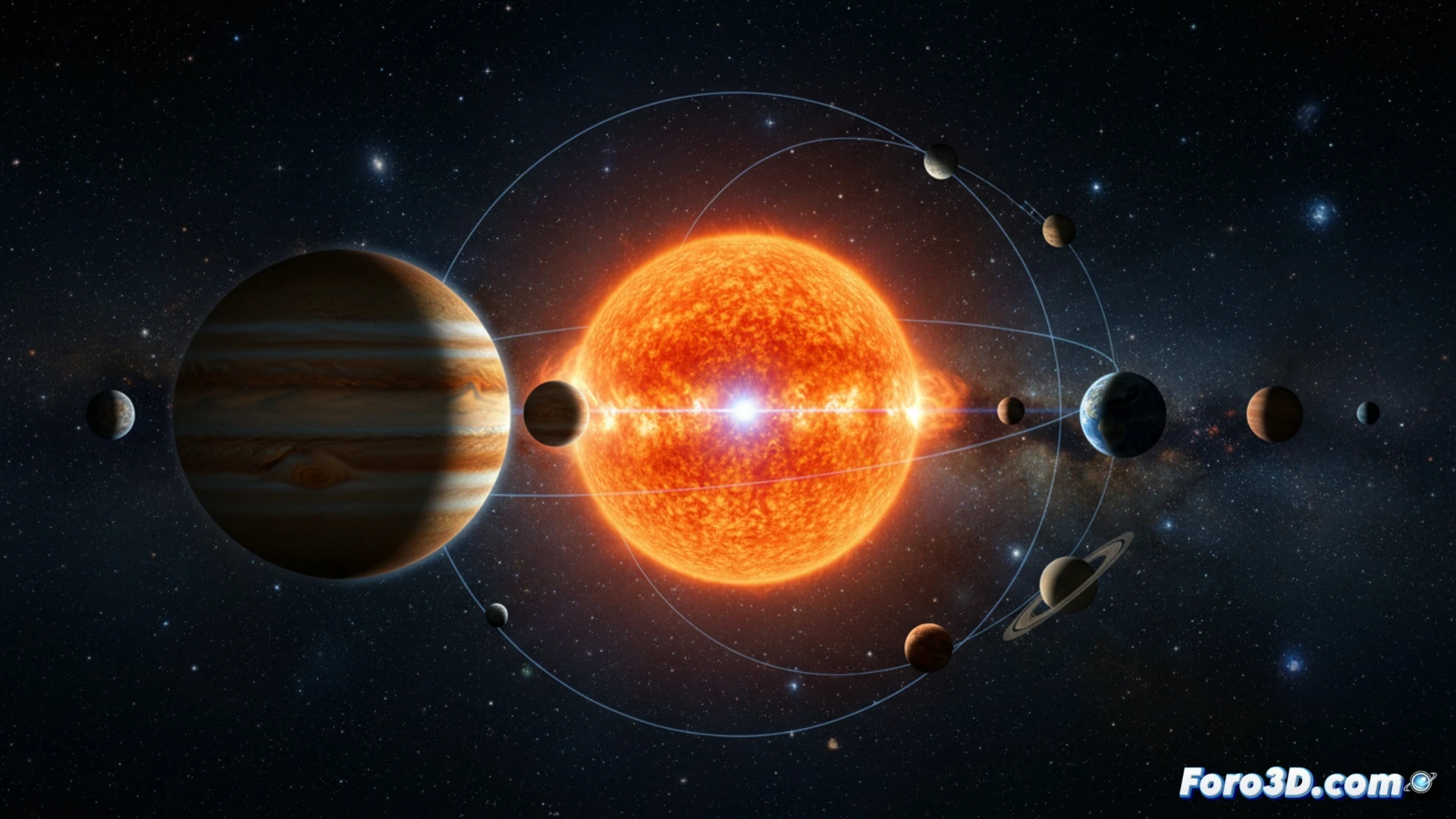
3D Modeling of Gravitational Displacement 🌌
To visualize this phenomenon, I propose developing an interactive 3D animation comparing two orbital models side by side. In the first panel, we will show the simplified model with Jupiter tracing a perfect ellipse around the static center of the Sun. In the second panel, we will represent the real model: the Sun will describe a small wobble around the barycenter, while Jupiter orbits that same empty point. The technical key will be scaling the Sun's diameter and Jupiter's orbit so that the barycenter's displacement, which in reality is located 1.07 solar radii from the surface, is visually striking. We can use a color gradient on Jupiter's trajectory to indicate gravitational acceleration and deceleration, and a pulsating red marker to point out the exact location of the barycenter.
Rethinking Our Place in the Cosmos 🌠
This representation not only corrects a conceptual error but also invites us to reflect on the relativity of motion. Not even the Sun is still; we all dance around a point that constantly changes with the position of each planet. By visualizing the barycenter, we understand that gravity is not an attraction towards a fixed center, but a constant negotiation between masses. For a 3D science communicator, capturing this dance is offering a window into the true dynamic and collaborative nature of the universe.
How would you model in 3D the dynamic movement of the solar system's barycenter to visualize the real trajectory of Jupiter and the Sun in a scientific rendering engine?
(PS: at Foro3D we know that even manta rays have better social bonds than our polygons)