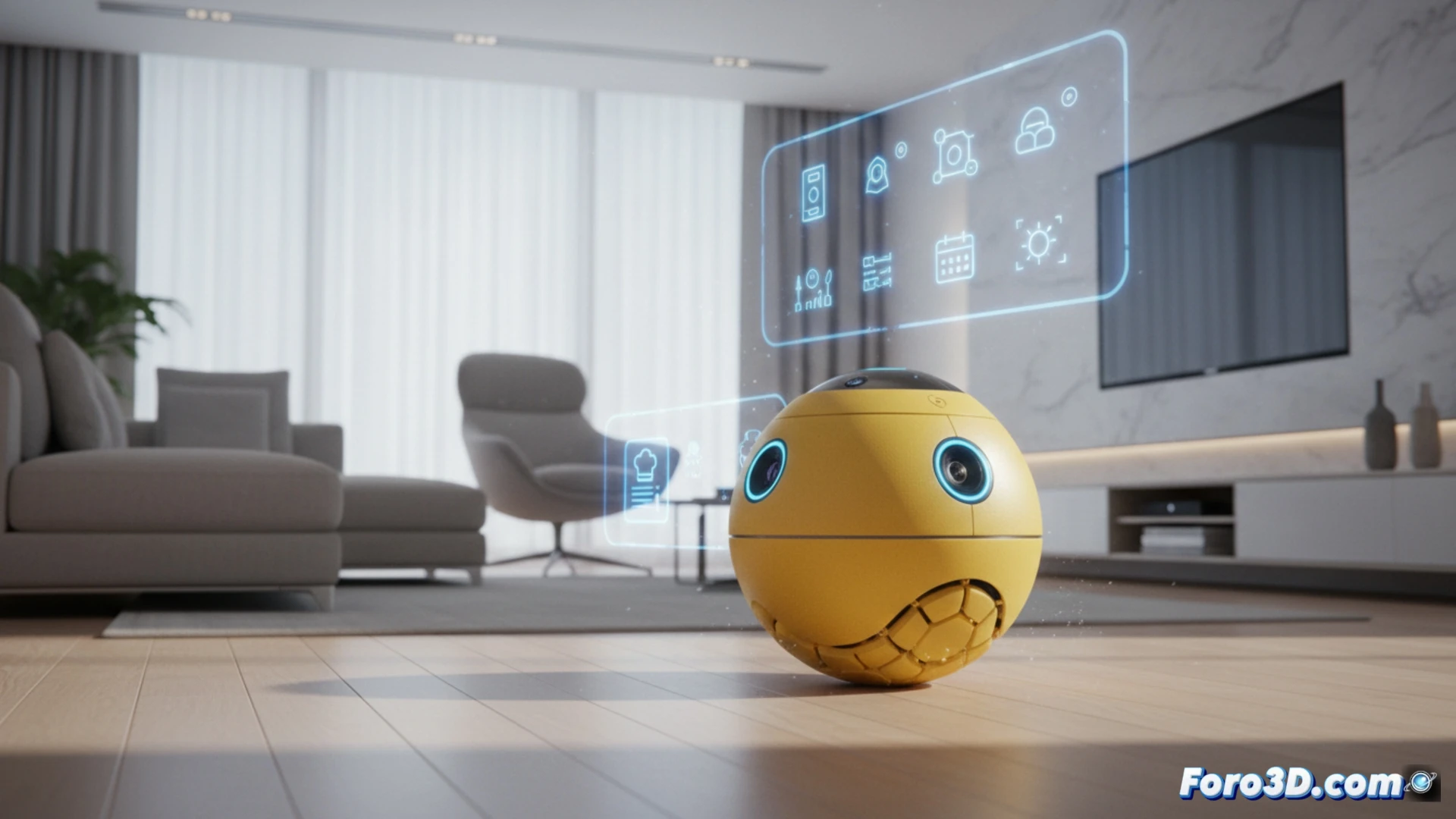
Samsung Electronics has introduced Ballie, a spherical home robot that integrates artificial intelligence to function as a personal assistant and mobile projector. Its spherical design allows it to move around the home while an adaptive projection system adjusts the image to any surface, from walls to floors. Equipped with LiDAR sensors and depth cameras, Ballie recognizes obstacles and users, offering natural interaction that combines robotics, computer vision, and home environment automation.
Technical Architecture: Autonomous Navigation and Adaptive Projection 🤖
The core of Ballie lies in its autonomous navigation system based on SLAM (Simultaneous Localization and Mapping). It uses a combination of inertial sensors, stereo cameras, and a solid-state LiDAR to build a real-time 3D map of the home. The AI algorithm processes this data to avoid obstacles and plan efficient routes. The adaptive projection function employs a DLP (Digital Light Processing) projector with automatic keystone correction. A depth sensor analyzes the geometry of the target surface and adjusts the focus and distortion of the projected image, allowing Ballie to display contextual information, video calls, or multimedia content without needing a fixed screen. Integration with Samsung's SmartThings ecosystem enables Ballie to control IoT devices, acting as a mobile home automation hub.
Implications for Home Robotics and 3D Vision 🧠
Ballie represents a significant advance in the convergence of mobile robotics and spatial augmented reality. Its ability to project interactive interfaces onto irregular surfaces solves a classic limitation of fixed assistants: the lack of contextual mobility. From an automation perspective, Ballie demonstrates how the fusion of low-cost 3D sensors with lightweight AI models allows a home robot to navigate and operate safely in unstructured environments. This design opens the door to future systems where the robot not only executes tasks but also becomes a node for adaptive visualization and control within the smart home.
As a developer, what technical challenges do you consider most critical for integrating an adaptive projector into an autonomous spherical robot like Samsung's Ballie, and how would this affect the accuracy of surface tracking and real-time distortion correction?
(PS: Simulating robots is fun, until they decide not to follow your orders.)