The Babel Engine, Ubisoft Ivory Tower's proprietary engine, demonstrates its maturity in The Crew Motorfest by offering a photorealistic representation of the island of O'ahu. This technical analysis breaks down how the engine manages three key visual pillars: a dynamic atmospheric lighting system, real-time reflections on car bodies, and a massive draw distance that allows observing the transition between tropical biomes without abrupt cuts. The graphics pipeline, supported by tools such as 3ds Max and Substance Painter, optimizes each polygon to maintain stable performance in an open world.
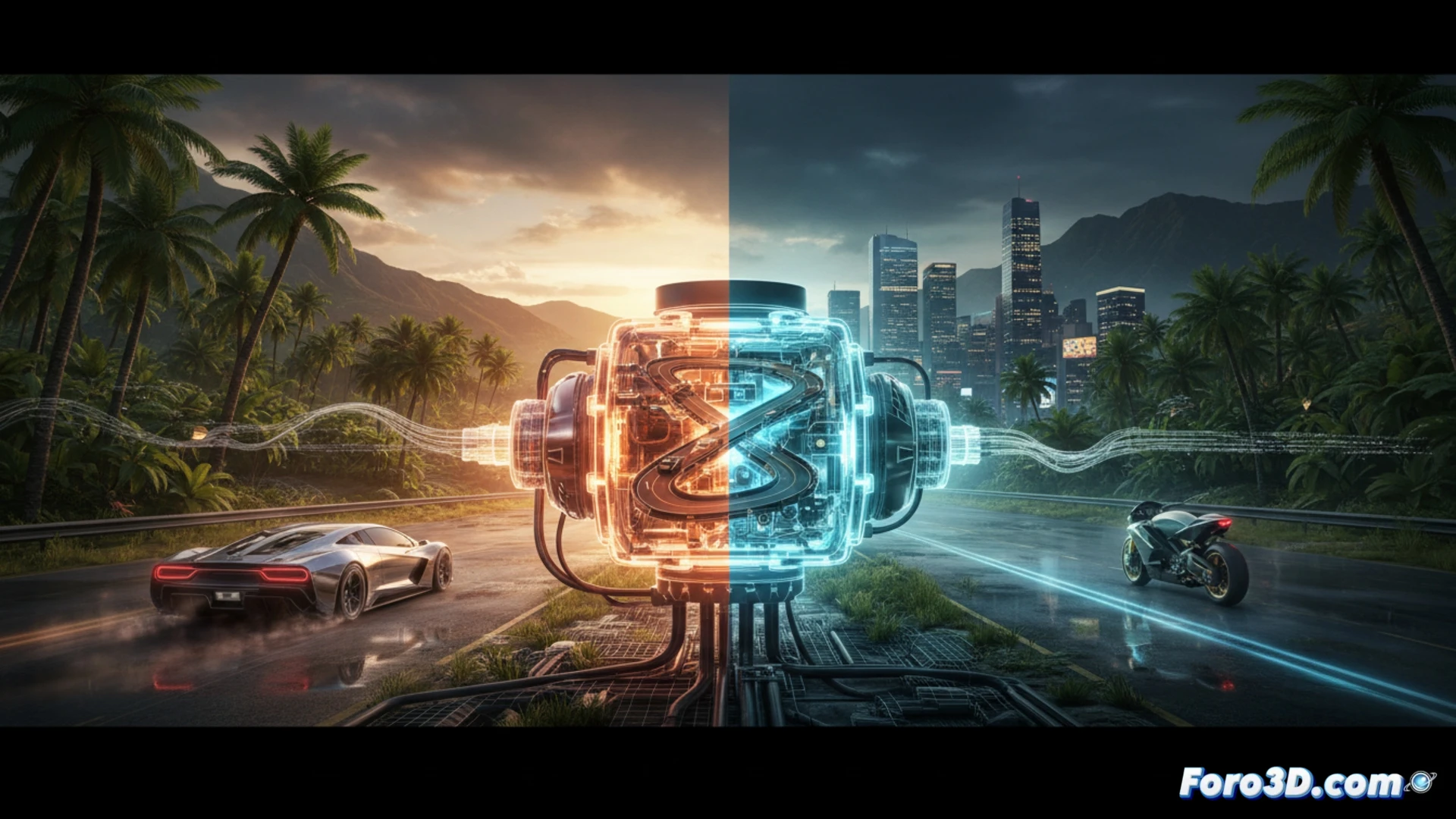
Rendering pipeline: lighting and LOD in draw distance 🎨
The Babel Engine implements an atmospheric lighting system based on volumetric scattering that simulates light dispersion in O'ahu's tropical humidity. For real-time reflections, the engine uses a combination of screen-space reflections (SSR) with low-resolution cubemaps as a fallback, prioritizing metallic shine on vehicles without penalizing the GPU. The large draw distance is achieved through a hierarchical LOD (Level of Detail) system that loads 8K textures for the foreground and progressively reduces geometry down to 512x512 on the horizon. The transition between biomes (jungle, coast, and city) is managed with a procedural blending shader that mixes height and normal maps in real-time, avoiding visible dividing lines. Tools like Photoshop are used to create the albedo maps, while Substance Painter generates the roughness and metalness maps that feed the engine's PBR.
The art of technical transparency in an open world 🚗
Beyond the numbers, the merit of the Babel Engine lies in its ability to hide technical complexity from the player. Atmospheric lighting is not just a visual effect; it is a system that adjusts color temperature according to the time of day and the humidity of each biome. Real-time reflections, although costly, are limited to the player's vehicle and nearby objects, using approximations for the rest. The transition between biomes, far from being a simple fade, involves a gradual change in foliage density and ground reflectance. It is an example of how intelligent optimization can create an immersive experience without sacrificing performance on mid-range hardware.
How does Ubisoft Ivory Tower's Babel Engine manage the dynamic transition between the different biomes of The Crew Motorfest without sacrificing lighting coherence and real-time performance?
(PS: game jams are like weddings: everyone is happy, no one sleeps, and you end up crying)