The food industry has found a legal loophole to label children's products as no added sugars while incorporating fruit concentrates, juices, and purées that act metabolically the same as free sugar. This practice, far from being harmless, programs children's palates toward a preference for excessively sweet flavors, laying the groundwork for future metabolic problems and childhood obesity. As technical writers in nutrition, we must dismantle these marketing strategies with visual data.
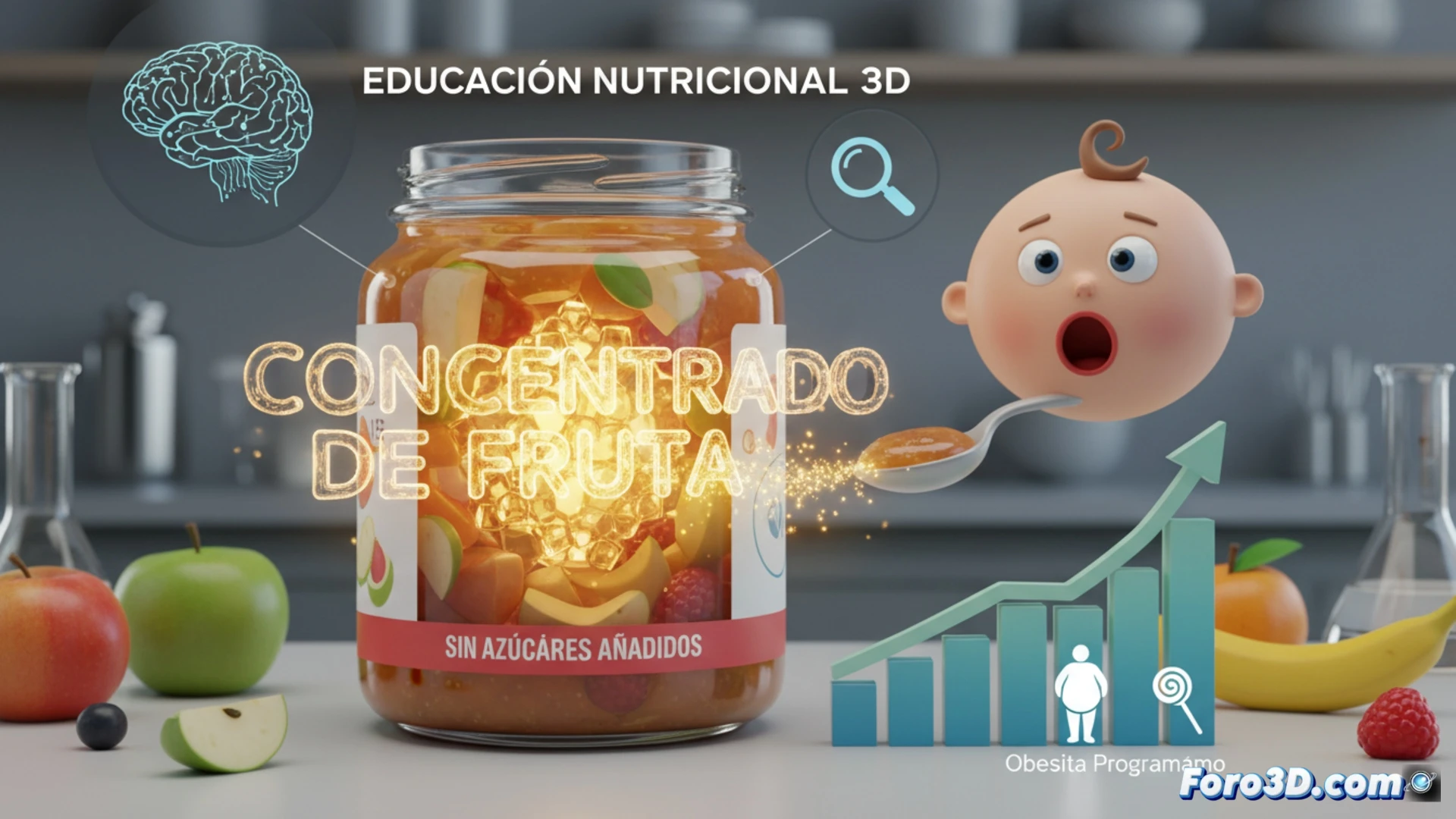
3D modeling of metabolism: concentrated fructose vs. sucrose 🧬
For our project at Foro3D, we propose an interactive infographic comparing two jars: one commercial jar labeled as no added sugars and another homemade jar made with whole fruit. We will model in 3D the molecules of free fructose (present in concentrates) and those of sucrose (table sugar), showing how both are processed by the child's liver in an identical manner. The simulation should include an animation of the T1R2-T1R3 taste receptor, activating with equal intensity in response to both substances, demonstrating that the brain does not distinguish between concentrated natural sugar and refined sugar. The modeling of the intestinal mucosa and the hepatic metabolic pathway (glycolysis and lipogenesis) will highlight the conversion to visceral fat.
The child's palate as a victim of food design 👶
The problem is not the fruit, but its concentration. By removing water and fiber, concentrated juices raise caloric density and sweetness to levels not found in nature. Our visual label comparator should include a 3D slider that, when moved, reveals that a baby food jar labeled no added sugars can contain up to 12 grams of free sugars per serving, equivalent to three packets of table sugar. The palate animation will show how this sweet bombardment progressively reduces taste sensitivity, forcing a search for increasingly intense flavors. With this tool, educators and parents can visualize the deception and make informed decisions, always prioritizing whole fruit mashed at home.
As a 3D printing expert, what techniques or materials do you recommend for manufacturing a homemade visual density meter that allows parents to compare the actual sugar concentration between a homemade baby food jar and an industrial one labeled no added sugars?
(PS: calories in 3D are like polygons: you never know how many you've consumed until it's too late)