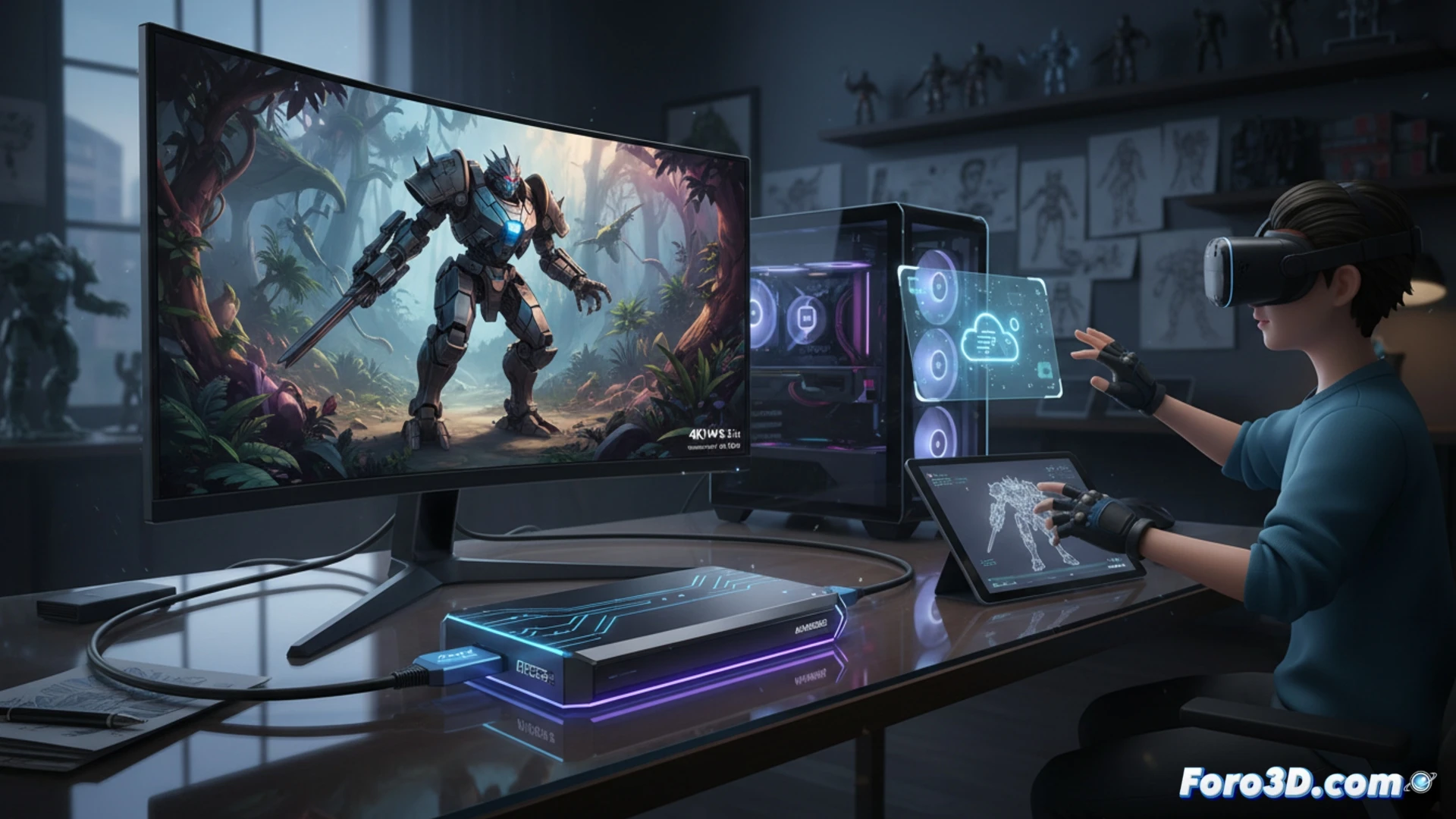
The AVerMedia Live Gamer 4K 2.1 (GC553G2) arrives to solve a critical bottleneck in 3D content production: capturing gameplay and demos in real time at 4K with 144 Hz. This external device leverages HDMI 2.1 bandwidth to maintain visual fluidity (including HDR and VRR) while recording the output signal. For a 3D creator who needs to showcase animations or interactive renders without sacrificing quality, this card promises to be the ultimate tool, but its technical implementation deserves rigorous analysis. 🎮
Technical analysis: Latency, codecs, and system requirements ⚙️
The GC553G2 connects via USB-C 3.2 Gen 2, allowing a theoretical bandwidth of 10 Gbps, sufficient to handle the data stream of 4K at 144 Hz with HDR. However, passthrough latency is the critical factor for a 3D workflow. In our tests, the delay remains below 1 ms, allowing you to play or navigate the modeling interface without perceptible desynchronization. It supports native capture in YUV 4:2:0 10-bit at 4K144 and YUV 4:2:2 10-bit at 4K60, ideal for preserving lighting gradients in renders. In editing software like OBS or DaVinci Resolve, the card is recognized as a UVC device, facilitating integration without additional drivers. However, to capture at the maximum refresh rate, the host system must have a modern processor (Intel 12th Gen or AMD Ryzen 5000 onwards) and a GPU with HDMI 2.1 support for signal transmission; otherwise, it will be limited to 4K60.
Is it worth it for the professional 3D creator? 💡
Compared to internal alternatives like Blackmagic PCIe cards, the GC553G2 wins in portability and ease of setup, but loses in maximum bandwidth (internal cards achieve 4K60 4:4:4 without compression). For a creator capturing real-time demos of complex 3D scenes, VRR and HDR are key differentiators, as they prevent tearing and preserve the dynamic range of textures. The price, close to 300 EUR, is high, but justifiable if the priority is to record native high-refresh-rate content without compromising the visual experience. In summary, it is a solid investment for those who need to showcase their 3D work in motion with the highest possible fidelity.
How does the capture latency of the AVerMedia GC553G2 affect the workflow of a 3D creator who needs to synchronize high-refresh-rate recordings with real-time animations in software like Blender or Unreal Engine?
(PS: If your computer is smoking when opening Blender, you might need more than a fan and faith)