The ASUS TUF Gaming A14 arrives on the market promising military durability and power in a compact format. With latest-generation AMD Ryzen processors, this 14-inch laptop presents itself as a tempting option for design students who need mobility without sacrificing performance. We analyze whether it can truly sustain workloads in Blender, Maya, and ZBrush, or if its limited size compromises cooling and graphical performance. 🎮
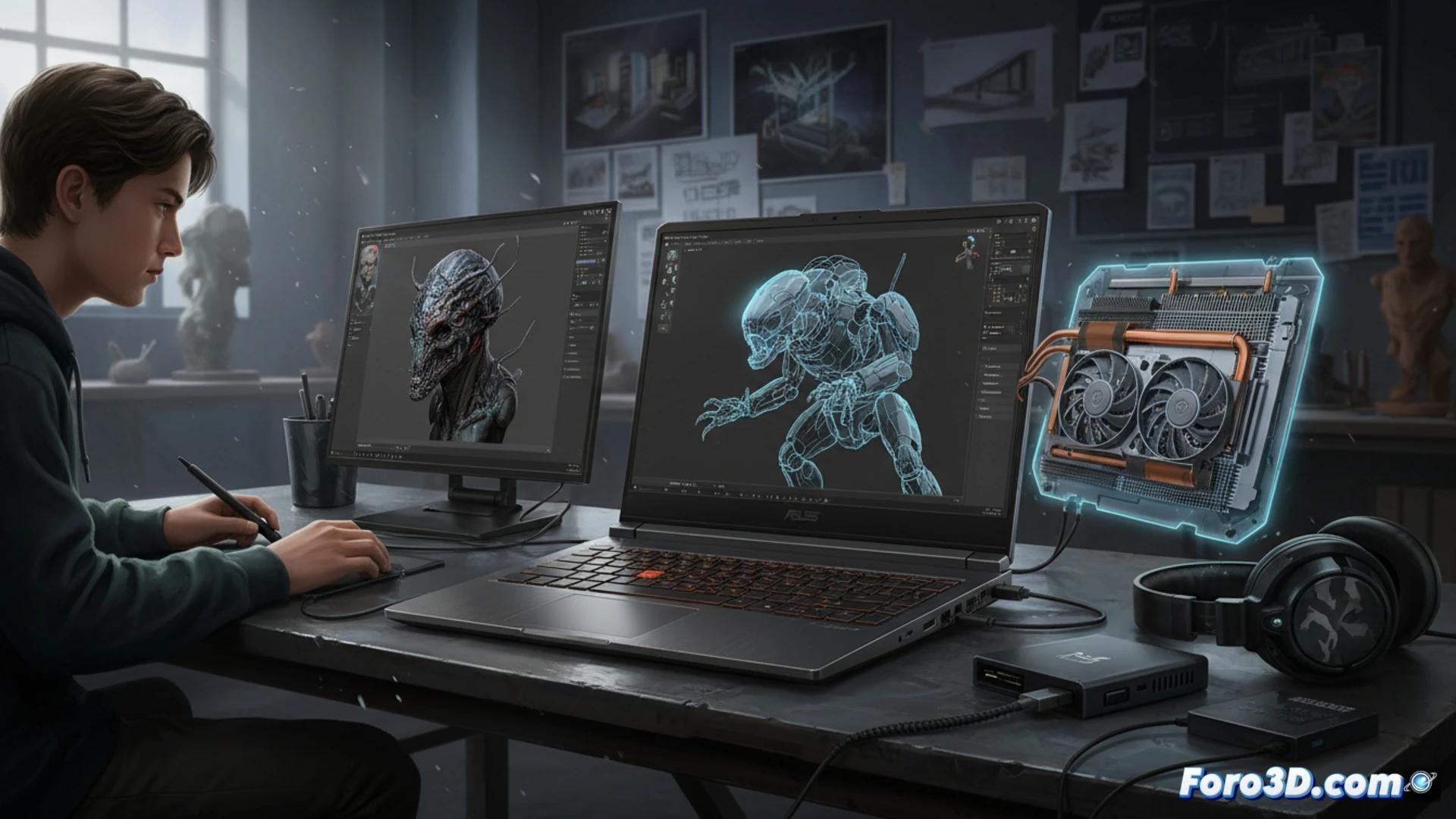
Technical specifications and rendering performance 🔥
For 3D workflows, the critical factor is the GPU. The TUF A14, being a gaming laptop, typically integrates dedicated NVIDIA GeForce RTX 40 series graphics, ideal for accelerating rendering tasks in Cycles (Blender) and Arnold (Maya). However, its 14-inch chassis imposes thermal limits. In synthetic benchmarks like Cinebench R23 and Blender Benchmark, AMD Ryzen 7 or 9 processors show excellent performance in polygonal modeling and simulations, but clock speed may throttle under sustained loads. For students working with high-density meshes in ZBrush, RAM (16 GB or 32 GB) will be key, although soldered memory in some models limits future upgrades. The cooling, with its dual-fan system, is decent for study sessions, but don't expect to maintain peak performance during prolonged 4K renders.
Durability and mobility: Is the size sacrifice worth it? 🎒
The MIL-STD-810H military certification is a strong point for students who carry the laptop daily between classrooms and studios. Its robust construction protects internal components, but the compact size reduces space for heat dissipation. This means that, while powerful for its class, a 15 or 16-inch laptop will offer better sustained rendering performance. For a design student who prioritizes portability and does light modeling work or quick renders, the TUF A14 is a solid choice. If your workflow demands hours of uninterrupted rendering, look for alternatives with greater thermal capacity.
Is it possible to perform complex 3D modeling on a 14-inch laptop like the ASUS TUF Gaming A14 without the compact size compromising cooling and sustained performance during long work sessions?
(PS: Your CPU heats up more than the debate between Blender and Maya)