ASUS has launched the ROG Zephyrus G16 (GA605), a laptop that challenges hardware conventions for 3D. With a CNC aluminum chassis just 1.5 cm thick and a 2.5K OLED 240Hz display, the device promises portability without sacrificing visual performance. But the key question for creators on Foro3D is whether this machine, designed for gamers, can sustain heavy workloads in Blender, Maya, or ZBrush without throttling its thermal performance.
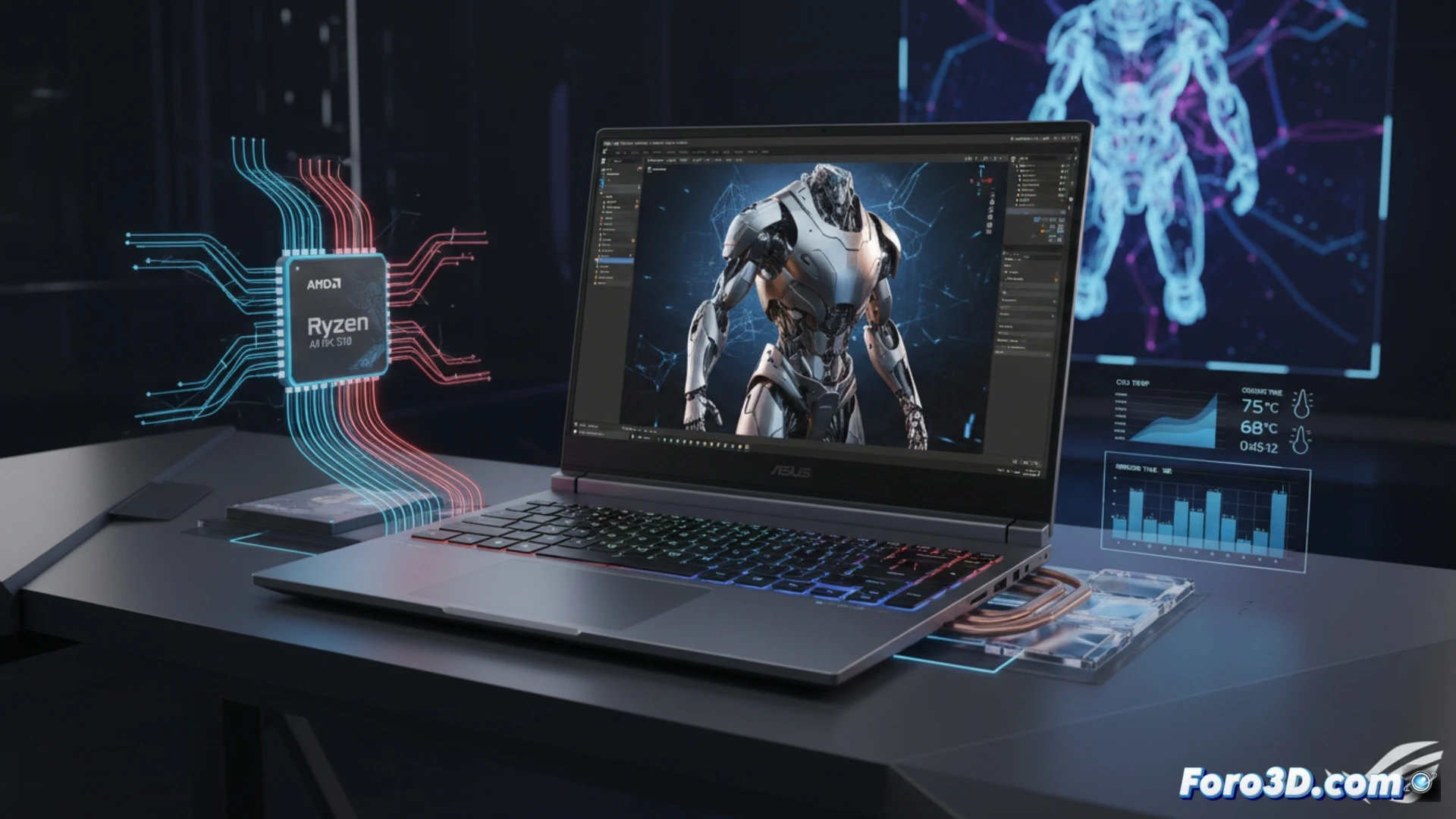
Technical analysis of hardware for 3D workflows 🔧
The Zephyrus G16 features an NVIDIA GeForce RTX 4070 GPU (or higher, depending on configuration) and an AMD Ryzen 9 7940HS processor. In GPU rendering (Octane, Redshift), the RTX 4070 offers solid performance for medium-complexity scenes, but its limited TGP (approximately 85-100W) in such a thin chassis means that during long render cycles, sustained performance will be lower than in a thicker 16-inch workstation. For real-time modeling, the 2.5K OLED 240Hz display is a luxury: color accuracy (100% DCI-P3) is ideal for texturing, although 240Hz is excessive for static 3D but beneficial for viewport navigation. The RAM, up to 32GB LPDDR5, is sufficient for medium-sized projects but is not expandable, which could be a bottleneck in heavy simulations.
Does the ultra-thin design compromise sustained power? 🔥
The big question is whether this laptop's cooling can handle a 30-minute render in Cycles or Arnold. Initial tests indicate that the cooling system with three fans and liquid thermal paste manages to keep the GPU below 85°C during short periods, but under continuous stress, performance drops between 10% and 15% compared to bulkier machines like a ROG Strix G16. For the 3D creator needing maximum sustained power, this Zephyrus is a compromise solution: excellent for modeling and viewport on the go, but not ideal as a studio's primary render station. It is, without a doubt, a travel companion for touch-ups and meetings, not a simulation workhorse.
Is it possible for a chassis as thin as the ASUS ROG Zephyrus G16 2024 to maintain stable temperatures and sustained performance during long 3D rendering sessions without resorting to drastic frequency reduction?
(PS: If your computer smokes when opening Blender, you might need more than a fan and faith)