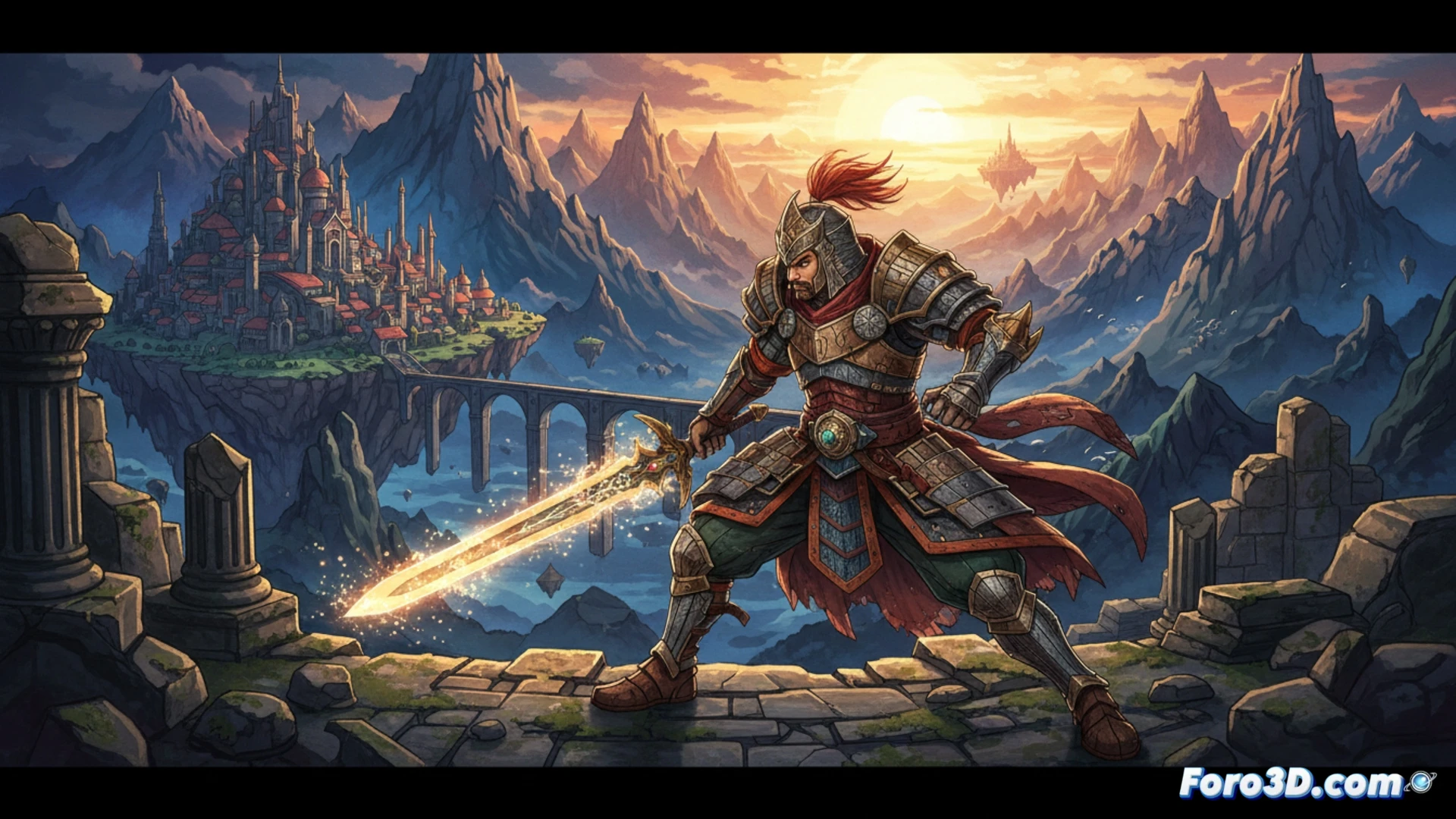
Astlibra Revision is a title that has surprised the indie scene with its faithfulness to classic JRPGs, but its true technical value lies in its custom engine. Developed on DX Library, a C++ framework for 2D graphics, the game proves that a commercial engine isn't necessary to achieve a powerful visual identity. Its paper doll aesthetic, where characters look like cutouts against backgrounds with depth of field, is the result of an architecture designed for total control of the graphics pipeline.
Graphics Pipeline: Sprites, Backgrounds, and the Illusion of Depth 🎨
The development team opted for a workflow that clearly separates 2D assets from environments. Character and enemy sprites are drawn in Photoshop with limited palettes and defined edges, mimicking the limited animation technique of 16-bit games. Backgrounds, on the other hand, are built with multiple parallax layers that the C++ engine renders in Z-order. Here lies the key to the paper doll style: by not using dynamic lighting or realistic shadows, depth is achieved by scaling and moving layers at different speeds. The custom engine allows adjusting these parameters without the overhead of a generic engine, achieving smooth transitions even on modest hardware.
Advantages of a Custom Engine Over Unity or Unreal ⚙️
Although Unity and Unreal offer ease of prototyping, Astlibra Revision demonstrates that a tailor-made engine can be more efficient for very specific styles. By writing everything in C++ on DX Library, developers avoid the bloat of unnecessary features and maintain absolute control over 2D rendering. This allows, for example, deep backgrounds to load in real-time without latency, something that in generalist engines would require additional optimizations. For an indie with a clear artistic vision, sacrificing the convenience of a visual editor for the freedom of a custom engine remains a viable bet and, as Astlibra shows, a very profitable one.
What technical and creative challenges did developing a custom engine for Astlibra Revision entail, and how did this influence the aesthetic and gameplay of its 2D sprites compared to using commercial engines like Unity or Unreal?
(PS: game jams are like weddings: everyone is happy, nobody sleeps, and you end up crying)