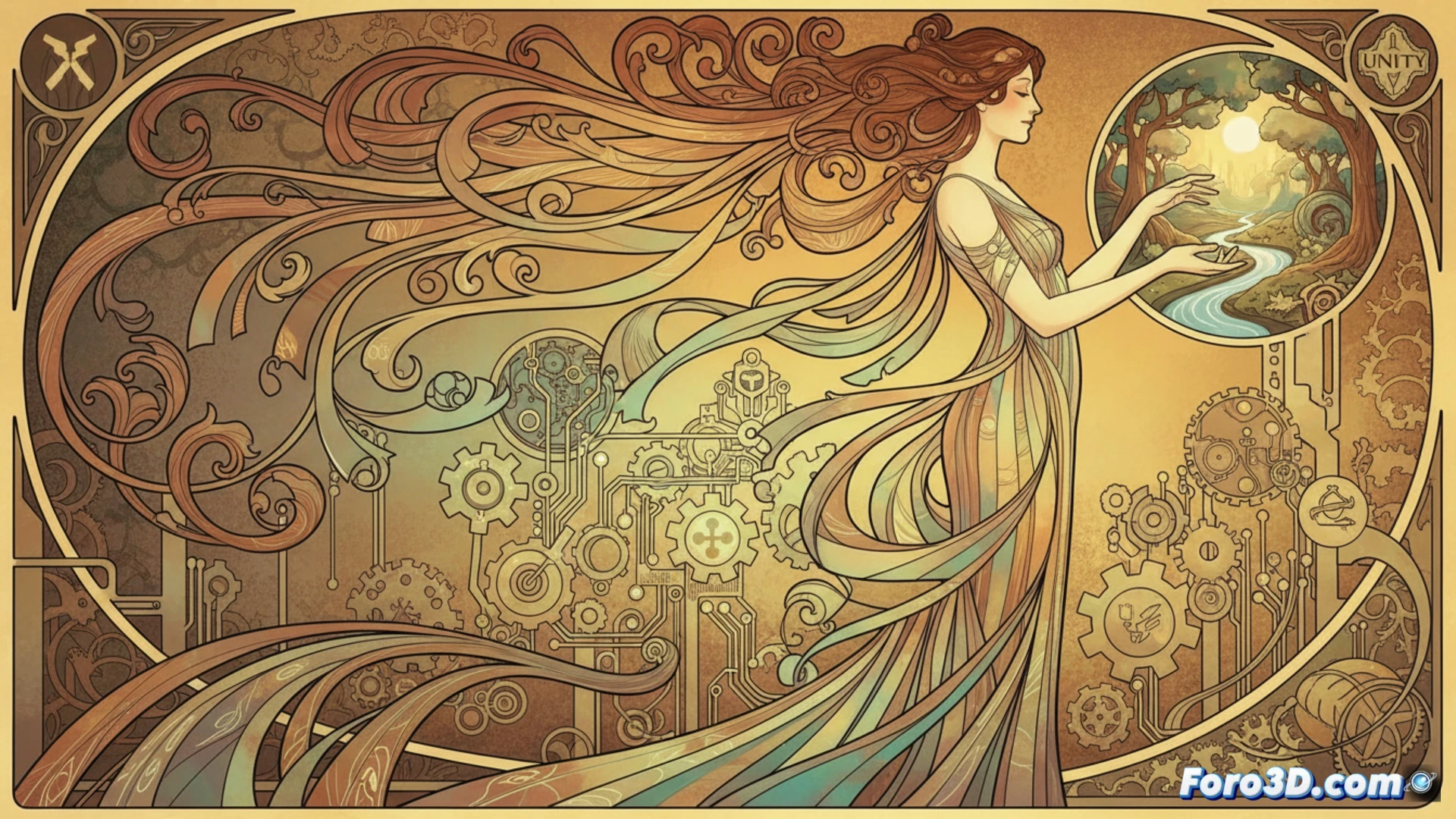
The independent studio has achieved a visual milestone by merging the ornamental style of Alphonse Mucha with a 3D engine. Songs of Silence uses Unity as its foundation, but its appearance does not rely on traditional physical lighting. The secret lies in a layer of non-photorealistic shaders that translate the curved lines and flat gradients of Art Nouveau into three-dimensional geometry, maintaining the illusion of an animated illustration without sacrificing real-time strategic gameplay.
Custom Shaders and the 2D/3D Bridge 🎨
The workflow begins in Clip Studio Paint, where characters and backgrounds are designed with brushes that mimic the texture of lithography. These 2D assets are exported to Photoshop for texture packing and the creation of mask maps that define flat shadow zones and ink edges. In Unity, the custom shader (Shader Graph) ignores realistic normal calculations and instead applies a lighting model based on the camera's angle relative to the character. The 3D map, although polygonal, is rendered with an outline shader that extracts silhouette edges and colors them with a solid black tone, imitating Mucha's characteristic stroke. Optimization is achieved by limiting the number of dynamic lights to a single direction and precomputing shadows in low-resolution textures.
Lessons for Indie Developers 🛠️
The case of Songs of Silence demonstrates that artistic coherence does not require a photorealistic engine, but rather rigorous control of the shader pipeline. For an independent developer, the key lesson is to invest time in creating masks in Photoshop that separate flat color zones from gradients, and then use those masks as parameters in Unity to control shading. Using Clip Studio Paint for initial sketches allows maintaining an organic stroke that the shader respects, avoiding the plastic-like appearance that 3D without detailed textures often has. The result is a game that looks like an animated painting, a technical feat only possible when concept art dictates the engine's rules, and not the other way around.
What shading and post-processing techniques were used in Songs of Silence to emulate the flat gradients and black outlines of Art Nouveau without resorting to pre-rendered textures?
(PS: shaders are like mayonnaise: if they break, you start all over again)