An artificial reef made from 3D-printed ecological concrete collapsed in less than a year. The collapse was not random. Analysis using 3D BlueView sonar and CFD simulation in Star-CCM+ revealed a clear cause: the porosity of the design generated vortices that eroded the base of the structure. This case illustrates how material fatigue under hydrodynamic stress can destroy even the most innovative ecological restoration solutions.
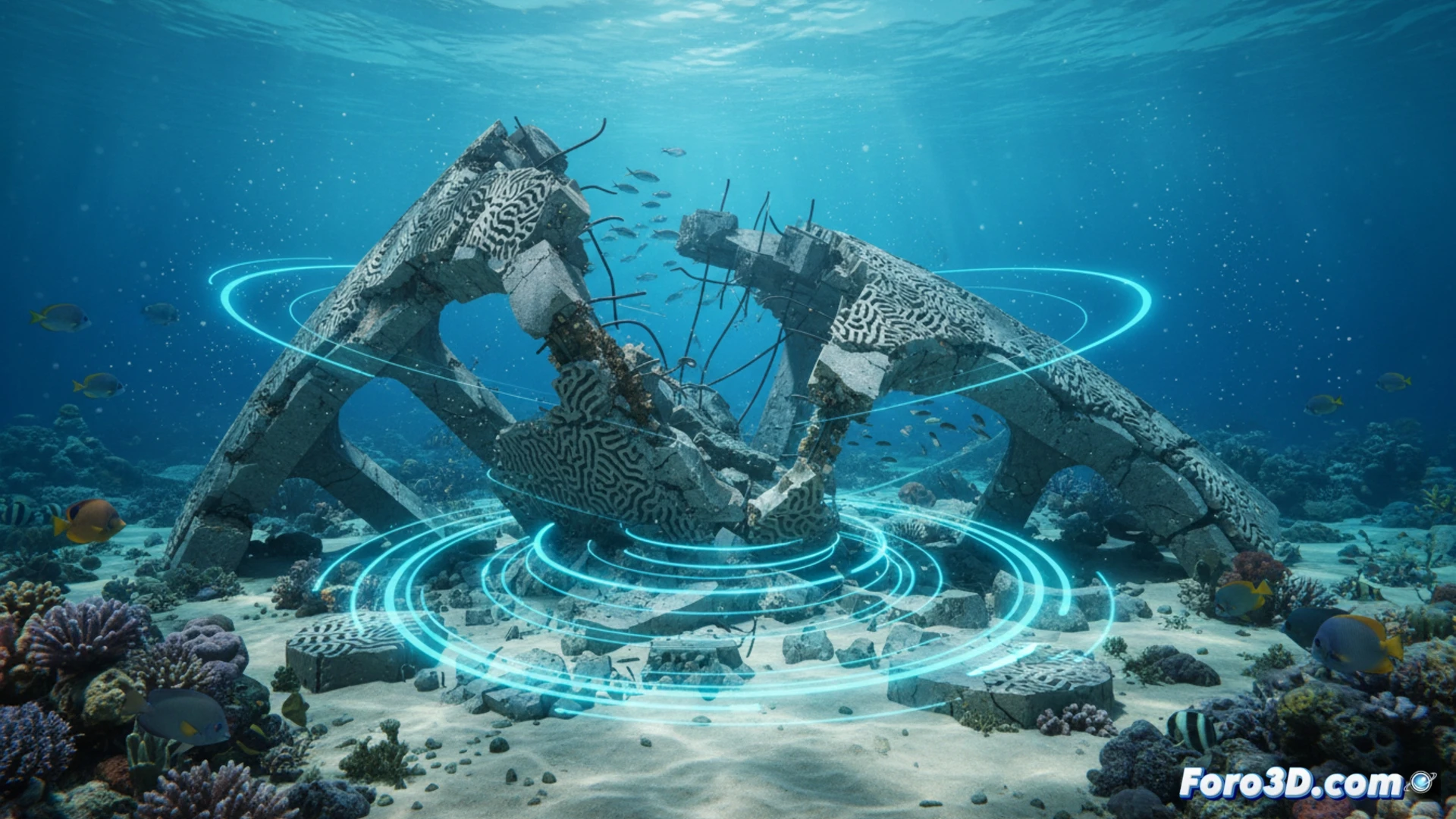
Mechanism of vortex erosion in porous concrete 🌊
The hydrodynamic simulation in Star-CCM+ modeled the flow around the reef and detected the formation of Von Karman vortices in the wake of the structure. These vortices, when interacting with the surface porosity of the ecological concrete, generated micro-turbulences that accelerated localized wear. The 3D underwater scan with BlueView confirmed that erosion was concentrated in the internal channels of the design, where surface roughness acted as a catalyst. Cyclic fatigue, induced by the back-and-forth of currents, progressively weakened the concrete matrix until collapse. The critical parameters to optimize are effective porosity, surface roughness, and the geometry of internal channels to minimize vortex generation.
Redesigning with data: Simulation as a structural lifeline 🛟
This failure demonstrates that ecological 3D printing is not sufficient without prior fatigue analysis. Integrating tools like Rhino 3D for parametric design and Star-CCM+ for CFD allows predicting critical erosion points before manufacturing. Optimizing porosity and roughness not only extends the reef's lifespan but also ensures it fulfills its ecological function. Without simulation, any innovative marine structure risks becoming an expensive and failed experiment.
Which hydrodynamic fatigue parameters were overlooked in the design of the 3D-printed ecological concrete reef, and how could they have been modeled before the collapse?
(PS: Material fatigue is like yours after 10 hours of simulation.)