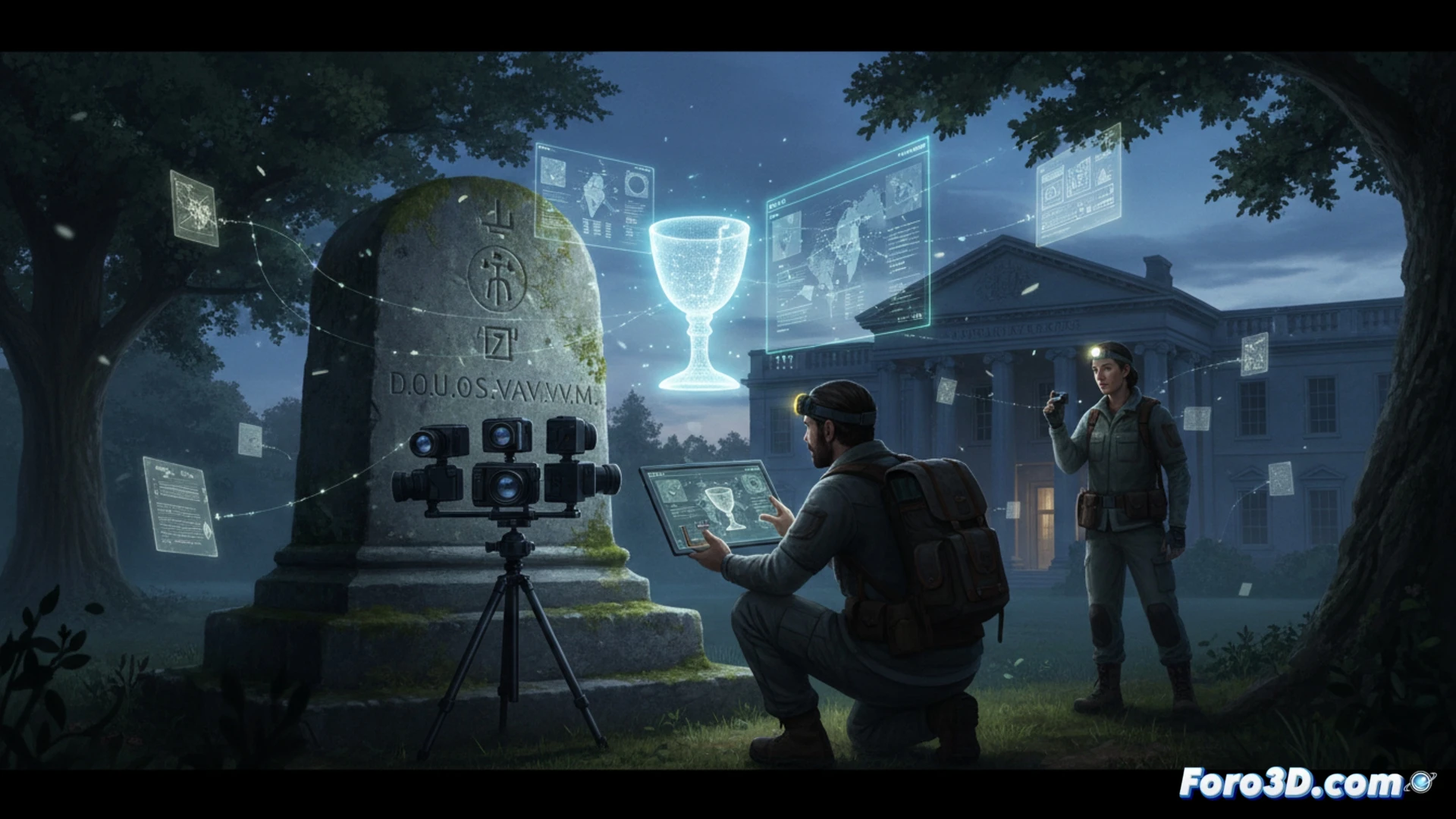
The Shugborough Inscription, an enigma carved in stone in the 18th century in Staffordshire, England, presents the sequence O.U.O.S.V.A.V.V., linked by legend to the location of the Holy Grail. Far from being a mere historical curiosity, this monument has become a perfect case study for digital archaeology. The application of techniques such as photogrammetry allows researchers to digitize every millimeter of the relief, revealing details imperceptible to the human eye and opening new avenues of analysis.
Photogrammetry and 3D Modeling for Epigraphic Analysis 🏛️
The digitization of the Shugborough monument through high-resolution photogrammetry allows for the creation of a textured 3D model that can be illuminated from any virtual angle. This is crucial for analyzing the inscription and the accompanying bas-relief, as digital raking light can accentuate grooves and tool marks that have been eroded by centuries of exposure. Furthermore, the model allows for the virtual reconstruction of the original landscape context, comparing the monument's orientation with possible astronomical or geographical alignments that could decipher the code, a task impossible with traditional observation.
Virtual Reconstruction and the Weight of Legend 🗝️
Beyond literal reading, digital archaeology allows us to recreate the journey of the pilgrim or initiate approaching the monument. Through virtual reality, we can reconstruct how the 18th-century landscape looked and how sunlight cast shadows on the letters on significant dates. This reflective approach does not seek to prove the existence of the Grail, but to understand why an enlightened society chose to engrave an indecipherable code. 3D technology thus becomes a tool for exploring the psychology of a mystery that transcends time.
Could photogrammetric analysis and infrared reflectography of the Shugborough inscription reveal hidden traces of a second layer of text that deciphers the code O.U.O. and its link to the Holy Grail?
(PS: and remember: if you can't find a bone, you can always model it yourself)