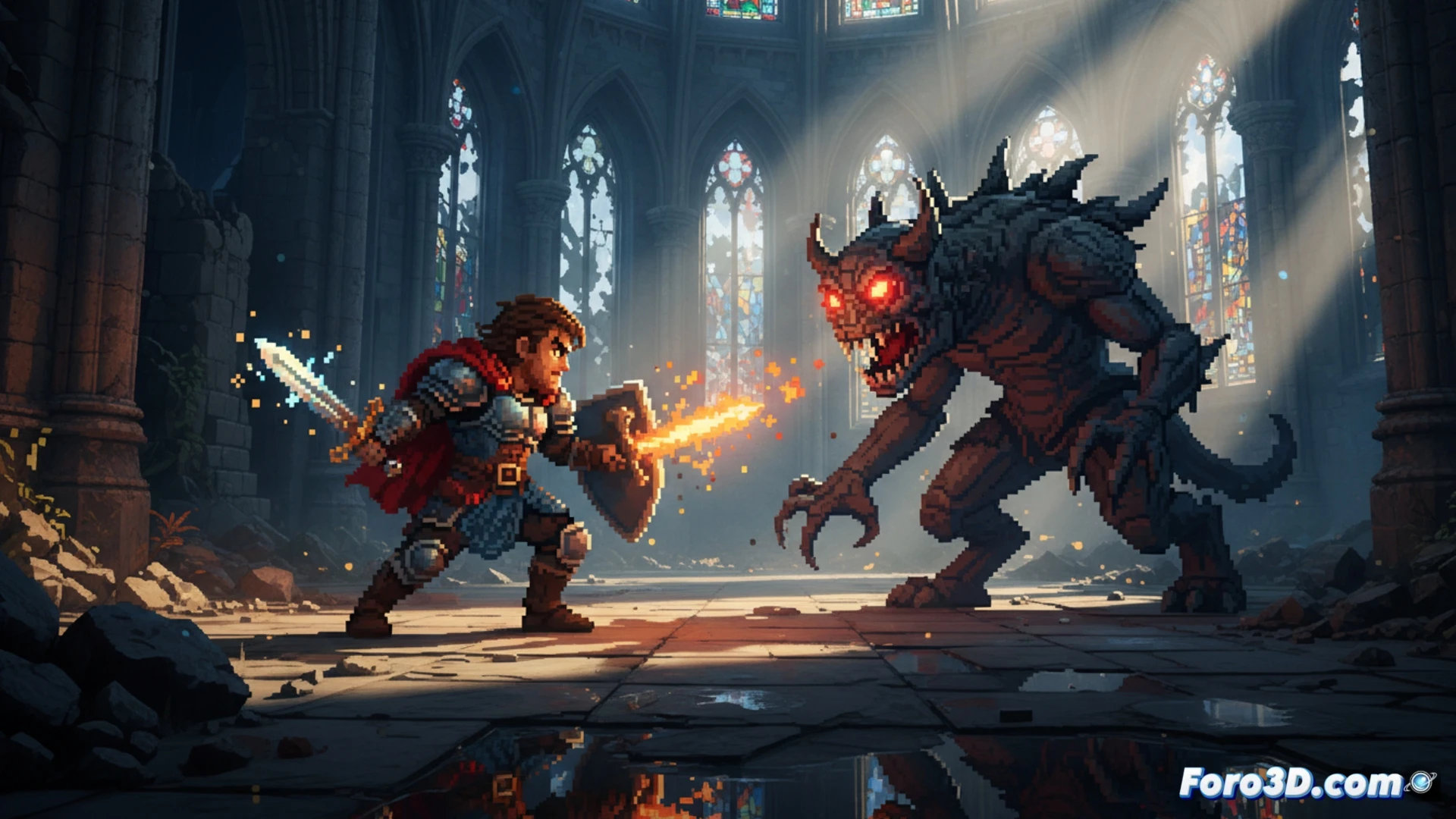
The study behind Arisen Force: Vonimir has presented an approach that redefines the HD-2D aesthetic. Instead of emulating retro textures, the project integrates hand-drawn sprites with a 3D world illuminated by Unreal Engine 5. This technique allows characters to retain their pixelated essence while the environment benefits from global light systems and dynamic reflections, something that engines like RPG Maker or GameMaker could never match.
Workflow: Aseprite, Blender, and the magic of UE5 🎨
The technical pipeline is as interesting as the visual result. Characters are created in Aseprite, where frame-by-frame animations are designed in low resolution. These sprites are exported as flat textures that are then applied to 2D meshes within Unreal Engine 5. For background structures, Blender is used to model low-poly geometry that serves as the scene's skeleton. Once in UE5, the real work begins: materials with realistic water properties are applied, and directional lights are placed that generate soft shadows on the sprites, creating an illusion of depth without losing the charm of pixel art.
Technical advantages over classic engines ⚙️
The big difference lies in lighting. In older engines, pixel art looked flat because the light was static or non-existent. In Arisen Force: Vonimir, water reflects sprites in real-time, and torches cast dynamic shadows on characters. This not only improves immersion but also allows developers to save time on pre-calculated shadows. The result is a hybrid that respects tradition but embraces modern hardware, demonstrating that the HD-2D technique is more of an evolution than a simple retro filter.
As a developer, what was the biggest technical challenge when integrating traditional pixel art with the modern lighting and post-processing tools of Unreal Engine 5 to achieve the HD-2D style of Arisen Force: Vonimir?
(PS: a game developer is someone who spends 1000 hours making a game that people complete in 2)