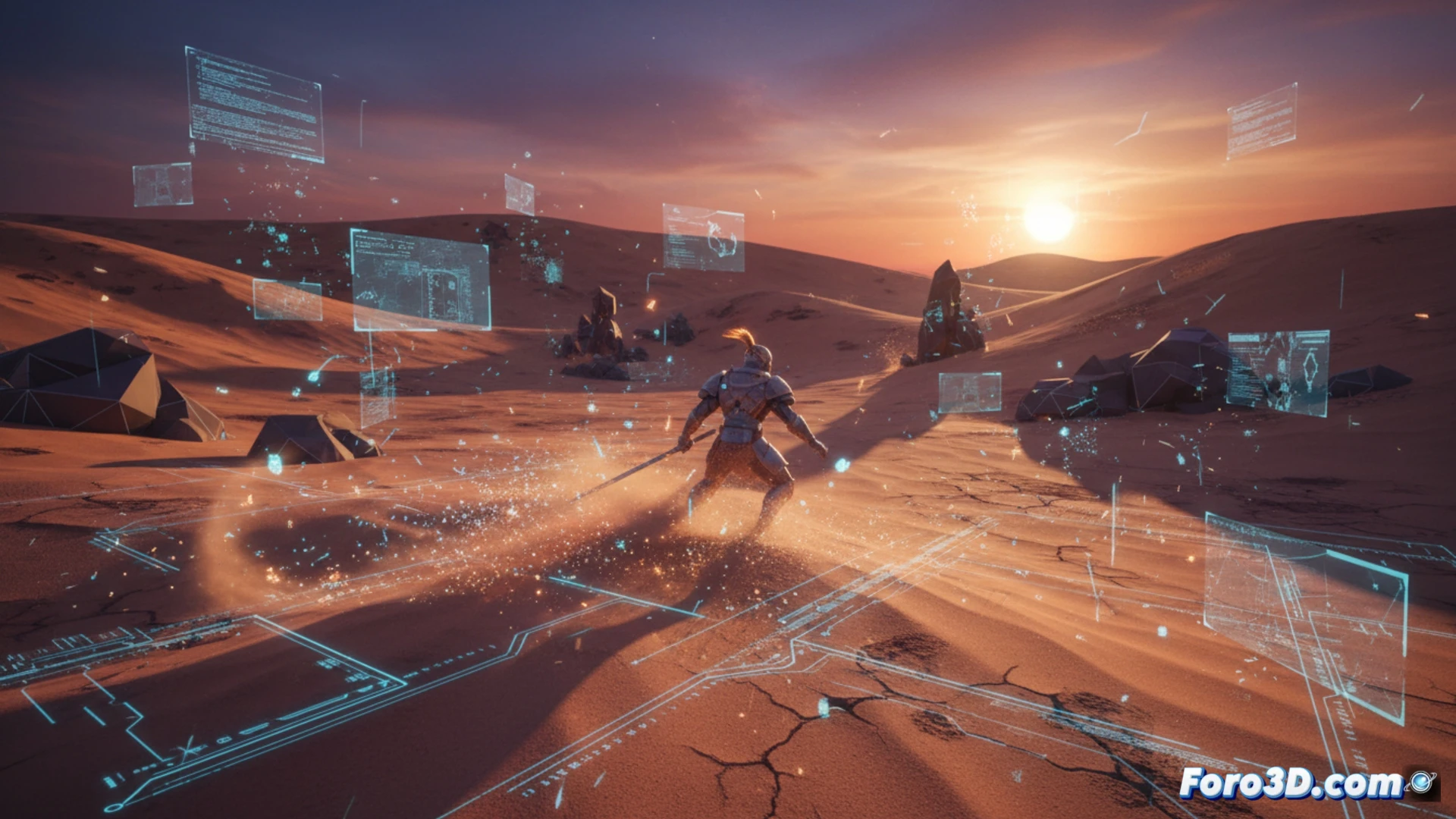
Deck13, a studio known for titles like The Surge, returns to the ring with Atlas Fallen, an open-world action game that poses a major technical challenge: rendering an infinite desert without sacrificing performance. The key lies in its proprietary engine, the Fledge Engine, which has been modified to manage two critical elements: real-time terrain deformation and a sand particle system that responds to the player's movement. Far from being a simple static background, the environment becomes another actor in the gameplay, and to achieve this, the team has had to implement extremely aggressive culling solutions.
GPU Culling and the Challenge of Dynamic Deformation 🎮
The biggest challenge of a massive desert is not the geometry, but the simulation. In Atlas Fallen, the sand is not just decorative; the player can glide over it at high speed, causing waves and crests that deform the ground mesh. To prevent the processor from collapsing, Deck13 delegated most of the visibility calculations to the GPU using an octree-based culling system optimized for modern hardware. This allows discarding millions of particles and polygons that fall outside the view cone or behind distant dunes. Additionally, the Fledge Engine uses an asymmetric LOD (level of detail) system: nearby monsters and structures are rendered with the high detail sculpted in ZBrush, while distant elements blend into a low-resolution mesh textured with procedural noise, saving shader cycles without breaking the illusion of infinity.
ZBrush and the Tactile Immersion of the Sand Monster 🐉
The creature design in Atlas Fallen also reflects an optimization philosophy. The monsters, sculpted with very high detail in ZBrush, are not simply imported as static meshes. The art team implemented a dynamic decomposition system: when the player hits an enemy, the engine activates a second, lower-density mesh that breaks into particle fragments, simulating that the monster is made of loose sand. This transition, managed by the Fledge Engine's particle system, allows the destruction to feel organic without the need for heavy per-vertex physics simulation. The result is an experience where performance remains stable at 60 fps on current-generation consoles, and immersion is achieved through intelligent resource management, demonstrating that a well-tuned proprietary engine can compete with commercial solutions like Unreal Engine in highly specific scenarios.
How does Deck13 manage to maintain smooth and stable performance in an open world like that of Atlas Fallen without sacrificing the graphical quality that characterizes its previous titles?
(PS: a game developer is someone who spends 1000 hours making a game that people complete in 2)