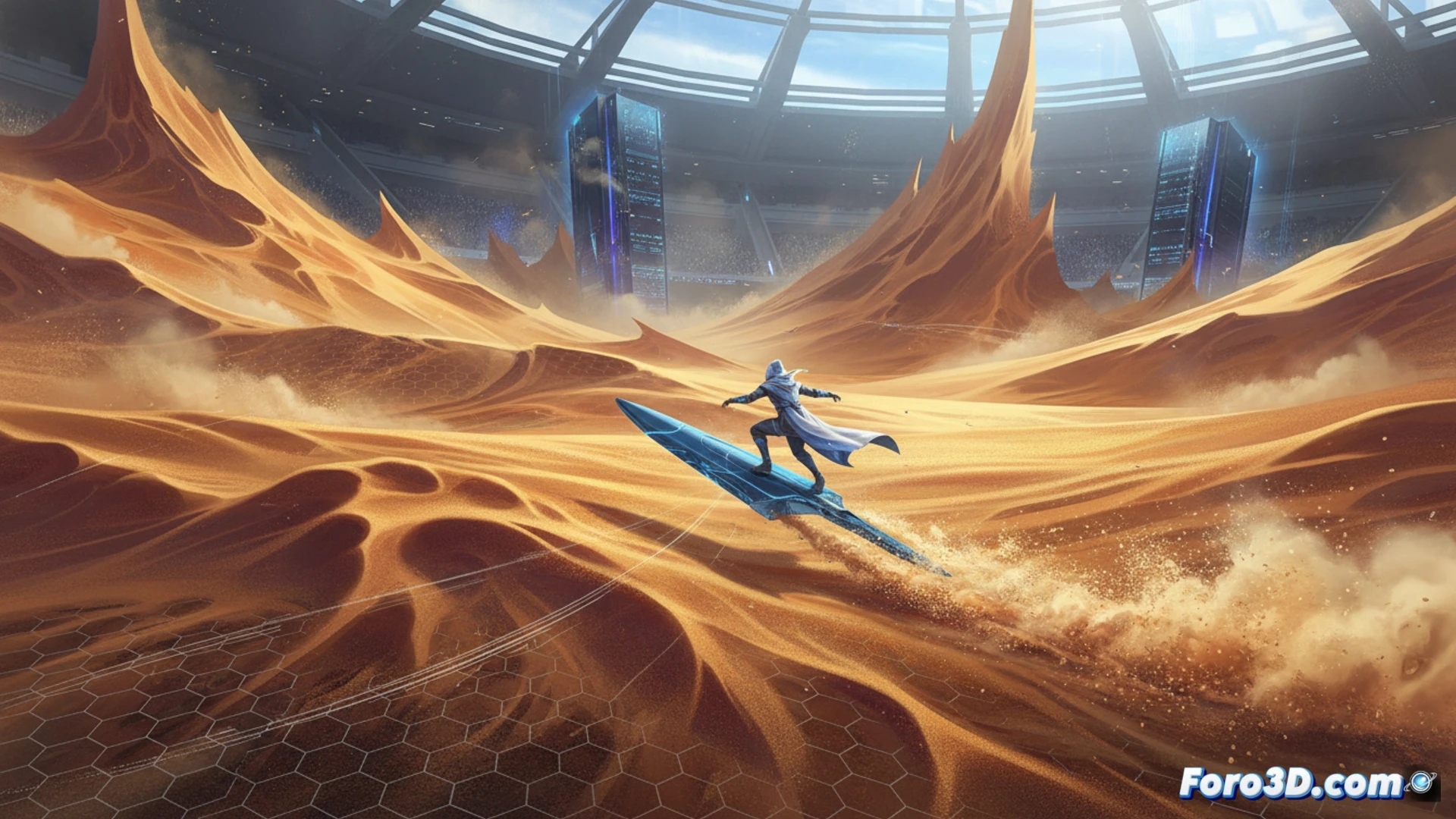
Giant Squid, a studio known for its art direction in titles like ABZÛ, once again pushes visual boundaries with Sword of the Sea. This time, the chosen graphics engine is Unreal Engine 5, and the main challenge is not water, but sand. The team has developed a fluid sand simulation system that reacts in real-time to the player's speed, combined with extreme movement physics for the flying sword or hoversword that serves as the main vehicle. 🎮
Simulation Pipeline: Houdini, Maya, and Nanite Optimization 🛠️
To make the sand behave like a dense fluid without collapsing performance, Giant Squid turned to Houdini for procedural simulation. From this software, displacement patterns and impact waves were generated, baked into flow maps. These textures are imported into Unreal Engine 5 to modify terrain vertex positions using a World Position Offset material. In parallel, Maya was used for key hoversword animations, creating motion curves that are later translated into physical forces within the engine. The key to visual realism lies in Nanite: by allowing virtualized geometry with millions of polygons, the desert ruins maintain extreme detail without needing LODs, freeing up resources for sand physics calculations.
Visual Narrative Through Procedural Physics 🌊
Beyond the technical showcase, the fluid sand simulation serves a narrative function. The hoversword's speed modifies the intensity of the sand waves, creating a visual language that communicates the character's inertia and mass to the player. The use of Houdini not only streamlines the work of VFX artists but also allows the world to respond organically to every action. This approach demonstrates that combining procedural tools with the power of Nanite in UE5 is not only viable for a triple-A studio but is the perfect formula for creating worlds that feel alive and reactive on an epic scale.
How does Giant Squid manage to simulate the physical interaction between fluid sand and the player's flight in real-time within Unreal Engine 5 without compromising the visual performance characteristic of its artistic style?
(PS: VFX are like magic: when they work, no one asks how; when they fail, everyone sees it.)