The circumzenithal arc, that flash of pure colors that draws an inverted smile at the zenith, is one of the most beautiful and difficult-to-photograph optical phenomena. Far from being a conventional rainbow, it is born from the refraction of sunlight through flat, hexagonal ice crystals suspended in cirrus clouds. To understand its exact geometry and chromatic dispersion, scientists today turn to powerful visualization and simulation tools that transform atmospheric data into interactive three-dimensional models.
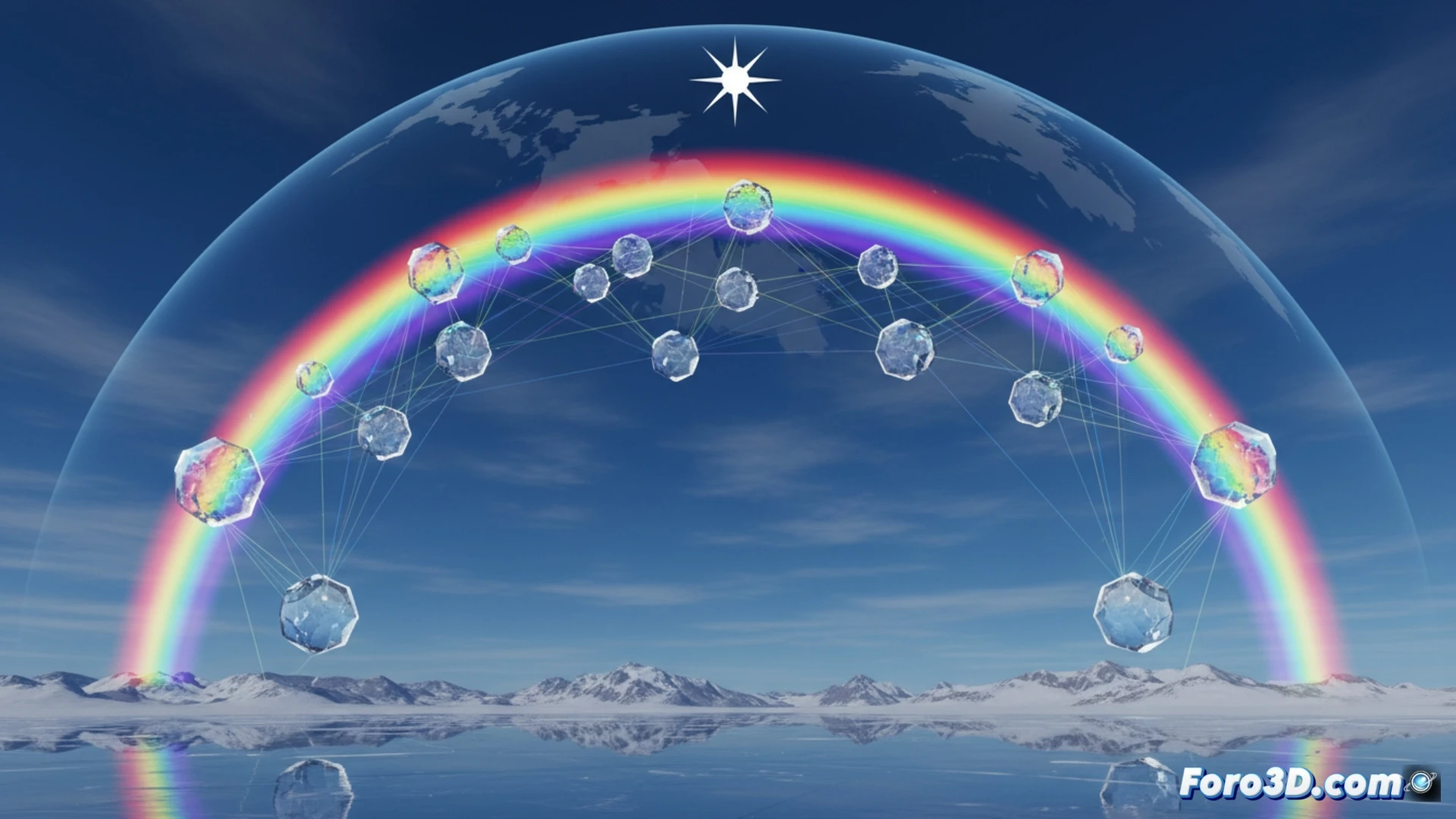
Volumetric analysis and multiphysics simulation of the halo 🌈
The study of this phenomenon requires a multidisciplinary workflow. With Volume Graphics VGSTUDIO MAX, it is possible to process tomographies or LIDAR data of cirrus clouds to generate an accurate volumetric model of the ice crystal distribution. Subsequently, COMSOL Multiphysics, in its Bio-electromagnetism module, allows adapting Maxwell's equations to simulate the refraction and dispersion of white light as it passes through a hexagonal crystal with a specific orientation. Finally, Materialise Mimics is used to segment and label the different crystalline orientations within the cloud volume, isolating them to understand which configurations produce the 46-degree arc relative to the observer. This combination of software turns an ephemeral meteorological phenomenon into a reproducible digital laboratory.
Visual outreach: when software explains nature 🔬
Beyond scientific validation, these 3D representations have enormous educational value. Visualizing on a screen how a light ray decomposes when passing through an ice crystal modeled in Mimics, or seeing the dynamic COMSOL simulation adjusting the solar angle, allows students and enthusiasts to understand atmospheric optics without relying on ideal weather conditions. Forums like Foro3D find here a perfect example of how scientific visualization technology serves not only industry or medicine but also to unveil the optical secrets that paint the sky.
What physical parameters of hexagonal ice crystals in the atmosphere are most critical for accurately modeling the chromatic dispersion and shape of the circumzenithal arc in a scientific rendering engine?
(PS: fluid physics for simulating the ocean is like the sea: unpredictable and you always run out of RAM)