The visual narrative of Aoashi, a work by Yugo Kobayashi, has broken the mold of traditional sports manga by translating the tactical complexity of football into sequences of high spatial legibility. Unlike other series that prioritize the impact of a strike or the speed of movement, Kobayashi constructs a dynamic chessboard where each panel functions like an isometric camera. This technique allows the reader, or sports analyst, to visualize the opening of spaces and passing lines with the same clarity that a state-of-the-art 3D rendering software would offer.
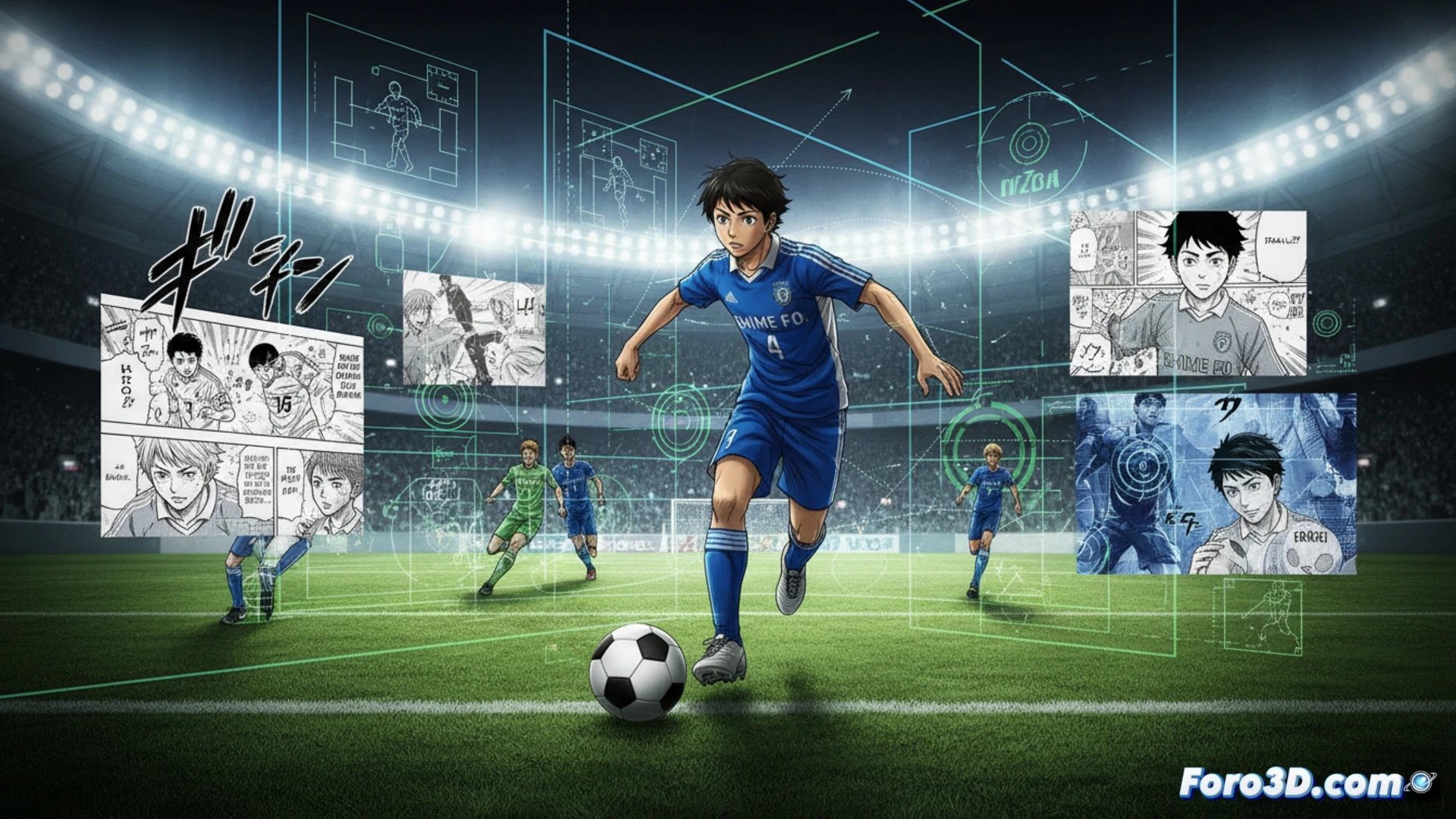
Tactical Visualization: From 2D storyboard to 3D simulation engine ⚽
Kobayashi's art intuitively applies advanced principles of 3D visualization. His panoramic panels, which often break the page margins, simulate a drone or overhead camera view, similar to optical tracking systems like Hawk-Eye or Second Spectrum. By drawing players with forced perspectives and shadows that define the depth of the field, the author enables the reader to mentally calculate the distance between a defender and an attacking midfielder. This capacity for spatial abstraction turns Aoashi into an interactive positioning manual, where each movement of Ashito Aoi is a node in a network of tactical data rendered in ink.
The manga as a training tool in sports analysis 🧠
For a professional in sports and 3D technology, Aoashi offers a fascinating case study on the democratization of tactics. While 3D simulation tools require expensive hardware and tracking data, Kobayashi manages to make a temperamental teenager understand concepts like creating passing triangles or rotating defensive blocks. The work demonstrates that true innovation lies not only in software, but in the ability to translate the complexity of movement into a universal visual language, bridging the gap between sequential art and sports engineering.
Can a 2D manga stroke capture the complexity of real football 3D tracking, or is volumetric animation the only way to represent sports tactics?
(PS: at Foro3D we know that a penalty simulated in 3D always goes in... unlike in real life)