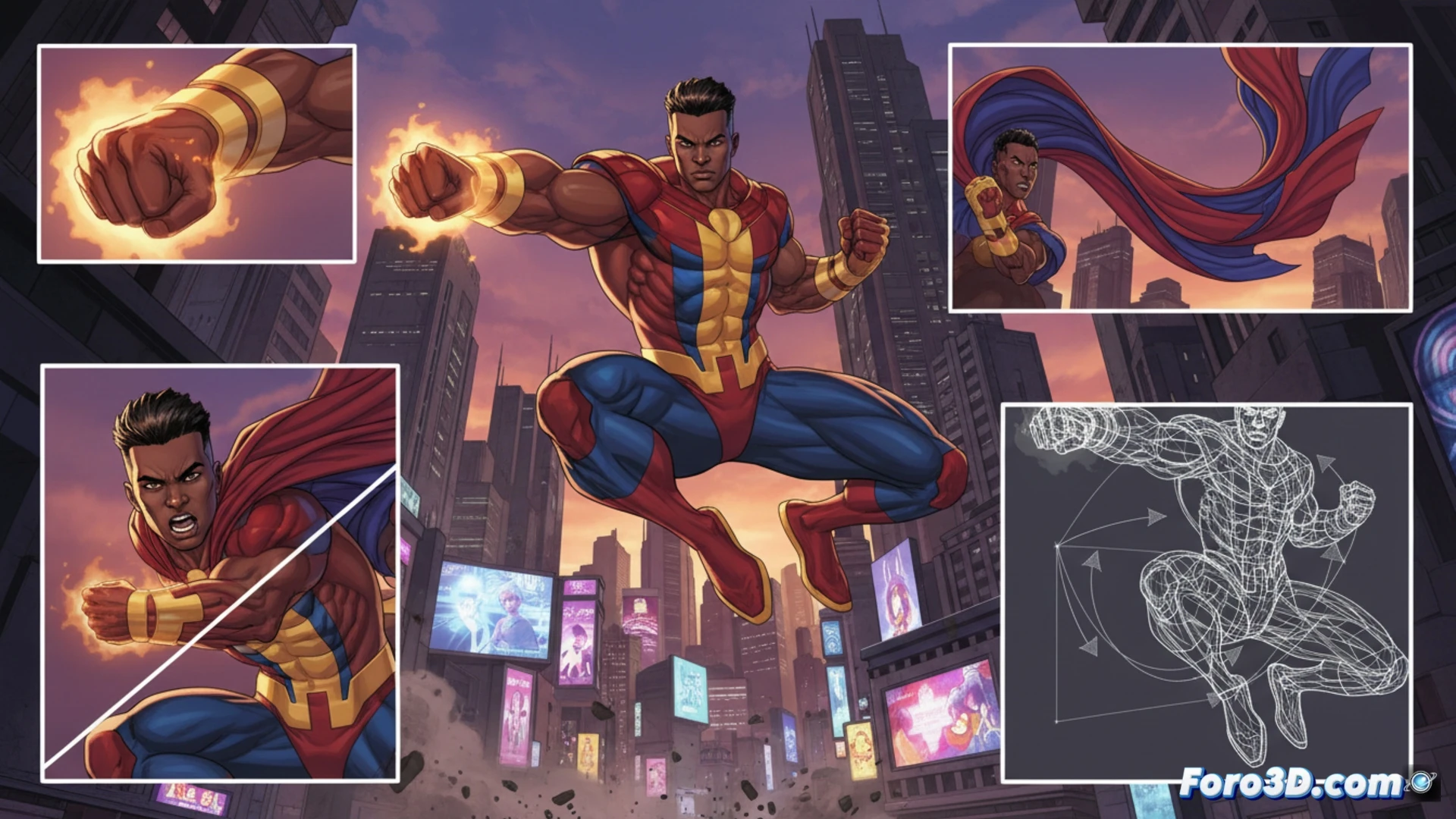
The Marvel character Prodigy (Ritchie Gilmore) presents a fascinating technical challenge for 3D animation. His combination of super strength, superhuman endurance, and a special suit that enhances his incredible leaps demands a rigging approach that allows for extreme deformations without breaking the silhouette. This article analyzes the techniques needed to capture the physics of a devastating punch and the dynamics of a gravity-defying jump, based on the visual style of Adam Pollina and the narrative of Joseph Harris.
Rigging for Extreme Muscle Tension and Layer Dynamics 🦾
To animate Prodigy's super strength, the rigging must prioritize volumetric deformation. Instead of simple linear bones, it is recommended to use a Joint system with volume controllers (muscle jiggle) that simulate momentary hypertrophy when applying force. The special suit requires a separate layer treatment: a cloth rig with constraint simulation to prevent penetrations, and a squash and stretch system controlled by a speed driver. For the incredible jumps, the key lies in a leg rig with inverse hierarchy (IK) that allows extreme compression during takeoff and controlled stretching in the air. The endurance translates into a slow response of the character to external forces, achieved with a delay rigging in the limbs.
The Jump as a Choreography of Power and Weight 💥
Unlike agile characters like Spider-Man, Prodigy must convey weight and power in every jump. The animation should prioritize anticipation: a deep compression of the torso and legs, followed by a vertical explosion. The suit must react with a delay in loose layers (hood or elbow pads), while the body maintains a rigid and powerful posture during flight. Marvel's aesthetic demands that every landing feels like a seismic impact, using a foot rig with impact absorption control and deformation waves on the ground. This technical approach not only brings Prodigy to life but also offers a model for any character combining brute force with vertical mobility.
What rigging and deformation control techniques are most effective for simulating the extreme stretches and twists of a superhero like Prodigy during a jump of superhuman proportions, without compromising skeleton stability or generating mesh artifacts?
(PS: Animating characters is easy: you just have to move 10,000 controls to make them blink.)