The mud eel of the genus Ilyophis represents one of the most elusive specimens in modern ichthyology. Inhabiting the abyssal depths, this species has developed reduced eyes as an adaptation to the perpetual darkness of the toxic sediments surrounding hydrothermal vents. Its elongated morphology and ability to thrive in sulfide-rich environments make it a perfect subject for scientific 3D visualization, allowing researchers to analyze its anatomy without the need for costly submarine expeditions.
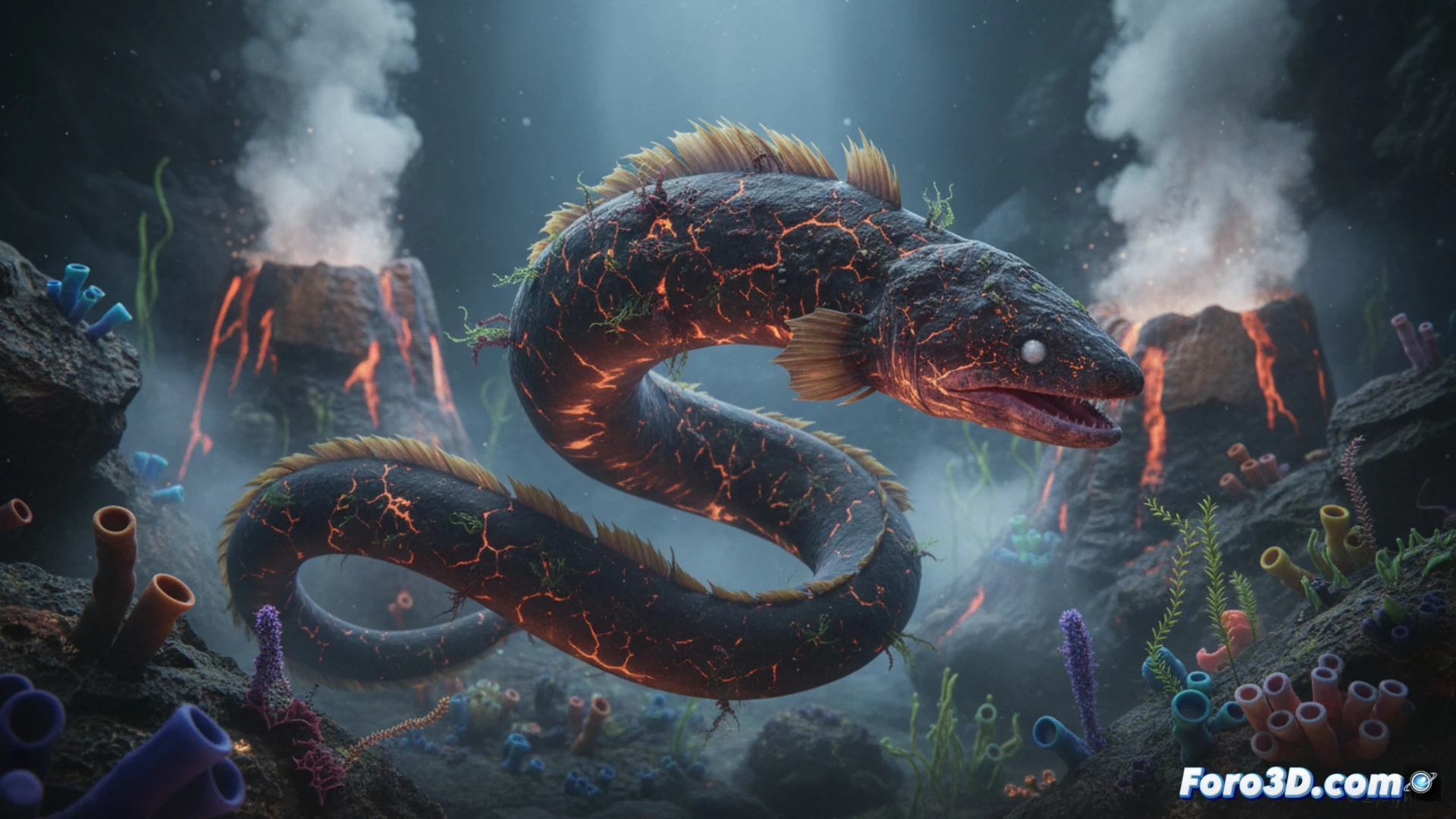
Anatomical reconstruction and hydrothermal habitat modeling 🐍
To create an accurate 3D model of Ilyophis sp., it is essential to analyze its key adaptations. Ocular reduction is represented by a decrease in the volume of the orbital cavity and a layer of translucent tissue simulating retinal degeneration. The body, lacking scales and highly flexible, requires spline-based rigging to simulate its serpentine movement within the substrate. The environment must include a gradient of toxic particles (hydrogen sulfide) and hydrothermal vents modeled with procedural textures of metal oxides. Lighting is critical: a volumetric light scheme with a single dim bioluminescent light source should be used, replicating the absolute twilight conditions of the ocean floor.
The value of the invisible in science communication 🔬
Beyond technical rigor, the 3D visualization of this eel fulfills an essential pedagogical function. By making accessible an organism that lives under lethal pressures and in complete darkness, the model allows the general public to understand how evolution shapes biology in extreme environments. For the scientist, the ability to rotate, virtually dissect, and simulate the behavior of Ilyophis in its toxic habitat opens new avenues of research without disturbing a fragile and remote ecosystem. Digital reconstruction thus becomes a bridge between the inaccessibility of the abyss and human understanding.
How can we accurately represent the transparency and bioluminescence of the mud eel's tissues in a 3D model, considering it inhabits abyssal zones without sunlight?
(PS: at Foro3D we know that even manta rays have better social connections than our polygons)