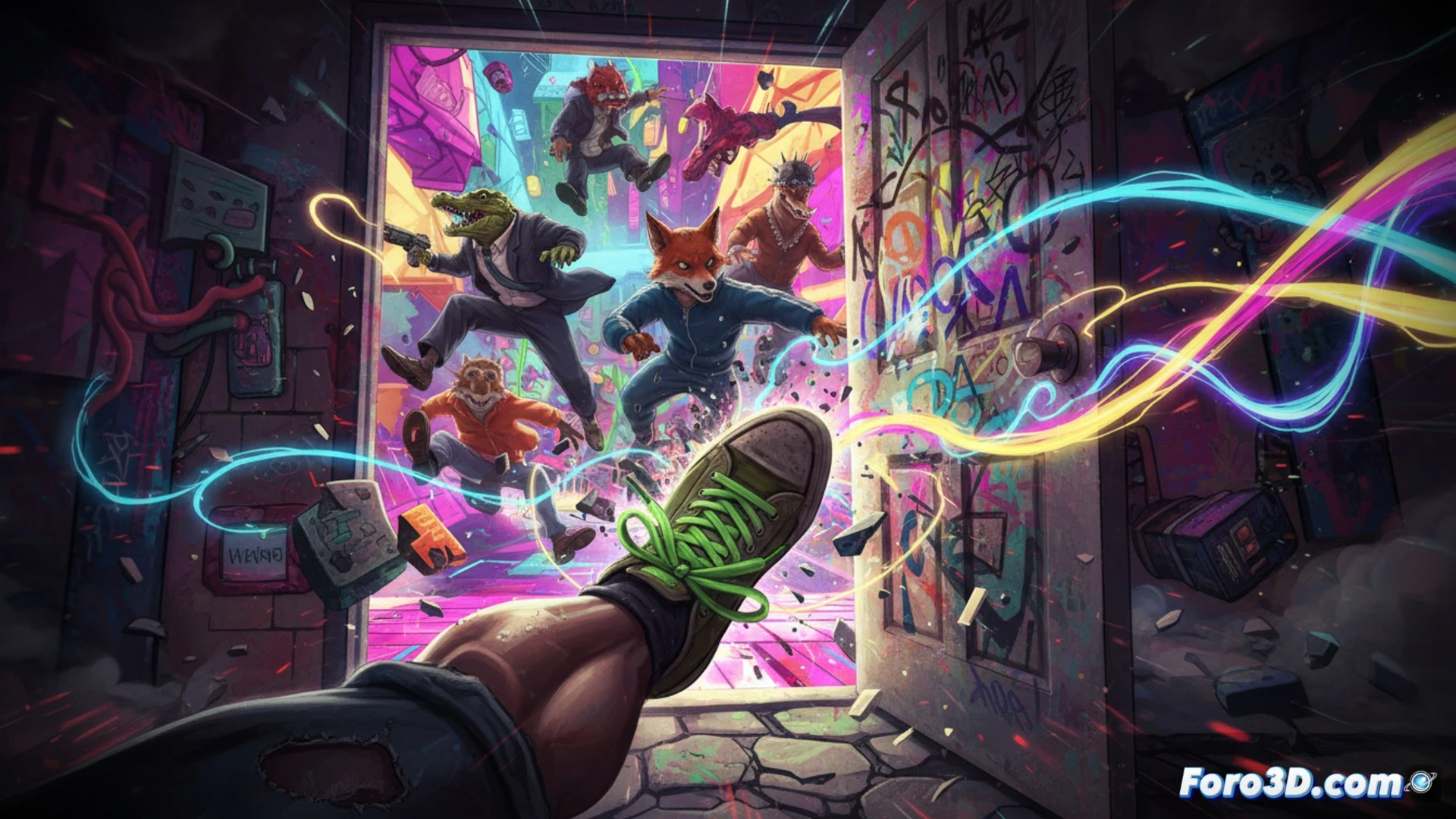
Anger Foot is a genre-defying title within the action genre, combining a psychedelic aesthetic with exaggerated cartoon violence. Developed in Unity, the game stands out for its ultra-fast animations and reactive physics that turn every kick into a visual spectacle. From a development perspective, this project is a case study on how to squeeze a multiplatform engine to achieve a unique visual identity without sacrificing performance.
Technical Pipeline: From Maya to Unity with Photoshop Textures 🛠️
The workflow in Anger Foot begins in Autodesk Maya for character and environment modeling and rigging. Assets are exported in FBX format, optimizing geometry to maintain a stable framerate during action explosions. Textures, created in Photoshop, use saturated color palettes and violent contrasts to reinforce the lysergic atmosphere. Inside Unity, the team uses the Mecanim animation system for abrupt transitions between idle, running, and kicking states, while the physics engine (PhysX) is tuned to simulate exaggerated bounces and destruction. The key lies in custom shaders: distortion effects and post-processing (such as bloom and chromatic aberration) are applied from the rendering pipeline, making each impact feel chaotic yet controlled.
Lessons for Indie Developers: Aesthetics Over Realism 💡
Anger Foot demonstrates that an indie game doesn't need photorealistic graphics to succeed; visual identity and gameplay come first. To replicate its success, prioritize a simple but addictive gameplay loop, and use art as a narrative tool. In Unity, don't underestimate the power of Animation Events to synchronize sounds and particles with kicks. Additionally, limit the use of dynamic lights in chaotic scenes; opt for light baking into textures to maintain 60 FPS. Finally, Photoshop isn't just for textures: use it to design UI sprites that vibrate with the same psychedelic energy as the game.
How does Unity manage to optimize visual fluidity and real-time psychedelic effects without sacrificing performance during the high-violence sequences in Anger Foot?
(PS: shaders are like mayonnaise: if they break, you start all over again)