Metroid Dread represents a milestone in the fusion of 2.5D technology with science fiction aesthetics. The game, developed on the Mercury Engine, achieves smooth performance on Nintendo Switch thanks to a rigorous pipeline. The key lies in how the engine manages cinematic transitions without cuts, combining cold lighting and reactive combat animations to create an immersive experience. We break down the tools and technical decisions behind this achievement. 🎮
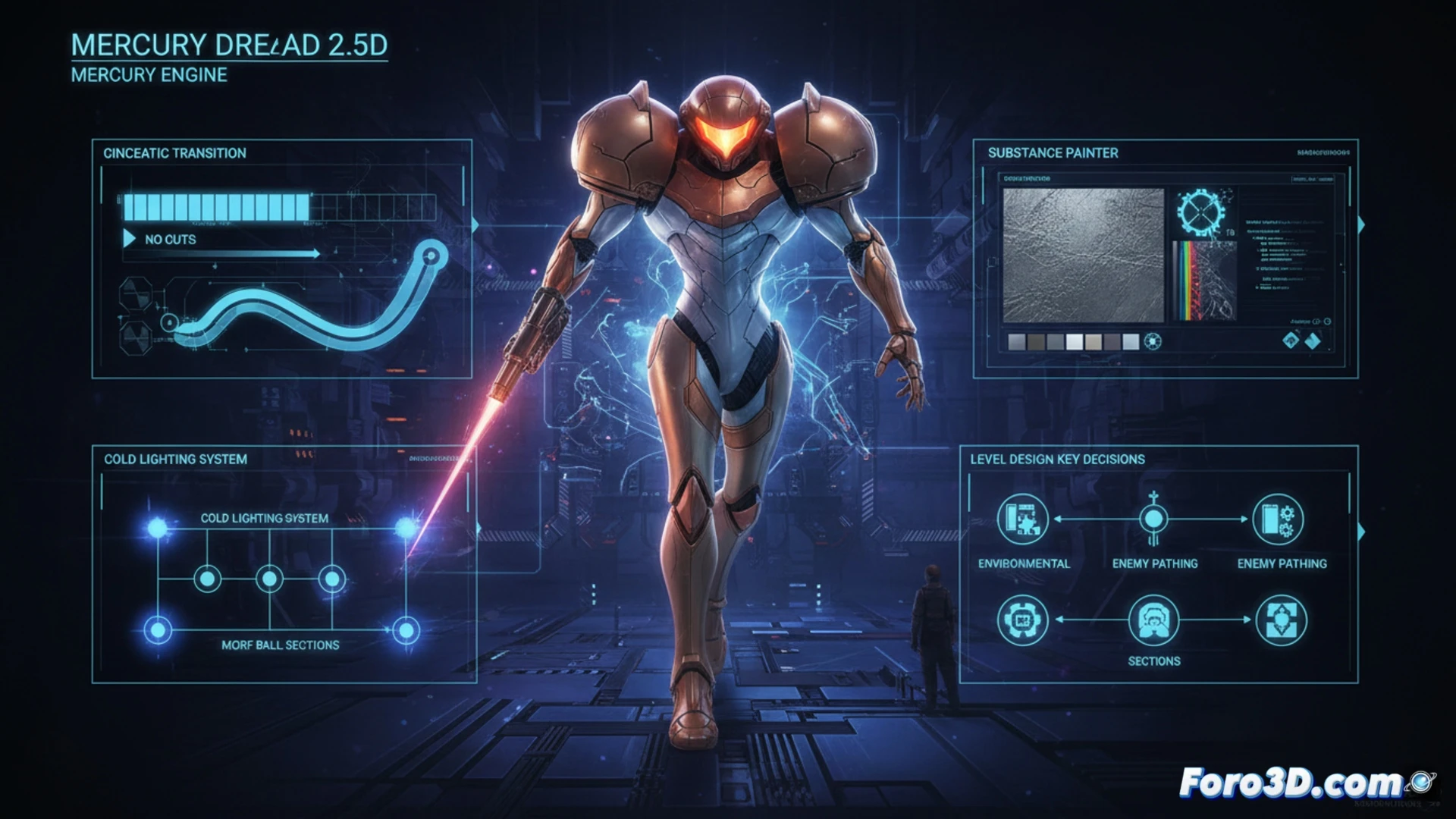
Modeling and texturing pipeline: from 3ds Max to Substance Painter 🛠️
The level design in Metroid Dread relies on Autodesk 3ds Max, used to build the geometry of the rooms and interconnected corridors of ZDR. 2.5D optimization demands precise control of depth of field and collisions, something the engine solves with parallel render planes. For textures, Photoshop is used in creating base maps and environmental details. However, the metallic finish of Samus's suit is achieved in Substance Painter, where the use of roughness and reflectivity maps allows simulating the armor's wear under the dynamic lighting of the Mercury Engine.
Cold lighting as a visual and technical language 💡
The aesthetic of Metroid Dread is not only artistic but also a performance solution. The cold, technological lighting, with high contrasts and hard shadows, allows the Mercury Engine to hide texture loads in the background. The seamless cinematic transitions, such as the chase scenes with the E.M.M.I. robots, require the engine to keep the assets of the next room in memory. This streaming architecture, combined with stylized shading, demonstrates that 2.5D optimization can be as complex as a traditional 3D game.
As a developer, what specific technical limitations of the 2.5D pipeline of Metroid Dread in Mercury Engine forced design decisions or gameplay sacrifices that are not obvious to the average player?
(PS: 90% of development time is polishing, the other 90% is fixing bugs)