The recent update of Euro Truck Simulator 2 has introduced profound changes to its Prism3D engine. The leap to DirectX 12 not only promises more efficient CPU thread management but also enables rendering of more complex scenes. Concurrently, the new particle system, designed to simulate rain and dust with greater granularity, redefines immersion standards on the road. This article breaks down the technical pipeline and the real impact of these optimizations on performance.
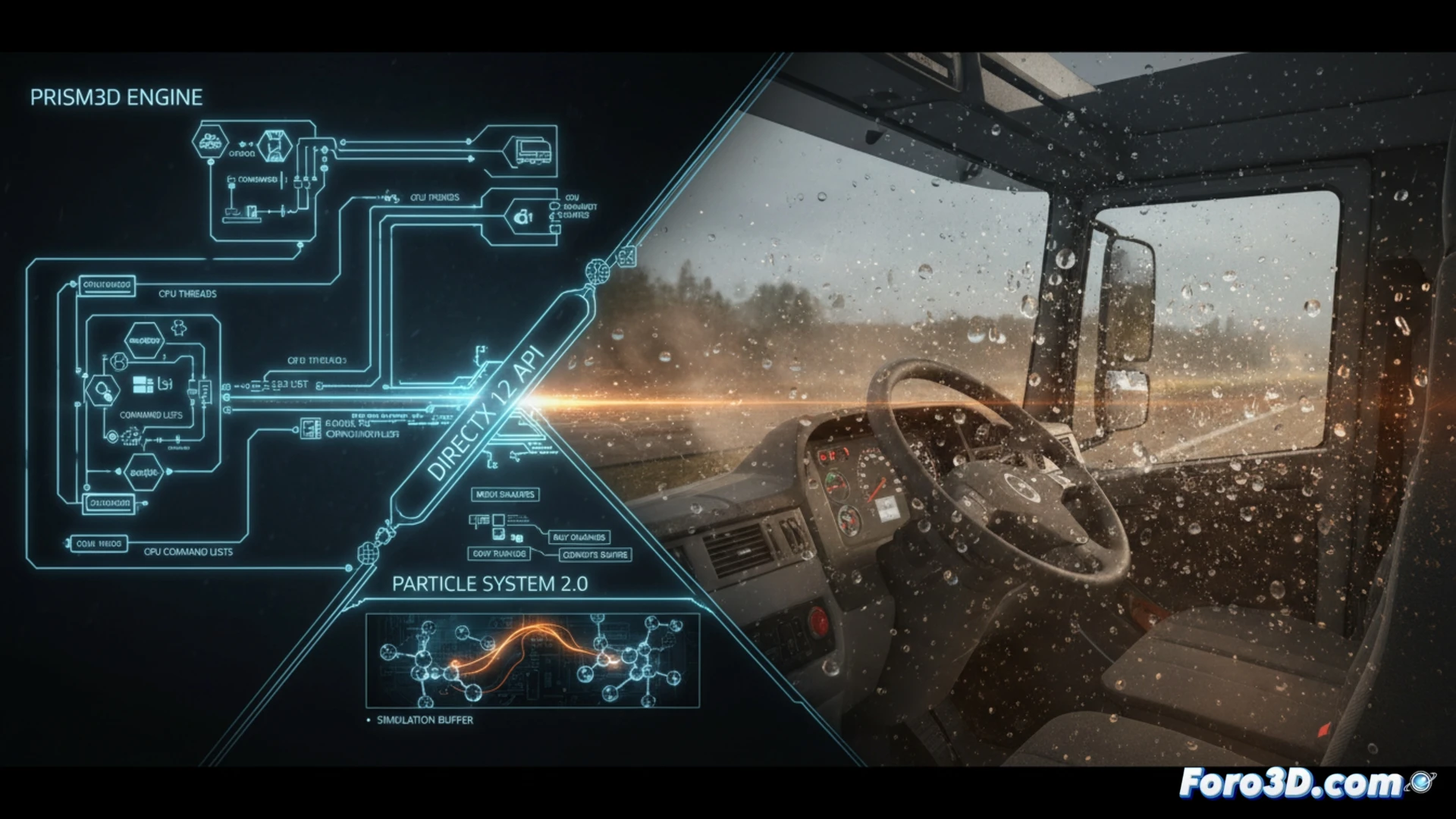
Technical Pipeline: From Blender to Prism3D with DX12 🛠️
The workflow for these improvements combines external tools with the proprietary engine. Blender is used for creating and retopologizing high-polygon models, especially for the new particle effects that require precise collision meshes for dust kicked up by tires. Photoshop is involved in generating PBR (physically based) textures that now benefit from DX12's dynamic lighting, allowing for more realistic specular reflections on wet asphalt. The final integration occurs in Prism3D, where the new particle system is managed as mesh instances, reducing draw call overhead. DX12 optimization allows the GPU to handle these calculations more directly, freeing the CPU for vehicle physics and traffic tasks. This results in a smoother experience even in high-density particle scenarios, such as sandstorms or torrential rains, where frame drops were previously experienced.
Real Impact: Realism vs. Performance on the Road 🚛
The implementation of these technologies is not merely cosmetic. The new particle system, being more granular, allows dust and rain to react to wind speed and direction, creating dynamic trails behind the truck. DX12 lighting enhances this effect, as each particle can receive shadows and reflections from the environment. However, the biggest challenge has been the technical balance: while on modern hardware (GPUs with 6GB+ VRAM) performance stabilizes at 60 FPS with improved shadow tracing, on older systems the particle load can saturate texture memory. The conclusion is clear: SCS Software has prioritized scalability, allowing users to adjust particle density without losing the essence of the graphical improvement.
Is it feasible to implement a particle system based on DX12 compute shaders in the Prism3D engine of Euro Truck Simulator 2 without compromising performance on low-to-mid-range configurations?
(PS: 90% of development time is polishing, the other 90% is fixing bugs)