A serious industrial incident has put the structural integrity of logistic assistance exoskeletons under scrutiny. A worker suffered severe injuries when the hydraulic arm of his equipment executed a violent and unexpected reverse movement. To clarify whether the cause was a software error or material fatigue, a rigorous forensic engineering workflow combining optical metrology, FEM simulation, and mesh comparison has been deployed. This case is a perfect example of how fatigue simulation can prevent tragedies.
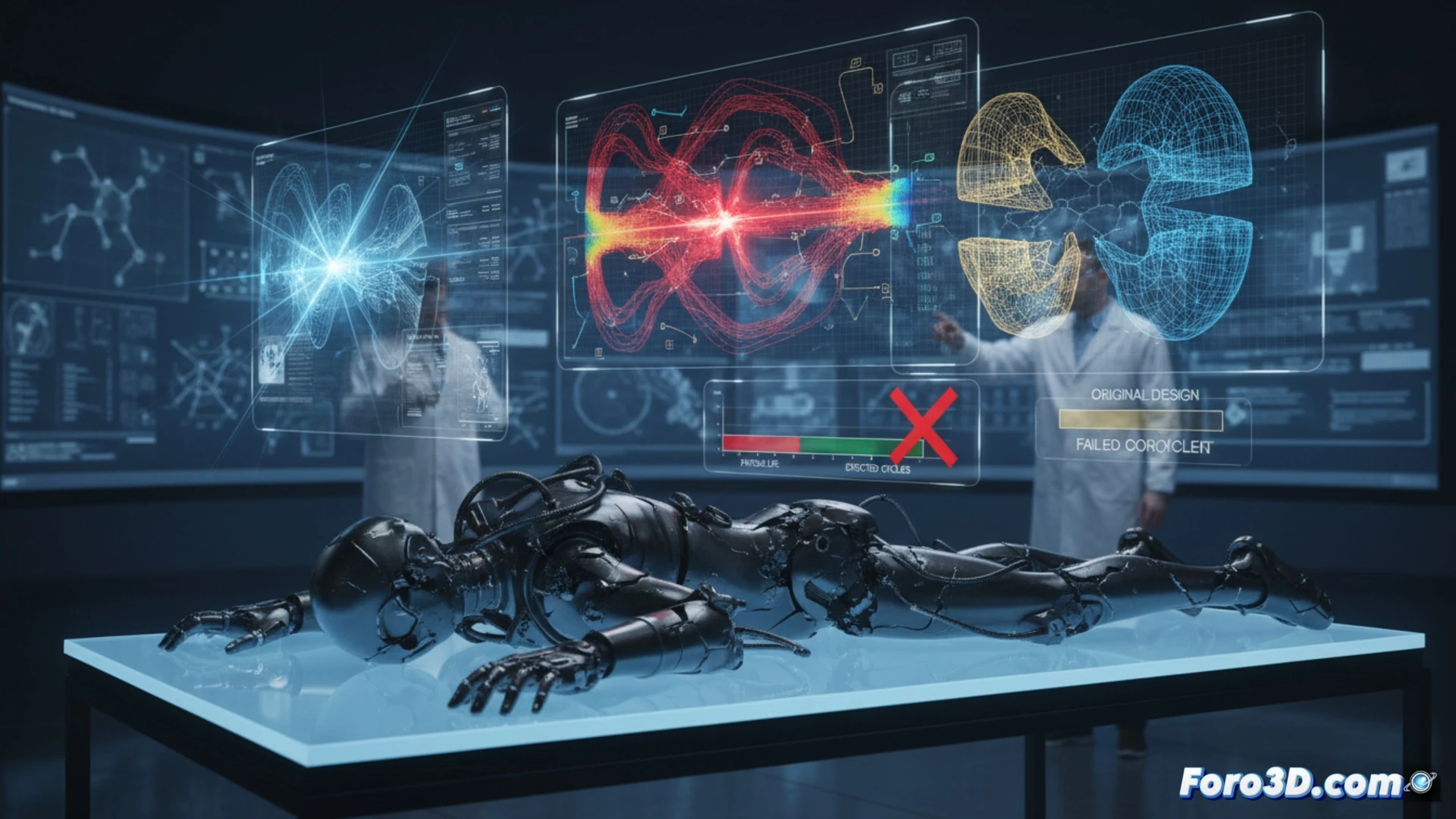
Forensic workflow: from sub-millimeter scanning to FEA 🔍
The process began with scanning the critical components of the exoskeleton, focusing on the micro-hydraulic pistons and actuator pivot points. Using GOM Inspect, point clouds were captured with sub-millimeter precision to digitize the post-failure state. These meshes were imported into CloudCompare for direct comparison against the original CAD design. The detected deviations revealed areas of concentrated plastic deformation on the piston rod. Subsequently, these deformed geometries were taken into SolidWorks, where a finite element analysis (FEA) was performed to simulate residual stresses and load history. The goal was to discern whether the wear marks on the pivots corresponded to progressive cyclic fatigue or a single anomalous load peak that exceeded the material's yield strength.
Cyclic fatigue vs. load peak: the truth in deformations ⚙️
The 3D analysis results point to a mixed failure. SolidWorks simulations confirmed that, while the material exhibited accumulated fatigue microcracks in the pivot area, the violent reverse movement was triggered by an instantaneous overload. The mesh comparison in CloudCompare showed a sudden deformation incompatible with gradual wear. This suggests that the control software allowed a command outside safe limits, but the prior material fatigue drastically reduced the safety factor. The case underscores the need to integrate periodic scanning of critical components into predictive maintenance protocols to prevent catastrophic failures.
What material properties would you assign?