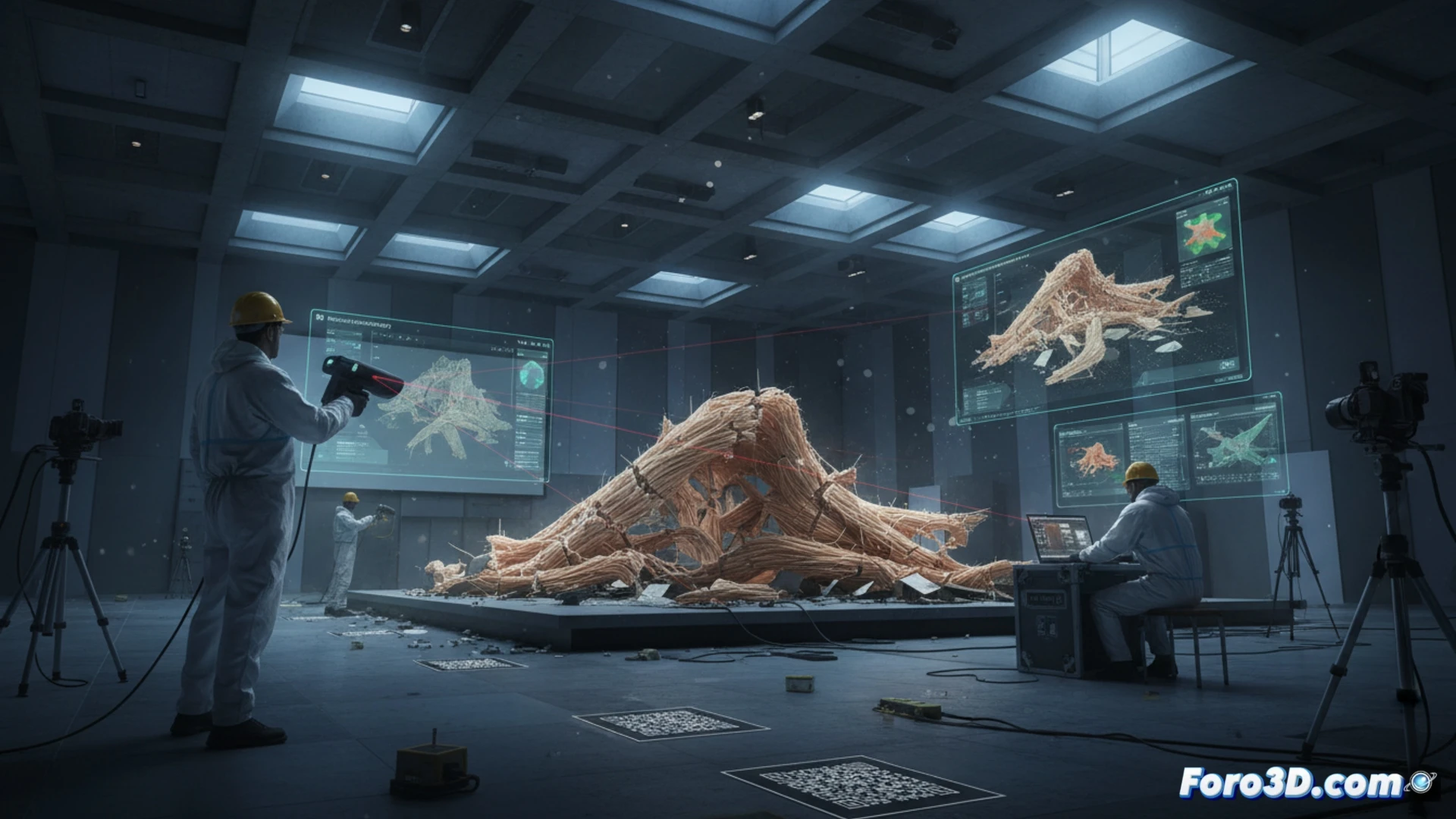
On October 15, an experimental auditorium built with mycelium bricks collapsed during a conference. Although there were no fatalities, the structural failure of this bioconstruction has sparked a crucial technical debate. The forensic team used photogrammetry with RealityCapture to digitize the debris, generating a precise mesh that will serve as a basis for determining whether the cause was biological or mechanical.
Competing Hypotheses: Biological Degradation vs. Load Failure 🧬
The investigation focuses on two lines. The first suggests that ambient humidity, above 70% during the preceding days, degraded the mycelium hyphae, reducing its compressive strength. To validate this, Ansys runs a biomechanical simulation that models the biological material as a porous composite with mechanical properties varying according to saturation. The second hypothesis points to an error in the calculation of the load distribution of the pavilion. Using GOM Inspect, the deformation of the supporting metal structure is analyzed by comparing it with the original CAD model, identifying anomalous stress concentration points.
The Final Verdict: A Hybrid Failure 🔍
The deformation maps from GOM Inspect revealed that the structural nodes were correctly designed, ruling out a pure load failure. However, the simulation in Ansys showed that the mycelium in the lower areas of the auditorium, in contact with ground moisture, lost 40% of its load-bearing capacity. The collapse began when these biological bricks gave way, creating a domino effect. The conclusion is clear: the support structure was viable, but the biological material was not adequately protected against moisture, a critical error in bioconstruction that 3D modeling has allowed to be diagnosed with precision.
Considering that mycelium bricks are an organic and living material, which may have been subjected to changing environmental conditions during the conference, what role did relative humidity, temperature, and possible dehydration or proliferation of parasitic fungi play in the structural degradation prior to the pavilion's collapse?
(PS: Simulating a collapse is easy. The hard part is keeping the program from crashing.)