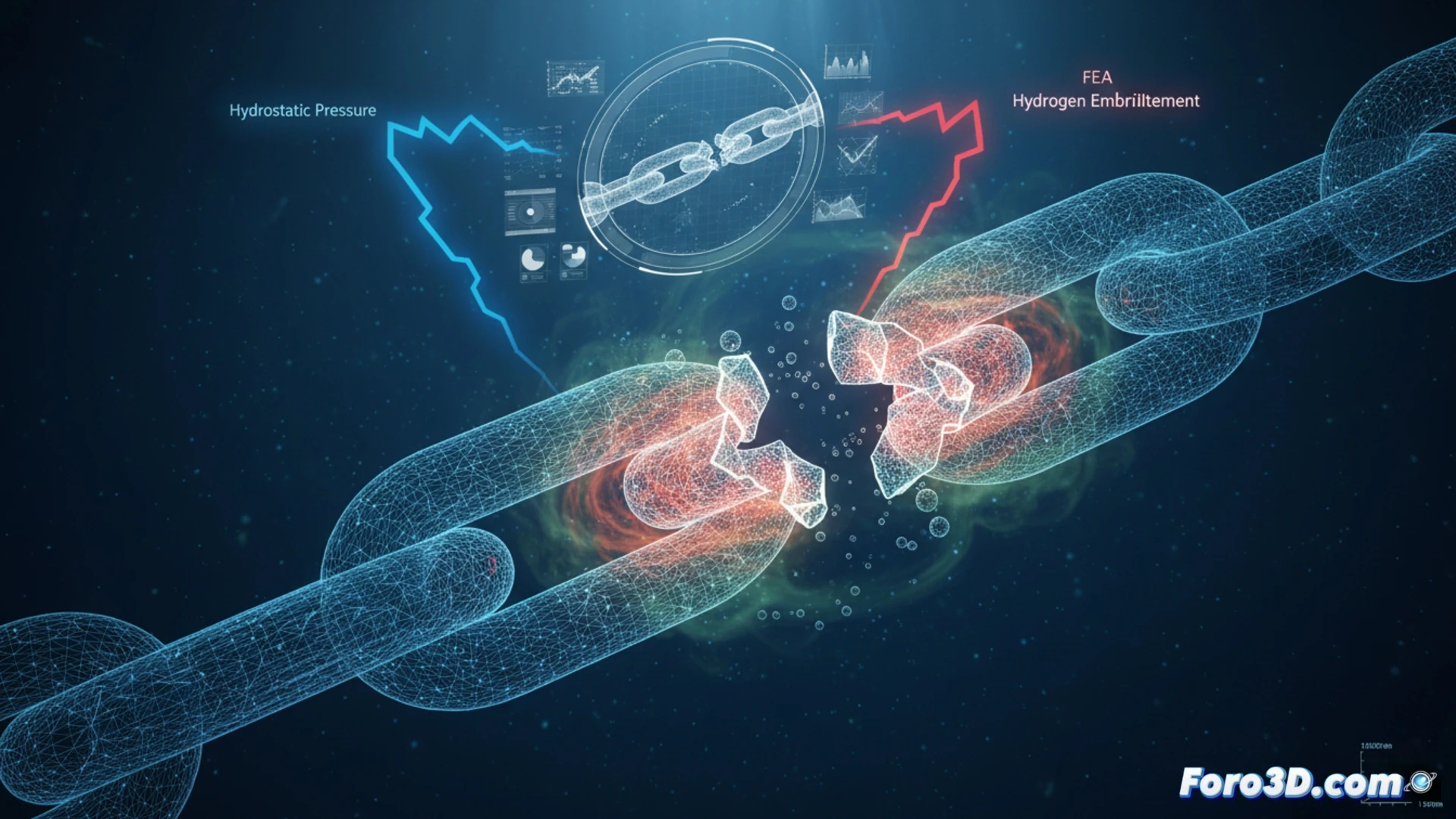
An abyssal mining crawler suffered a catastrophic break in the Mariana Trench, becoming immobilized at a depth of 10,000 meters. The rescue team managed to recover images of the fractured link, and through photogrammetry in Agisoft Metashape, a high-precision 3D model was generated. Now, the technical challenge is to determine whether the failure was due to extreme hydrostatic pressure or hydrogen embrittlement, a common phenomenon in sulfide-rich environments.
Workflow: from photogrammetry to finite element analysis 🔧
The process begins with the alignment of 240 underwater photographs in Agisoft Metashape, generating a dense point cloud with a resolution of 0.02 mm per pixel. The resulting mesh is exported to SolidWorks Simulation, where two loading conditions are applied: a hydrostatic pressure of 100 MPa (equivalent to 10,000 meters) and a simulated chemical environment of hydrogen embrittlement. The results show that under pure pressure, the link undergoes homogeneous plastic deformation. However, when including embrittlement, the simulation reveals a stress concentration at the root of the track tooth, exactly replicating the fracture pattern observed in the real model.
Forensic visualization and lessons for materials engineering 🧬
To communicate these findings, Blender is used to overlay the stress map from SolidWorks onto the photogrammetric model of the actual link. The final animation shows how hydrogen embrittlement reduces the toughness of martensitic steel, causing a brittle fracture instead of a ductile one. This case demonstrates that in abyssal environments, hydrostatic pressure is not the only enemy; chemical degradation of the material can be the critical factor. The combination of Metashape, SolidWorks, and Blender offers a replicable workflow for any forensic analysis of components subjected to extreme conditions.
Considering the extreme conditions of hydrostatic pressure and corrosion in the Mariana Trench, how does the interaction between cyclic fatigue from abyssal currents and hydrogen embrittlement influence the nucleation and propagation of cracks in the link steel, and what 3D simulation parameters are critical for modeling this failure?
(PS: Material fatigue is like yours after 10 hours of simulation.)