A catastrophic failure in a submerged tidal turbine caused the loss of a blade during a routine operation. The initial investigation pointed to a manufacturing defect, but a 3D reconstruction of the leading edge revealed micro-impact marks. The analysis concluded that an object carried by the tidal current struck the blade, initiating a crack that propagated by fatigue until complete fracture. This real case demonstrates how Foreign Object Debris is a critical threat in marine environments.
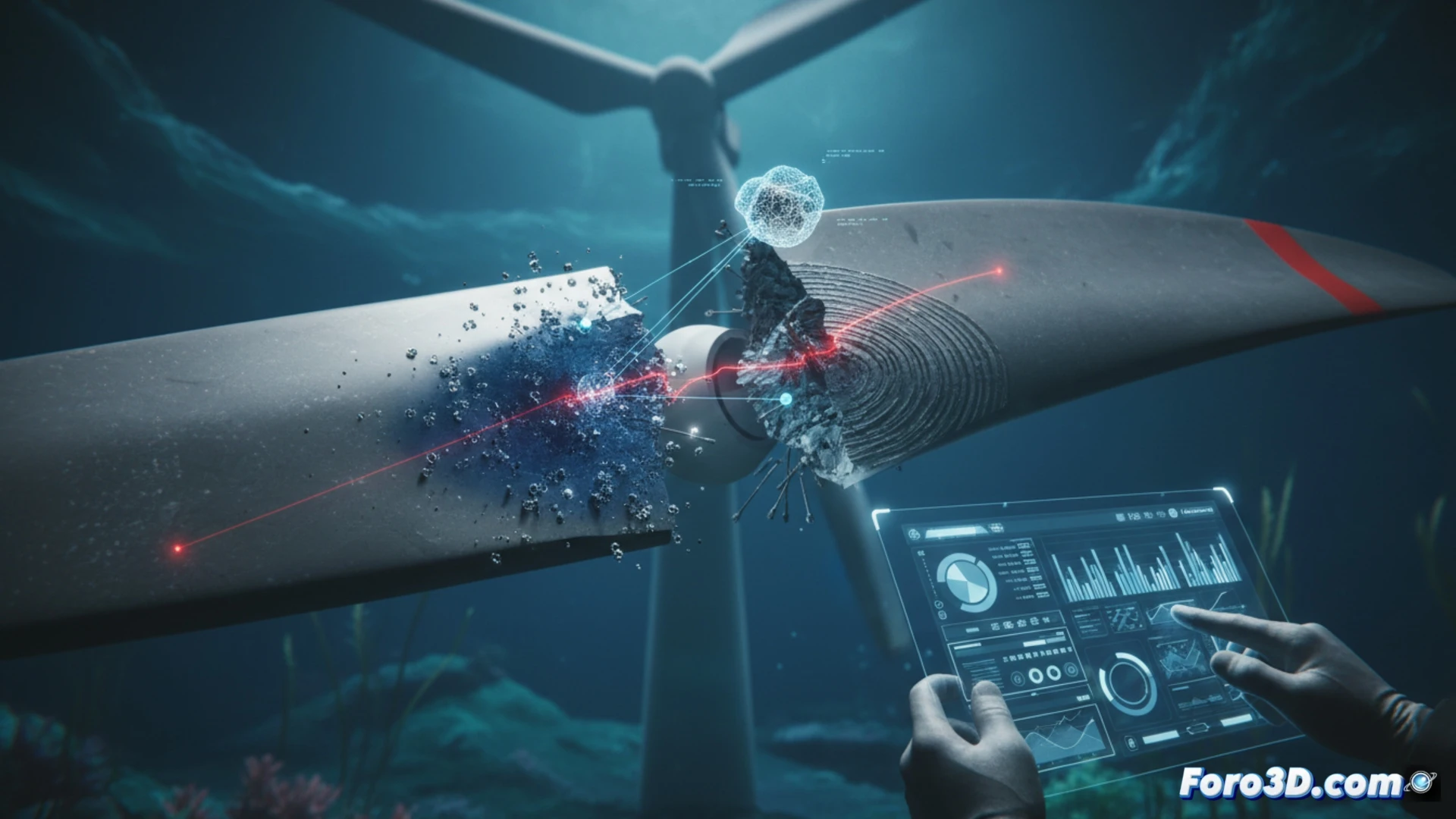
Forensic reconstruction with OrcaFlex, Blender, and GOM Inspect 🔧
The forensic process combined three key tools. First, OrcaFlex modeled the cyclic hydrodynamic loads of the tide to establish the pre-impact stress state. Second, the 3D mesh of the fractured blade was digitized and analyzed in GOM Inspect, identifying a localized indentation on the leading edge with plastic deformation patterns incompatible with an internal defect. Third, Blender executed a ballistic impact simulation with an object of equivalent density to a log or concrete block, exactly reproducing the geometry of the mark. The correlation between the simulation and the 3D scan confirmed the origin of the failure: a single impact that reduced the resistant cross-section and triggered the propagation of a high-cycle fatigue crack.
Fatigue from cyclic impact in marine materials 🌊
This case underscores the need to integrate impact fatigue (FOD) simulation into the design of tidal turbines. While static tests certify nominal strength, the combination of a sharp localized damage and millions of tidal cycles can reduce service life by 70%. The methodology employed here, which unites fluid dynamics simulation with mechanical impact analysis, allows establishing damage tolerance thresholds. For materials engineers, it is a reminder that fatigue depends not only on load but also on the impact history of the component in service.
As a forensic engineer, which factors in the finite element simulation do you consider most decisive for differentiating between a high-cycle fatigue fracture and one caused by the initial FOD impact on the tidal turbine blade?
(PS: Material fatigue is like yours after 10 hours of simulation.)