A critical incident has shaken a quantum algorithm mining farm: the liquid helium cooling system failed catastrophically, destroying high-value experimental processors. The investigation of the incident was not limited to a visual inspection; laser scanning and computational simulation were used to determine whether the cause was induced vibration or an orbital welding defect. This case demonstrates how 3D technologies are becoming essential forensic tools in the advanced semiconductor industry.
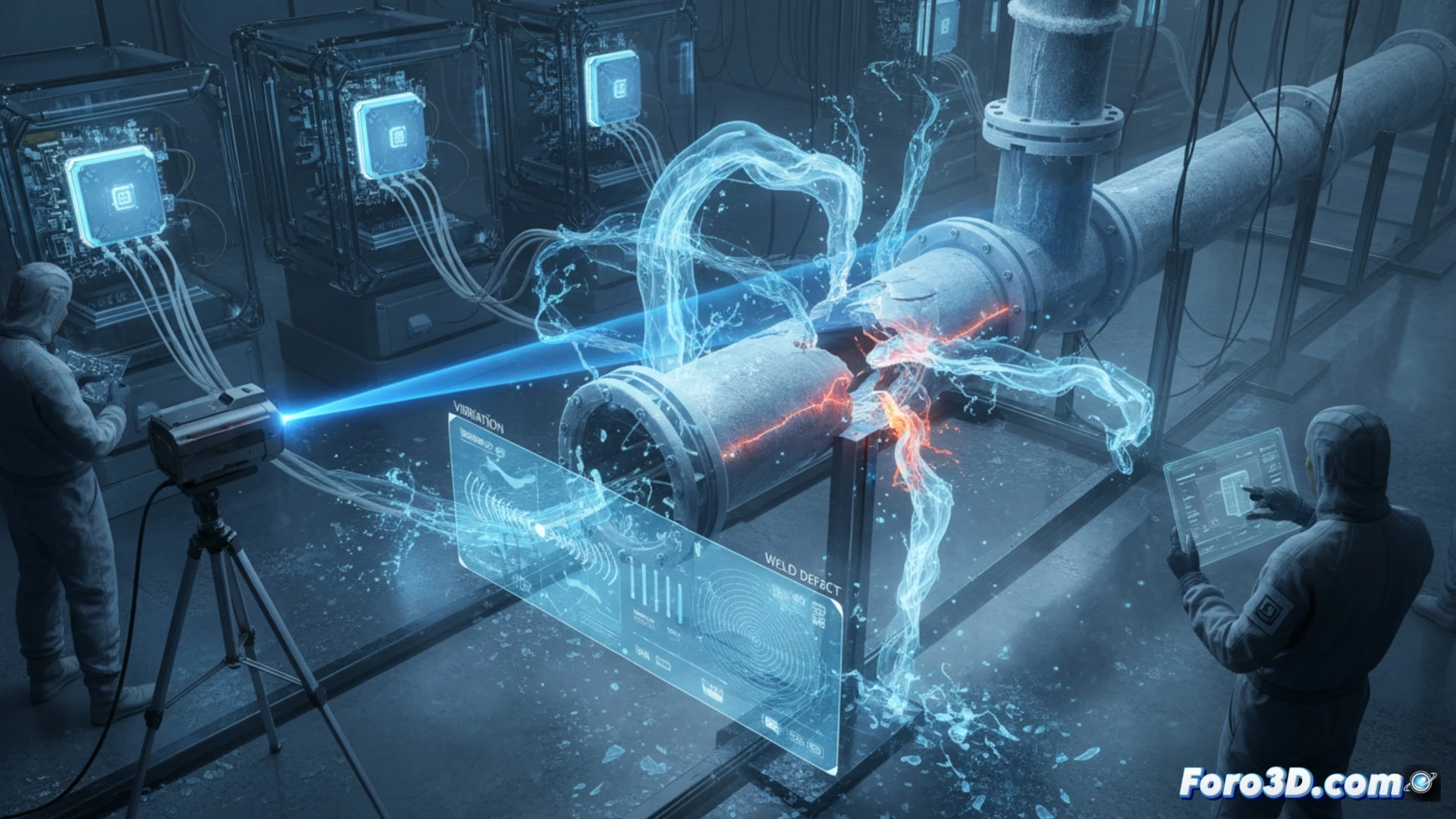
Forensic reconstruction with laser scanning and fluid dynamics 🔬
The forensic team used a high-precision laser scanner to map the trajectory of helium condensation particles, generating a point cloud that was processed in Autodesk ReCap to document the scene with millimeter accuracy. With that data, the geometry was imported into COMSOL Multiphysics, where the fluid dynamics of the cryogenic leak were modeled. The simulations allowed comparing two hypotheses: a leak caused by structural vibration that fractured the pipe, versus a microscopic defect in the orbital weld. The results pointed to a microcrack in the welded joint, underscoring the need for stricter quality controls in liquid helium infrastructures.
Lessons for structural integrity in microfabrication ⚙️
The final visualization of the particle trajectory in 3ds Max not only served to present the finding but also revealed flow patterns that went unnoticed in the initial inspection. This incident reinforces that, in semiconductor and quantum processing environments, the structural integrity of cryogenic systems is as critical as chip design. The combination of laser scanning, CFD simulation, and 3D rendering is becoming the standard for failure analysis in high-tech infrastructures.
How 3D forensic analysis of cryogenic failure can be applied to identify microfabrication defects in quantum chips after exposure to extreme temperatures in a quantum algorithm mining farm.
(PS: modeling a chip in 3D is easy, the hard part is making it not look like a Lego city)